Point of Sale Software

Here are some Articles from the Blog Subject - Eftpos -

The POS Solutions AI Chatbot Surcharge Schedule
POS SOFTWARE

The POS Solutions AI Chatbot Surcharge Schedule

Australia’s card-surcharging rules changed on 1 October 2026. Today we can no longer add surcharges to payments made through designated card networks, while lower domestic interchange caps also began applying.

The difficulty for retailers is that the full effect on merchant-service costs will not be clear immediately. The first industry data is due by 30 October 2026, pass-through information from large acquirers is due from 30 January 2027, and enhanced merchant statements will begin from 1 April 2027.

This staged release is frustrating for retailers who need to understand their costs now. In the meantime, the most practical approach is to establish a reliable baseline and review the available information as each official milestone arrives.

The POS Solutions AI chatbot schedule is designed to help retailers do that. It can organise the available information, compare payment costs over time and help identify questions to put to a payment provider. However, a retailer’s own contract, pricing plan, transaction volume and card mix will determine the final result. If you send us your quotes or contracts, we will run them through the AI.

Why is the information released in stages? 

The information is being released in stages because different parts of the changes depend on different reporting periods, and the change has set implementation dates.

The first reports provide industry and network data. Later reports are intended to show how changes in interchange fees flowed through to merchant-service fees. From April 2027, we should receive enhanced merchant statements that hopefully will make payment-cost information easier for retailers to identify and compare.

The first report, due by 30 October 2026, covers the quarter from 1 July to 30 September 2026. This period ended before the new rules began, so it provides a pre-change baseline rather than a direct measure of the effect on a retailer’s costs. The information will be useful for comparison, but it will not automatically determine what an individual retailer should be paying. A retailer’s result will still depend on its payment contract, pricing model, provider charges and card mix.

The review schedule

POS Solutions plans to release the available information approximately two weeks after each milestone. This allows time for relevant reports and provider information to become available and a distillation to be done and checked.

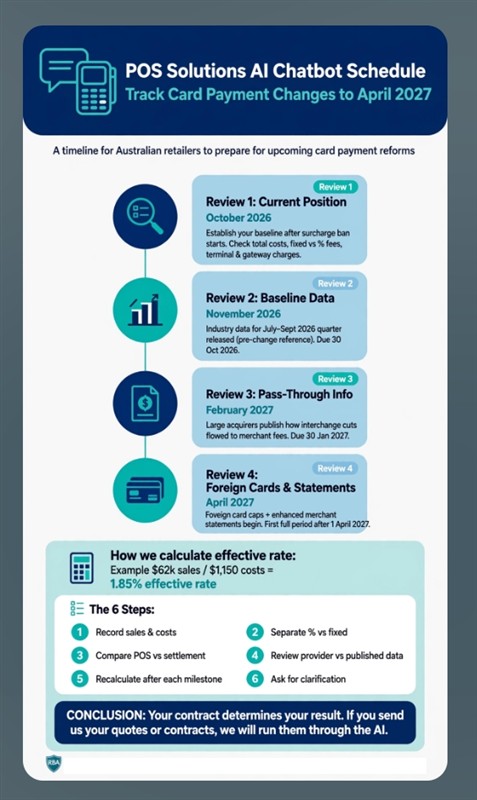
POS Solutions AI review Timing What it examines
Review 1: Current position October 2026 Whether the retailer’s statements and POS data provide a reliable starting point
Review 2: Baseline data November 2026 Industry and provider data published after the 30 October reporting deadline
Review 3: Pass-through information February 2027 Published information about how interchange reductions flowed through to merchant-service fees
Review 4: Foreign cards and statements April 2027 Foreign-issued card caps and enhanced merchant-statement information

Review 1: October 2026

The first review establishes the retailer’s current position after the new rules began on 1 October 2026.

The review can examine whether the retailer’s statements contain enough detail to identify:

  • Total card-acceptance costs.
  • Domestic debit and credit transactions.
  • Foreign-issued card transactions, where applicable.
  • Fixed fees and percentage-based charges.
  • Terminal, gateway, platform and account charges.
  • The relationship between POS sales and settlement totals.

A reliable starting point is important because a retailer needs its own baseline before it can measure any changes.

Review 2: November 2026

The second review follows the first reporting deadline of 30 October 2026. The report covers the quarter from 1 July to 30 September 2026. Because this information is before the surcharge ban and related changes began, it only provides a pre-change reference point. We hope that this information will help our clients compare themselves to the broader market conditions, hopefully giving us a precise calculation of what an individual business should have saved.

Review 3: February 2027

Large acquirers must begin publishing information about how reductions in interchange fees flowed through to merchant-service fees. The big question is how the answer to the government will be framed. The justification for the changes.  We expect that it will be only partly true as we think that other fees like merchant-service costs may be increased or added, such as security fees, scheme fees, acquirer margins, fixed charges, terminal costs, gateway charges, etc.

In any case the published information will give retailers a stronger basis for asking their provider to explain changes in pricing.

Review 4: April 2027

From this date, foreign-issued card interchange caps and enhanced merchant-statement requirements should make international-card costs easier to identify and compare. Only then will enhanced statement requirements apply. It's unbelievable seven months later. 

How POS Solutions AI reviews payment costs is explained below.

If the information supplied to the retailer meets expectations, POS Solutions AI can compare:

  • POS sales data.
  • Payment reports.
  • Merchant statements.
  • Provider pricing information.
  • Regulatory milestones.
  • Card volumes and transaction values.

The system does not rely on one advertised rate. It compares total costs with the value and number of card transactions.

For example, a retailer may process $62,000 in card sales and pay $1,150 in total card-acceptance costs during a month. The effective cost is approximately 1.85 per cent.

If the previous month’s cost was $1,200 on $60,000 in card sales, the previous effective rate was 2.00 per cent.

This evidence would show that the effective rate has fallen. The review can then investigate why. Possible explanations may include:

  • A change in the retailer’s card mix.
  • More or fewer foreign-issued cards.
  • A change in average transaction value.
  • A new monthly or account charge.
  • A change in the provider’s pricing.
  • Differences between POS sales and settlement totals can also be useful.

As you can appreciate, although a lower effective rate is useful information, it does not by itself prove that the retailer’s pricing has improved.

What the reviews can identify

At each scheduled review, POS Solutions AI may help identify:

  • Changes in total card-related costs.
  • Changes in the effective payment rate.
  • Unusual increases in provider charges.
  • Differences between POS sales and settlement
  • Changes in average transaction value and card volume.
  • Missing or unclear card-category information.
  • Possible differences between provider claims and the retailer’s own records.
  • The date of the next scheduled update is also included.

Most importantly, the system can compare the retailer’s POS data with the payment provider’s reports and pricing information. If the figures do not match, the system can flag the difference for further investigation.

The chatbot helps to organise and analyse information. It does not replace the retailer’s payment provider, accountant or financial adviser, and it cannot determine the meaning of a contract where the underlying information is incomplete or unclear.

Questions to ask your provider

If the figures do not match, the AI can write a request for a written clarification from the payment provider.

Useful questions include:

  • What changed in my pricing from 1 October 2026?
  • Which part of my merchant-service fee reflects interchange?
  • Did my blended rate change?
  • Did any terminal, gateway, platform or account charges change?
  • How do you classify domestic debit, domestic credit and foreign-issued cards?
  • Are foreign-issued card transactions separately identified?
  • Can I receive an enhanced merchant statement?
  • Which statement period will first include the enhanced information?
  • How have any reductions in interchange fees been reflected in my pricing?
  • Are there any new minimum monthly charges or account fees?

Written answers are more useful than a general advertised rate because they give the retailer a record that can be compared with statements and POS data.

Conclusion

The payment reforms will not produce one universal cost for every retailer. Two businesses may process similar sales but have different results.

The POS Solutions AI schedule is intended to provide you a way to review the available information as it is released.

The information will continue to arrive in stages. A retailer’s own records therefore remain the most important starting point for understanding how the changes affect the business.


If you send us your quotes or contracts, we will run them through the AI.

Written by:

Bernard Zimmermann


Bernard Zimmermann is the founding director at POS Solutions, a leading point-of-sale system company with 45 years of industry experience. He consults to various organisations, from small businesses to large retailers and government institutions. Bernard is passionate about helping companies optimise their operations through innovative POS technology and enabling seamless customer experiences through effective software solutions.

 

Add new comment

Restricted HTML

  • Allowed HTML tags: <a href hreflang> <em> <strong> <cite> <blockquote cite> <code> <ul type> <ol start type> <li> <dl> <dt> <dd> <h2 id> <h3 id> <h4 id> <h5 id> <h6 id>
  • Lines and paragraphs break automatically.
  • Web page addresses and email addresses turn into links automatically.
CAPTCHA This question is for testing whether or not you are a human visitor and to prevent automated spam submissions. Image CAPTCHA
Enter the characters shown in the image.

Card Surcharge Ban 2026 now on

POS SOFTWARE

Australian Card Surchage Ban


Australian retailers can no longer add a separate fee when customers pay by card on eftpos, Visa, Mastercard, American Express and UnionPay. All have dropped surcharging. PayPal follows suit on 5 October. Other cards, such as Diners Club, may depend on your EFTPOS provider.

Disclaimer: I am not a lawyer, so please do not accept my advice without checking.

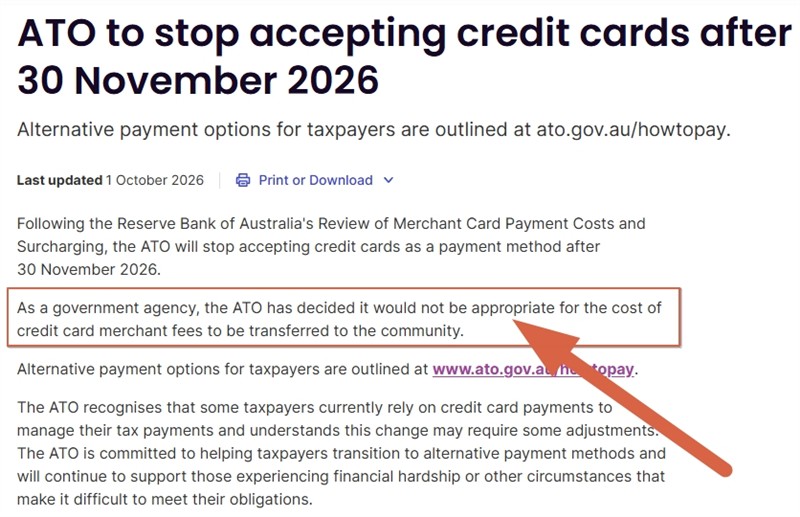
As a quick note, most of us have read this ruling by the ATO, and I thought it sucked. Where is all this saving on the interchange fee that was supposed to be paid for the transaction the government claimed? 

Notice showing ATO will stop accepting credit cards

ATO confirms it will stop accepting credit card payments

Quick Summary: Can I Still Charge Card Fees?

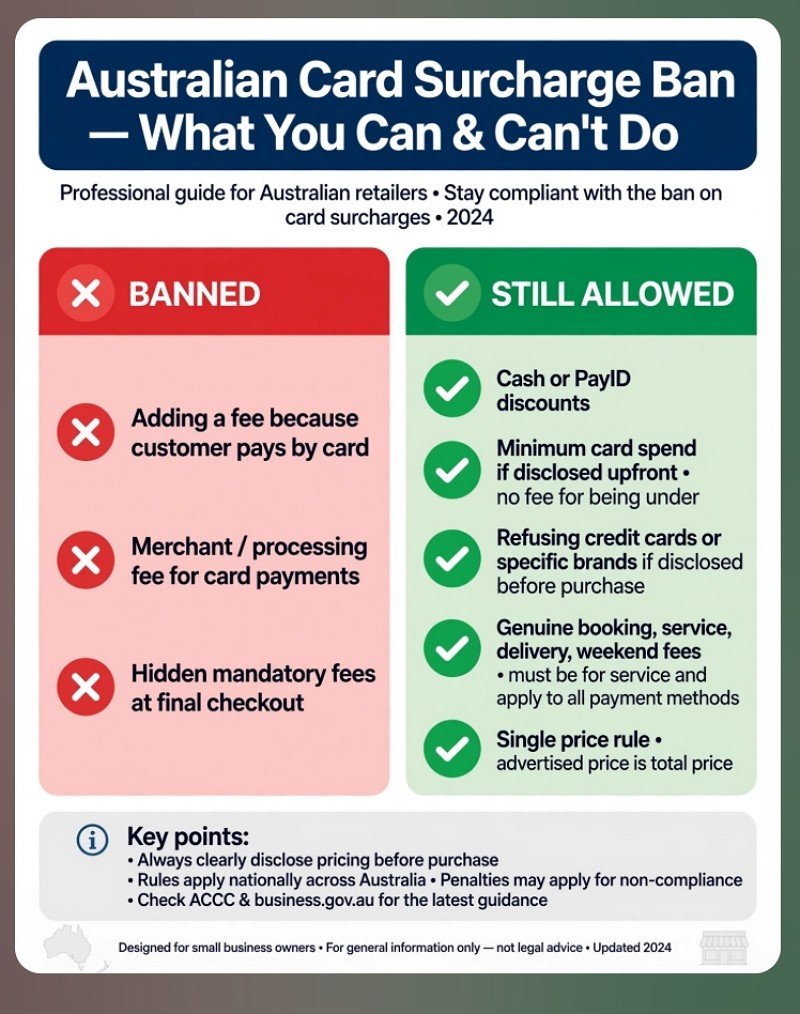
  • No. You can't add a fee just because a customer pays by card, whether in-store, online or in-app.
  • Yes to genuine booking, service, delivery and weekend or public holiday fees, provided they aren't a disguised card surcharge.
  • Yes to cash or PayID discounts.
  • Yes to minimum card spends, if disclosed upfront — and you cannot charge a fee for falling short.
  • Yes to refusing credit cards or specific brands if disclosed before purchase.
  • Single-price rule: the advertised price must be the total mandatory price.

What the Card Surcharge Ban Actually Covers

Banned vs. Still Allowed Fees

Banned:

Any surcharge applied because the customer used a covered card type (credit, debit or prepaid), whether in-store, online or in-app.

Still Allowed:

Fees unrelated to the card, such as booking, platform fees, service and delivery fees, and weekend or public holiday surcharges.

5 Legal Ways SMBs Can Protect Their Margins

You still pay processing fees. You just can't itemise them as a card surcharge.

  1. Bake your costs into your prices.
  2. Offer cash or PayID discounts. You may offer something like "1.5% off for cash".
  3. Set minimum card spends, disclosed upfront. You can decline a transaction under the minimum. You can't charge a fee for being under it.
  4. Refuse cards or specific brands. You can decline credit cards entirely while accepting other schemes, as long as customers are told before purchase.
  5. Ensure platform and ordering fees are handled correctly.
    • Obtain advice from the third-party service before doing so. A genuine platform fee is for online ordering, click-and-collect, QR ordering or a booking tool.
    • The fee must be for the service.
    • It should apply regardless of payment method.
    • If it is mandatory and can be calculated in advance, it must be shown upfront.

Who Is Watching? (ACCC and Card Networks)

Some card networks and payment providers have stated they will be enforcing the no-surcharge rules. That includes eftpos, Visa and Mastercard, as well as providers like Stripe, Square, Tyro and the banks.

A Practical Playbook

  1. Model your price lift.
  2. Clear signage. If you have a minimum card spend, ensure clear signage.
  3. Review platform fees. Please ensure that the fees are service-based and disclosed upfront.

Common Pitfalls to Avoid

  • Adding a "merchant fee" or "processing fee" for card payments.
  • Hidden mandatory fees on the final screen.
  • Assuming the ban removes your costs.

Bottom Line

The ban is real and in force and operates partly through card-network rules not just a simple ACCC prohibition. 

Written by:

Bernard Zimmermann


Bernard Zimmermann is the founding director at POS Solutions, a leading point-of-sale system company with 45 years of industry experience. He consults to various organisations, from small businesses to large retailers and government institutions. Bernard is passionate about helping companies optimise their operations through innovative POS technology and enabling seamless customer experiences through effective software solutions.
 

Add new comment

Restricted HTML

  • Allowed HTML tags: <a href hreflang> <em> <strong> <cite> <blockquote cite> <code> <ul type> <ol start type> <li> <dl> <dt> <dd> <h2 id> <h3 id> <h4 id> <h5 id> <h6 id>
  • Lines and paragraphs break automatically.
  • Web page addresses and email addresses turn into links automatically.
CAPTCHA This question is for testing whether or not you are a human visitor and to prevent automated spam submissions. Image CAPTCHA
Enter the characters shown in the image.

How to Calculate Your True EFTPOS Cost in Minutes

POS SOFTWARE

Calculate Your True EFTPOS Cost in Minutes
Here is a step-by-step way to calculate what you really pay each month for EFTPOS and credit cards. It takes a few minutes and uses information you already have in your POS system.

For most small businesses turning over around $1 million a year, the total cost of accepting cards is typically between 1.1% and 2.5% of card sales. It depends on your average basket size, number of transactions, the plan you are on and how good a negotiator you are.

That might not sound like much, but on $40,000 to $60,000 in monthly card sales, a difference of 1% adds up to nearly $6,000 a year. Multiply that across a group and you quickly see why this is worth checking.

What You Will Need

  1. Your merchant statement or rate sheet from your EFTPOS provider
  2. From your POS system, run a 12-month totals report: total sales value and number of transactions for each payment type — eftpos, Visa/Mastercard debit, Visa/Mastercard credit, and American Express

The Simple Formula

For each card type, calculate:

Monthly cost = (Monthly sales × percentage rate) + (Monthly transactions × fixed fee per transaction)

To get the monthly figures from your 12-month POS report:

  • Monthly sales = Total sales for that card type ÷ 12
  • Monthly transactions = Number of sales for that card type ÷ 12

Then work out your most important number — your effective rate:

Effective rate = (Total monthly fees ÷ Total monthly card sales) × 100

This single percentage tells you the true cost and is what you should use to check your margins.

A Worked Example: A Newsagency or Pet Shop

Imagine an average month for a suburban newsagency with a bookshop and gift section. The rates below are examples only to show the maths. Yours will depend on your provider and whether least-cost routeing is enabled.

Total card sales for the month: $45,000

Card Type Monthly Sales Monthly Transactions Example Rate Monthly Cost
EFTPOS $22,000 900 0.40% $88.00
Visa / Mastercard debit $13,000 450 0.50% $65.00
Visa / Mastercard credit $8,000 220 1.00% $80.00
American Express $2,000 40 1.30% $26.00
Total $45,000 1,610   $259.00

For this example we have assumed no fixed per-transaction fee to start.

Effective rate = $259 ÷ $45,000 × 100 = 0.58%

This is a best-case rate, usually only possible with least-cost routeing turned on and no terminal rental included. Most businesses will see a higher number on their actual statement.

Now add a 10-cent fixed fee on every transaction, which many plans include:

  • Fixed fees: 1,610 × $0.10 = $161.00
  • New total: $259 + $161 = $420.00
  • New effective rate: $420 ÷ $45,000 × 100 = 0.93%

That extra 0.35% comes entirely from the cents-per-transaction charge. On top of this, you may also pay a terminal rental of $30 to $80 per month, which should be but is often not included in this percentage.

Now if you look through your statements, we will see other charges that you need to add to your costs.

Use these to calculate your actual percentage.

This actual percentage tells you, for example, if an item's retail price is $10, and your actual percentage is 0.95%. It costs you $10 x 0.95% for EFTPOS to sell it. 

Common Pricing Models

Providers quote costs differently. Knowing your model helps you use the formula:

1. Flat-rate or blended pricing: One percentage applies to all card types, for example, 1.1% on everything. It is simple to calculate, but you often overpay on cheaper EFTPOS and debit transactions.

2. Interchange-plus or scheme-plus pricing: You pay the actual interchange or scheme cost plus a fixed margin. This is usually cheaper at scale, but the statements can look more complex.

3. Tiered pricing: Different rates apply to "qualified", "mid-qualified" and "non-qualified" transactions. It is harder to forecast, which is why calculating your own effective rate is so important.

Whichever model you are on, your effective rate (total fees divided by total card sales) lets you compare like with like.

Putting Your Numbers to Work

Once you know your numbers, you can:

Check whether your rates are reasonable. For a sub-$1m turnover business, an effective rate of 1.1% to 2.5% is common depending on your provider and card mix.

Model changes. What if you negotiated 0.2% off your credit rate? What if you moved to a plan with a slightly higher percentage but no terminal rental? Plug the new rates into the same formula and compare.

A Quick Checklist for Your Next Statement

When your next merchant statement arrives, look for:

  1. Your total card turnover for the month
  2. The total fees charged
  3. A breakdown by card type, if provided
  4. Any fixed per-transaction fees or terminal rental charges
  5. The effective rate, or calculate it yourself: (total fees ÷ total card sales) × 100
  6. Add extras to calculate your actual rate.

That one number tells you more about what you are really paying.

Written by:

Bernard Zimmermann


Bernard Zimmermann is the founding director at POS Solutions, a leading point-of-sale system company with 45 years of industry experience. He consults to various organisations, from small businesses to large retailers and government institutions. Bernard is passionate about helping companies optimise their operations through innovative POS technology and enabling seamless customer experiences through effective software solutions.

 

Add new comment

Restricted HTML

  • Allowed HTML tags: <a href hreflang> <em> <strong> <cite> <blockquote cite> <code> <ul type> <ol start type> <li> <dl> <dt> <dd> <h2 id> <h3 id> <h4 id> <h5 id> <h6 id>
  • Lines and paragraphs break automatically.
  • Web page addresses and email addresses turn into links automatically.
CAPTCHA This question is for testing whether or not you are a human visitor and to prevent automated spam submissions. Image CAPTCHA
Enter the characters shown in the image.

What Should a Retailer Check in a Merchant EFTPOS Rate Before Signing

POS SOFTWARE

What Should a Retailer Check in a Merchant EFTPOS Rate Before Signing

From 1 October 2026, changes to card surcharge rules make it harder for many retailers to pass merchant fees directly to customers.

Payment providers know retailers are reviewing their options right now, so many are offering deals with features that I think are smoke and mirrors, designed to hide the real cost. Before you sign, take a breath. Yes, a good-looking rate can save you real money, but a bad deal will hurt badly. Here are the six checks I'd run on any offer.

1. How Long Does the Contract Lock You In?

I've said this before: be very careful about signing a long-term contract now. Three-year merchant agreements are still the norm, so ask for a month-to-month agreement instead. If the provider insists on a longer commitment, ask what it will cost to leave, whether terminal rental continues after you stop using the terminal, and whether the provider can change its rates during the term. In my experience these long-term contracts are only long-term to you not the provider.

No one knows exactly how the market will settle after 1 October, and it will keep shifting. So you need flexibility more than ever.

2. Does the Quote Match Your Card Mix?

A provider can't tell you what its offer will really cost without knowing how your customers pay. As a working example, most of our retail clients process roughly 75% debit and 25% credit card transactions. Check your end-of-day POS reports and merchant statements for your own split.

Only once you have that figure should you ask the provider to price your debit and credit transactions specifically. A flat rate of 1.2% or 1.4% is easy to compare, but simplicity isn't the same as value. Always ask for the estimated total monthly fee in dollars, not just a headline rate.

3. What Does the Basket Size Cost on Your Actual Sales?

Your average basket size matters. For many of our retail clients it sits around $20 to $30, but a lot of smaller sales can change the result quickly. I have seen quotes based on $5 basket sizes. Clearly these are based on very old industry figures. 

The facts are a 12-cent fee on a $25 debit sale works out to 0.48%. The same 12-cent fee on a $4 drink or newspaper works out to 3%. Some provider pricing models are still based on older transaction patterns, with far more small transactions than retailers typically see today. Check your end-of-day POS reports and merchant statements for your real basket size, then ask the provider to run the quote against those actual figures.

4. When Will the Money Reach Your Account?

A low rate isn't much use if your takings arrive after you need them. This matters especially if you sell lotto and need enough cash available by settlement day. The penalties will cost you more then the savings. 

Ask the provider for its daily cut-off time and when funds from each day's sales will actually land in your bank account. Check Fridays, weekends and public holidays specifically. If faster settlement requires opening an account with a particular bank, factor that into your decision.

Don't accept "fast settlement" as an answer on its own. Ask for the schedule in writing, then compare it against the dates you need to pay lotto, suppliers and wages.

5. What Fees Sit Outside the Headline Rate?

If the offer uses interchange-plus pricing, ask the provider to show the interchange charges and any other fees separately. Don't assume interchange-plus will always beat a blended rate — always compare the final dollar amounts.

Also check least-cost routing (LCR). Ask whether it's available, whether it's switched on for your terminals, and how the provider decides which network to use for eligible debit taps. We recently reviewed a client's EFTPOS plan and found LCR had never been activated — they'd been paying more than they should. This isn't an isolated case: the RBA's own review found LCR is enabled for only around 84% of eligible in-person merchants, and switched on by just three of eleven large online payment providers, and that merchants with LCR enabled tend, on average, to have lower debit acceptance costs. Not all providers implement LCR the same way, so ask specifically how each one decides which network to route through, and get comparative numbers rather than taking "we support LCR" at face value.

Also watch for new fee structures. Some providers now split out security and interchange fees separately. Interchange fees may be coming down, but in some cases the added security fee eats up much of that saving — so check the combined total, not just the headline interchange figure. Terminal rental, security or PCI-related charges, setup costs and exit fees can all wipe out a saving on card rates.

6. What does the surcharge ban cover from your provider?

Officially, the ban only covers EFTPOS, Visa and Mastercard. However, many of the providers are including Amex, JCB and UnionPay. You need to ask do you need them. If so, how much will this unofficial ban cost you? This is important as you may be unnecessarily burnt.


What We Recommend

For now, we strongly recommend keeping your options open. Use your real POS figures, insist on clear settlement terms in writing, and avoid a long lock-in unless the complete offer makes a genuinely strong case for it.

Based on the offers we've reviewed, Swift Payments is one provider we're currently recommending clients consider, largely because of its month-to-month terms, If it does not work out you can change in 30 days. But don't take any recommendation, including ours, without testing the written quote against your own card mix, basket sizes and settlement needs.

If you have a new proposal and want to check what you're really paying, send your latest merchant statement or quote to our support team. We have written an AI to review EFTPOS rates and conditions. We can use that to break down your the charges, to compares them against your actual sales data and other EFTPOS rates, and gives you specific questions to put back to the provider.

If you'd rather run the review yourself, ask us for a copy of our AI so you can do it on your own computer. Either way: audit the offer before you sign it.

Written by:

Bernard Zimmermann


Bernard Zimmermann is the founding director at POS Solutions, a leading point-of-sale system company with 45 years of industry experience. He consults to various organisations, from small businesses to large retailers and government institutions. Bernard is passionate about helping companies optimise their operations through innovative POS technology and enabling seamless customer experiences through effective software solutions.

 

Comments

In it something is. Many thanks for the information, now I will not commit such error.

Add new comment

Restricted HTML

  • Allowed HTML tags: <a href hreflang> <em> <strong> <cite> <blockquote cite> <code> <ul type> <ol start type> <li> <dl> <dt> <dd> <h2 id> <h3 id> <h4 id> <h5 id> <h6 id>
  • Lines and paragraphs break automatically.
  • Web page addresses and email addresses turn into links automatically.
CAPTCHA This question is for testing whether or not you are a human visitor and to prevent automated spam submissions. Image CAPTCHA
Enter the characters shown in the image.

Don't Sign a Fixed EFTPOS Contract Now, it is too Risky

POS SOFTWARE

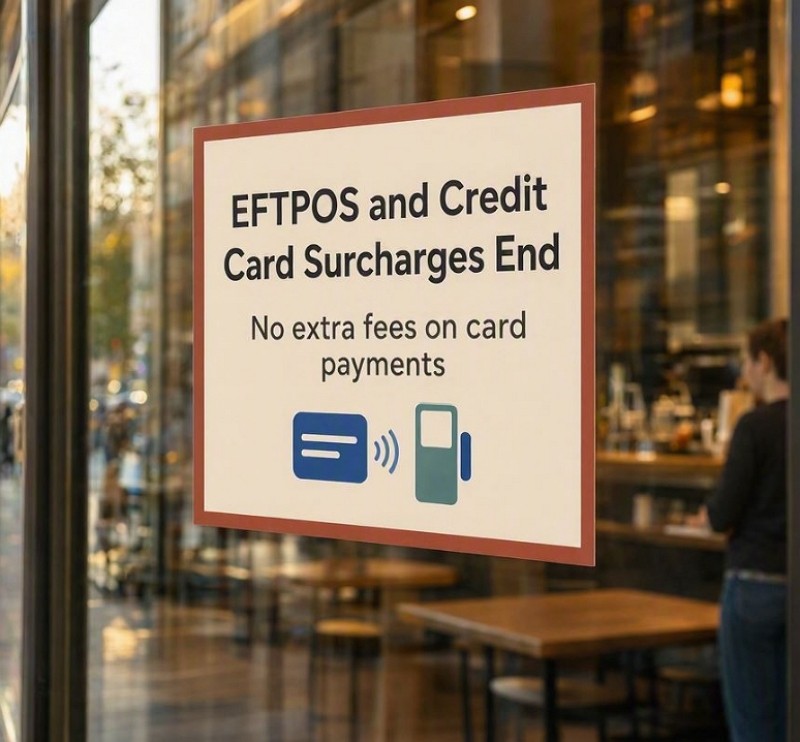
EFTPOS and Credit Card surcharges end in Oct

You work hard to find good stock deals all the time. You work all the time to reduce costs, so why give up years of EFTPOS payment flexibility for a deal that only looks good today? Things *will* very soon, and nobody really knows what's happening with EFTPOS. This uncertainty is exactly what puts small Australian retailers at risk of carrying the burden if things shift.

This is why our offer for EFTPOS and Credit Cards have no fixed terms. You do not like it you can walk away, no risk.

Key Takeaways

  • Card surcharging ends across EFTPOS, Mastercard and Visa networks from 1 October 2026
  • Interchange caps fall sharply on the same date.
  • Standard fixed EFTPOS contracts let the provider vary fees on 30 days' notice, while the retailer stays locked in.
  • Early termination fees on Australian EFTPOS contracts commonly run from $200 to over $2,000, depending on the provider and remaining term.
  • Free terminal offers and rentals can change in 30 days.
  • Banks and fintechs now offer no-lock-in EFTPOS plans, often at comparable or better rates than fixed-term deals.

Why This Is the Worst Time to Lock In

Fixed-term EFTPOS contracts tie you to one provider for generally 24 to 36 months. There are penalties if you leave early. Signing one now is betting that today's payment system will stay the same. We all know it won't. 

On 1 October 2026, the Reserve Bank of Australia's payments reform takes effect nationwide. Wholesale interchange costs will drop significantly, new fees will soon be introduced.

Consider what this means if you sign a fixed-term contract today. You'd be locked into a rate, and right now, nobody, not a salesperson, a bank, or even your accountant can say what a fair rate will be after the changes. That's why flexibility matters more than ever. 

The Contract Is a One-Way Street

Most standard EFTPOS agreements let the provider change your fees with little notice, but you don't get the same flexibility. Check the variation clause in your contract. You'll likely see that the provider can adjust rates or charges with just 30 days' written notice. In my experience, they often blame "third-party costs" or "operational changes," which turns out to be often just shifting costs from one part of the bank to another part.

It's a one-sided deal. If their costs increase, you pay more. If your situation changes and you need to switch, you pay the penalty not them.

In all my years working with EFTPOS providers, I've never seen a variation clause used to lower what merchants pay or risks. It's always used to pass on extra terms, cost increases or now we are seeing to add new fees. I've never heard of a provider calling a merchant to say, "Good news, your rate just dropped and we are passing it on to you." If wholesale interchange drops in October and you're on a flat or blended rate, don't expect your provider to pass on the savings. Now more than ever, you need the freedom to switch if you want.

The Free Terminal Isn't Free

A common offer is "$0 terminal rental for your first 12 months." It sounds generous, but once you calculate the costs for the remaining 24 months of a 36-month contract, it's not such a great deal.

After the promotional period, providers usually charge between $18 and $35 per terminal each month. Over two years with two terminals, that adds up to more than $1,000 in rental fees. Costs the promotional offer didn't mention upfront. Compare this to renting month-to-month with no extra fees.

It's simple: the banks *free* year is paid back, with interest, during the years you're locked in and can't leave.

What Happens When Your Business Changes

Businesses change over time. You might sell, downsize, move, or switch POS software, and any of these changes could cause problems if you're stuck in a fixed-term contract.

Sell your shop with 18 months left on the contract, and that bill lands on you. If you sell your shop with 18 months left on the contract, you'll be responsible for the remaining payments unless the provider agrees to transfer the contract which isn't guaranteed. Generally they will have a different bank which is often a problem. Also if you're on a bad deal, the new owners probably won't want to take it over anyway even if its the same bank.

Zero EFTPOS EFTPOS

That model dies on 1 October 2026, because the card schemes' no-surcharge rules will apply across the board. I think most people on this deal are looking at high fees. 

You Lose Your Growth Leverage

If your card turnover increases and it likely it will after 1 October you should be able to get a better deal with lower rates. With a no-lock-in plan, you can renegotiate at any time or switch to a competitor offering a better rate. On a fixed contract, you don't benefit from your growth. You're stuck with the rate you signed up for. Major retailers, I know use flexible plans and so quietly negotiate better rates.

What to Insist On Instead

These days, there's little reason to sign a fixed contract when you can get the same or better pricing without the risk.

Before you sign anything, get these in writing:

  • No minimum term, or at most a short one with a clearly stated, capped exit fee
  • Transparent Interchange++ pricing; try to get details on the interchange, scheme fees and the provider's margin itemised separately.
  • Terminal ownership or flexible rental: review the costs.
  • Confirmed POS Software compatibility in writing, not just a verbal assurance from the sales rep. 
  • A matching notice period: if they can vary your terms on 30 days' notice, you should be able to exit on the same notice.

The Bottom Line

October 2026 will change the economics of card payments in Australia. Surcharging will end, wholesale costs will drop sharply, and real competition between providers will begin. Retailers who can move easily will benefit. Those locked into a 36-month contract signed today will spend the next two and a half years paying old rates in a new market.

When the next EFTPOS rep offers you a "great deal" with a fixed term for EFTPOS, there's only one answer that matters: NOT NOW

Written by:

Bernard Zimmermann


Bernard Zimmermann is the founding director at POS Solutions, a leading point-of-sale system company with 45 years of industry experience. He consults to various organisations, from small businesses to large retailers and government institutions. Bernard is passionate about helping companies optimise their operations through innovative POS technology and enabling seamless customer experiences through effective software solutions.
 

Add new comment

Restricted HTML

  • Allowed HTML tags: <a href hreflang> <em> <strong> <cite> <blockquote cite> <code> <ul type> <ol start type> <li> <dl> <dt> <dd> <h2 id> <h3 id> <h4 id> <h5 id> <h6 id>
  • Lines and paragraphs break automatically.
  • Web page addresses and email addresses turn into links automatically.
CAPTCHA This question is for testing whether or not you are a human visitor and to prevent automated spam submissions. Image CAPTCHA
Enter the characters shown in the image.

Ask Our Australian EFTPOS Directory (Chatbot Goes Live Monday)

POS SOFTWARE

Australian EFTPOS Directory Chatbot


You're probably already shopping around for an EFTPOS provider. On Monday, we're launching an Australian merchant acquiring and EFTPOS provider directory chatbot. Most retailers want to drop their merchant figures into one place and get a straight answer on multiple providers. Here, you can enter your turnover, average sale, card mix, and current and quoted rates. Then you ask the questions you would ask a broker, without the sales call.

Key takeaways

  • The directory is a chatbot loaded with Australian acquirer, EFTPOS and fee-model source material.
  • You enter your own figures (turnover, ticket size, card mix, current merchant rate, terminal rent) and ask follow-up questions.
  • The bot compares banks, fintechs and specialist acquirers
  • From 1 October 2026, the chatbot is built around cost inside the price.
  • It will do its best to access flat-rate, interchange-plus and blended quotes.
  • A useful shortlist for a single-store retailer is still a handful of names.

What is the merchant acquiring chatbot?

The merchant acquiring chatbot is a question-and-answer tool sitting on top of our Australian EFTPOS and acquirer source set. First, it is not a static page ranking 65 logos. You ask in plain English. For example, you enter in "We turn over $18,000 a week, average $12.40 a sale, mostly debit, $45 a month terminal rent, 1.4% blended. What should I ask CommBank versus Tyro versus Zeller?"

Moreover, the source material stays in the workspace. That means answers can point back to fee models, hardware notes and the October rule change, instead of guessing from a brochure.

Why launch it as a chatbot?

A chat fits how you actually run a shop. You can ask it questions, change scenarios such as average sale from $8 to $22 and ask again. This can make it feel real.

The other reason is the deadline. From 1 October 2026, designated card networks stop merchants from adding a surcharge for Visa, Mastercard and EFTPOS. Bank fees now have to live in the shelf price. The chatbot is there so you can model that shift with your numbers.

What can you ask it?

You can ask it anything you would put in an email to an EFTPOS/Credit provider:

  • "Here is my current rate and weekly card mix. Is interchange-plus likely cheaper than flat-rate for us?"
  • "We still surcharge 1%. What happens to margin after 1 October if volume stays the same?"
  • "Compare a big-four integrated terminal with Tyro for a single counter and our POS."
  • "What questions should I ask before I sign a 24-month rental?"

First, put in as many real numbers as you can; the more, the better. The more accurate, the better; remember, garbage in means garbage out.

How many providers sit behind the answers?

The AI source now covers about 65 platforms. There will be more on Monday when it's released, as we are waiting for a few more providers to send us information. Most are the majors; unfortunately, many providers refuse to release information publicly, but we have done what we can.

What you should have ready before you type

From your total reports, or better yet from your EFTPOS statement, you need, as a minimum, four figures: weekly card takings, average transaction value, debit amount, credit amount and what you pay now: rate plus terminal plus extras. Most of you can import the current EFTPOS provider invoice from a PDF.

What's next

Get a copy and start investigating.

Next month we will release an update once the dust settles. 

Written by:

Bernard Zimmermann


Bernard Zimmermann is the founding director at POS Solutions, a leading point-of-sale system company with 45 years of industry experience. He consults to various organisations, from small businesses to large retailers and government institutions. Bernard is passionate about helping companies optimise their operations through innovative POS technology and enabling seamless customer experiences through effective software solutions.


Add new comment

Restricted HTML

  • Allowed HTML tags: <a href hreflang> <em> <strong> <cite> <blockquote cite> <code> <ul type> <ol start type> <li> <dl> <dt> <dd> <h2 id> <h3 id> <h4 id> <h5 id> <h6 id>
  • Lines and paragraphs break automatically.
  • Web page addresses and email addresses turn into links automatically.
CAPTCHA This question is for testing whether or not you are a human visitor and to prevent automated spam submissions. Image CAPTCHA
Enter the characters shown in the image.

Retailers Should Rethink Telstra's Premium Service After Recent Network Outages

POS SOFTWARE

Telstra outage July 2026

When your Telco goes down, retail shops can’t operate as usual.

Key Takeaways

  • Telstra says its higher fees are due to better network reliability.
  • Many businesses using Tyro EFTPOS terminals were affected during the 8 July 2026 outage.
  • More than 300 Triple Zero calls did not go through during the outage.
  • EFTPOS systems with backup connections provide retailers with important protection against outages.

Telstra recently had a major outage. For many retailers, the biggest problem was that their EFTPOS machines stopped working. Tyro, a leading EFTPOS provider, confirmed its network was hit during the disruption.

For a retailer, typically losing EFTPOS access can mean sales drop by half.

Another issue was that many businesses lost the ability to communicate.

Most of us know that Telstra charges more than other telcos. When asked, they usually say it’s because their network is more reliable and covers more areas. For businesses, this can seem worth it because we rely on steady communication. Telstra also said its recent price increases would help pay for better networks.

But after this outage, it’s fair to question whether those reasons still make sense, especially given the high bills and lost sales.

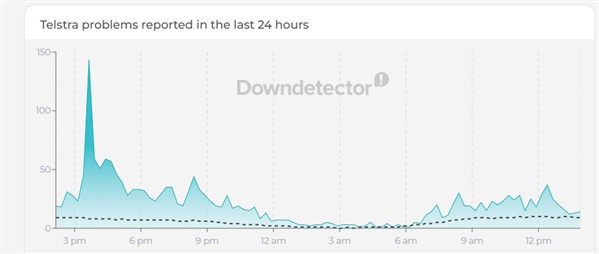
Clearly, Telstra is not infallible despite premium pricing built on the promise of reliability. A quick glance at monitoring services like Downdetector shows localised faults are reported regularly.

Reported problems of Telstra


Last Wednesday's failure, however, was not a small localised fault. It halted Victoria's V/Line regional trains and disrupted traffic lights across multiple states. Most seriously, Telstra confirmed that over 300 Triple Zero calls were logged but unsuccessful.

I suspect that this failure will cost Telstra heaps.

Action at Renewal Time

When your contract ends, ask around and get quotes from different providers. Don’t just take claims of better reliability at face value; ask what happens if the service fails. Keep in mind that a lower price doesn't always mean better protection, so compare your options carefully.

Some EFTPOS providers we handle include premium backup features which, at no cost to you, allow you to use your EFTPOS terminal when your internet or mobile network goes down. This means that you can still process transactions and avoid missing sales.

The Telstra outage in July 2026 showed that even a claimed premium service can fail without warning. Retailers pay more for peace of mind, but in this case, it often meant a higher bill with no extra protection.

PS POS Solutions once took Telstra to court over overcharging. We won about $40,000.

Written by:

Bernard Zimmermann


Bernard Zimmermann is the founding director of POS Solutions, a leading point-of-sale system company with 45 years of industry experience, now retired and seeking new opportunities. He consults with various organisations, from small businesses to large retailers and government institutions. Bernard is passionate about helping companies optimise their operations through innovative POS technology and enabling seamless customer experiences through effective software solutions.


Add new comment

Restricted HTML

  • Allowed HTML tags: <a href hreflang> <em> <strong> <cite> <blockquote cite> <code> <ul type> <ol start type> <li> <dl> <dt> <dd> <h2 id> <h3 id> <h4 id> <h5 id> <h6 id>
  • Lines and paragraphs break automatically.
  • Web page addresses and email addresses turn into links automatically.
CAPTCHA This question is for testing whether or not you are a human visitor and to prevent automated spam submissions. Image CAPTCHA
Enter the characters shown in the image.

The Australian Government's Paper on Mandating Cash

POS SOFTWARE

Australian Government

The Australian government has released a draft proposal to mandate cash acceptance. It is a much watered-down version of its previous statement. The most crucial point is that it does nothing about the big problem of disappearing bank branches and ATMs, which makes it difficult for many who want to use cash.

The good news is that for most business owners, this new rule won't change much and accepting cash will be a business decision for you, not a legal one.

Do You Have to Accept Cash?

For most retailers, the simple answer is no.

The new rule applies only to specific businesses, as the paper mainly covers supermarkets and many petrol stations. If you own a pet shop, a newsagency, a chemist's, or another type of small store, you are excluded as the rule only affects businesses that make more than $10 million in a year. Most independent shops fall well below this line.

If you run a local shop, you can decide for yourself whether to accept cash or go cashless.

An Exception for Franchise Stores

There is one important exception. If your shop is part of a big chain, like a 7-Eleven or a branded petrol station, you might have to accept cash. This is because the $10 million rule applies to the whole organisation, not just to a shop.

Deciding What's Right for Your Business Since the law doesn't force you to accept cash, you can choose what benefits your business. Consider these points.

Reasons to Keep Taking Cash

Retain all customers: Some prefer cash, especially older shoppers or those on tight budgets. While most now use cards, about 1.5 million Australians still rely on cash for daily shopping. Accepting cash helps you keep these customers.

Stand out from competitors

The big supermarkets will still be taking cash. This means people wanting to pay in cash will be forced away if you do not accept it.

Credit and debit card fees

These are high and likely to go up soon.

Reasons to Go Cashless

Save time

Handling cash takes time

Cost

It does cost to accept.

The future is digital.

It's getting harder to find banks and ATMs. As this trend continues, as a society, we are losing the ability to accept cash. Going cashless now can help prepare your business for the future.

Your Choice to Make

Choose payment methods that suit you. Consider your customer types and cash handling costs. Whether using cash or digital, the choice is yours.

Written by:

Bernard Zimmermann


Bernard Zimmermann is the founding director of POS Solutions, a leading point-of-sale system company with 45 years of industry experience, now retired and seeking new opportunities. He consults with various organisations, from small businesses to large retailers and government institutions. Bernard is passionate about helping companies optimise their operations through innovative POS technology and enabling seamless customer experiences through effective software solutions.


Add new comment

Restricted HTML

  • Allowed HTML tags: <a href hreflang> <em> <strong> <cite> <blockquote cite> <code> <ul type> <ol start type> <li> <dl> <dt> <dd> <h2 id> <h3 id> <h4 id> <h5 id> <h6 id>
  • Lines and paragraphs break automatically.
  • Web page addresses and email addresses turn into links automatically.
CAPTCHA This question is for testing whether or not you are a human visitor and to prevent automated spam submissions. Image CAPTCHA
Enter the characters shown in the image.

Determining what your cash/EFTPOS breakup is?

POS SOFTWARE

Determining your cash and EFTPOS payment breakup involves reviewing the mix of payment methods your customers use, such as cash, debit cards, and credit cards. We are going to do it directly from your point-of-sale (POS) system. 

This matters now so much as in the current climate, with RBA discussions focusing on making payments fairer for consumers while claiming to protect merchants, knowing your payment mix will help you forecast potential impacts. In my view, their proposals will encourage customers to drop lower-fee methods like cash and debit, and push the consumer to premium credit cards with high fees. 

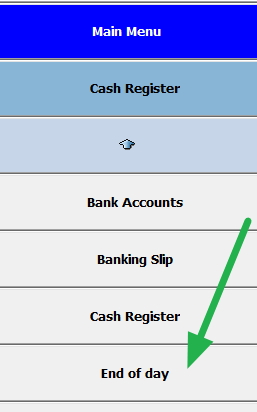
Go to the main menu and select "End of day."

Click where it has a green arrow.

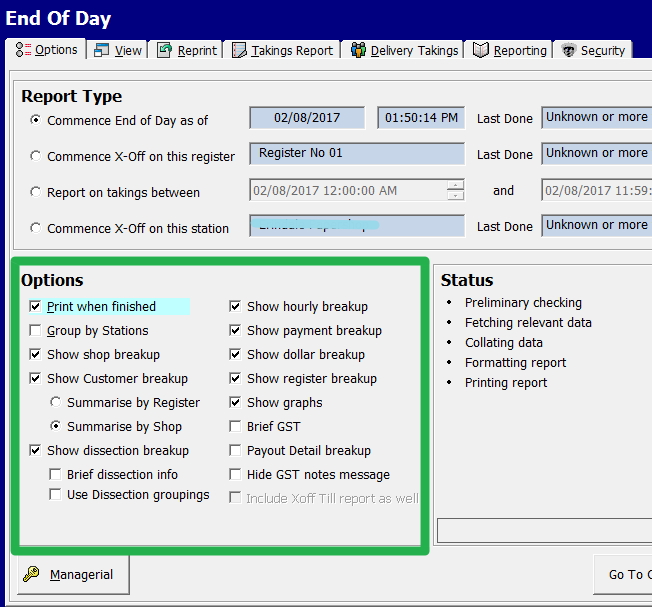
Now, in your Options menu, marked in a green square, tick everything. You will not be sorry if you get too much.


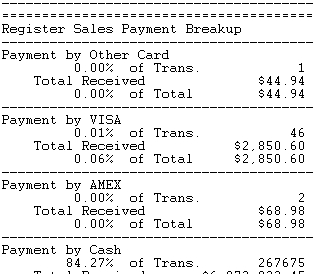
The part of the report you are looking for is the Sales Payment Breakup below.

Pick an appropriate period, generally the last year. Running it a few times with slightly different dates as you may get a better value with different dates. One caveat here is that cash receipts are going up slightly now.

Also while you are there, I suggest checking some of the other great information there such as hourly breakups, to understand peak times for specific payment methods. If your mornings see more cash sales from quick coffee runs, while evenings lean towards cards for larger purchases, you can tailor promotions accordingly. In my experience, retailers who dive into these details often uncover trends that lead to smarter decisions, like staffing adjustments or targeted discounts. 

Written by:

Bernard Zimmermann


Bernard Zimmermann is the founding director of POS Solutions, a leading point-of-sale system company with 45 years of industry experience, now retired and seeking new opportunities. He consults with various organisations, from small businesses to large retailers and government institutions. Bernard is passionate about helping companies optimise their operations through innovative POS technology and enabling seamless customer experiences through effective software solutions.



Add new comment

Restricted HTML

  • Allowed HTML tags: <a href hreflang> <em> <strong> <cite> <blockquote cite> <code> <ul type> <ol start type> <li> <dl> <dt> <dd> <h2 id> <h3 id> <h4 id> <h5 id> <h6 id>
  • Lines and paragraphs break automatically.
  • Web page addresses and email addresses turn into links automatically.
CAPTCHA This question is for testing whether or not you are a human visitor and to prevent automated spam submissions. Image CAPTCHA
Enter the characters shown in the image.

Proposed plan to remove surcharges on Cards

POS SOFTWARE

RBA Proposed plan to remove surcharges on Cards

If you own or manage a retail business in Australia, it's time to consider the Reserve Bank of Australia's (RBA) proposed changes to card payments, which aim to eliminate surcharges on debit and credit cards. While the RBA surcharge ban offers some benefits, it also brings challenges for SMB retailers.

The Labor Party entered the last election committed to eliminating debit card surcharges, which were part of their election promises. Now the RBA has expanded this significantly, proposing a broader ban that includes both debit and credit cards. If it goes through, it will directly impact many SMB retailers as it means you will no longer be able to impose a surcharge to offset the costs of accepting credit, debit, or prepaid cards from major networks such as Mastercard, Visa, or EFTPOS. This forces you to absorb these expenses.

After yesterday's consultation, although we were hoping for something better, we concluded that it's not all negative, as the RBA is also requesting that interchange fees be lowered. For instance, debit card interchange fees are to be decreased from 10 cents to 6 cents per transaction, while credit card fees go to 0.3%. The plan also caps fees for foreign cards, but it's unclear how this works. For example, if a French bank charges 50 cents, what does the RBA propose? Reading the document, it's unclear how these lower fees are to be passed on to the SMB retailer. My immediate concern is whether the banks will be able to charge additional or higher administration fees to offset these reductions.

The RBA plan will require payment processors to disclose their fees in a clear and comparable manner, segmented by merchant size and card type. Although some saw this as a positive, I view it as insignificant, as reputable payment processors have been doing this for some time.

These changes are scheduled to commence on 1 July 2026. At least this gives us all a reasonable timeframe for adaptation.

Before I review some of the positives and negatives, let me note that today, the debit card is the dominant form of payment in retail, and it should, as such, be the default payment method for pricing.

Positives for SMB Businesses

The reforms could reduce card acceptance costs through new, lower caps on interchange fees. Since most SMBs already absorb these costs into pricing, they stand to save money. The RBA estimates that 90% of businesses that do not surcharge will benefit (our data shows 70% do not surcharge), meaning the majority could still gain.

Eliminating the surcharge will prevent many customer disputes, complaints, and confusion, and reduce friction with customers.

The push for greater fee transparency is another benefit, as it eliminates the need for you to request it directly. Potentially leading to cost savings.

It does not stop you from offering discounts for cash transactions. This approach rewards customers who opt for the lower-cost option of cash without violating the new surcharge ban.

Implementation costs, while present, are relatively modest. In our POS System and most others, it's just a minor change to the settings. The price of many goods in the shop will need to be changed to include the costs of the surcharges.

Challenges and Considerations, the negatives.

While the reforms offer substantial upsides, they also present problems for SMB businesses operating today with tight margins. Payment providers will still be charging fees, which SMBs must now absorb. For retailers in low-margin sectors, such as those with regulated or capped prices, like Lotto, I doubt they will see an increase in merchant margins to compensate for the loss of the surcharge. Lotto has made it quite clear that they do not like these surcharges.

Unfortunately, the plan favours larger retailers, who now have better rates, over smaller ones, and the RBA seems unconcerned with that.

The ban on surcharges encourages customers to use higher-cost cards. Many will switch from debit to credit cards. What happens if an American Express card is used?

Reliance on payment providers to pass through savings from lower interchange fees introduces uncertainty. I have spoken to them several times about this issue, and they claim that they are making little of it. If so, where do they make up the difference? Therefore, although the RBA anticipates that these reductions will benefit merchants, there is no guarantee that they will occur. Will there be higher administrative charges?

Additionally, merchants will lose some negotiating leverage with banks, as the current surcharges have been a concern for the banks.

The Outlook for SMB Retailers

With the current strong political backing, the RBA's plan is likely to proceed as outlined in their July 2025 consultation paper. SMB retailers should prepare now for the July 1, 2026, rollout.

So get ready to adapt? Once we are aware of the exact changes, we will provide a free guide to our users to help them make the necessary adjustments.

This information is based on the RBA's consultation papers from July 2025, which can be found here.

Written by:

Bernard Zimmermann


Bernard Zimmermann is the founding director of POS Solutions, a leading point-of-sale system company with 45 years of industry experience, now retired and seeking new opportunities. He consults with various organisations, from small businesses to large retailers and government institutions. Bernard is passionate about helping companies optimise their operations through innovative POS technology and enabling seamless customer experiences through effective software solutions.


Add new comment

Restricted HTML

  • Allowed HTML tags: <a href hreflang> <em> <strong> <cite> <blockquote cite> <code> <ul type> <ol start type> <li> <dl> <dt> <dd> <h2 id> <h3 id> <h4 id> <h5 id> <h6 id>
  • Lines and paragraphs break automatically.
  • Web page addresses and email addresses turn into links automatically.
CAPTCHA This question is for testing whether or not you are a human visitor and to prevent automated spam submissions. Image CAPTCHA
Enter the characters shown in the image.

Linkly EFTPOS Issues After the July 2025 Microsoft Update

POS SOFTWARE

Linkly eftpos

We have received a few reports of another issue with Linky EFTPOS from people who have installed the latest Microsoft update. We are not sure, as we cannot find any official Microsoft or Linkly statement to confirm the link. 

What we can say is that some report to us that their Linkly-integrated EFTPOS terminals displayed "Pinpad Offline" and some that the Linkly client application is not appearing in the Windows system tray. We think it's a communication error between Linkly and their EFTPOS terminal. 

What I did was to uninstall the latest Microsoft update and then turn off both the computer and the EFTPOS terminal. Then, I started it up again. What I suggest is that if you are experiencing Linkly EFTPOS issues after a Windows update, turn off the computer and the EFTPOS terminal, then turn them on again. If this does not work, please get in touch with Linkly Support or your bank’s merchant services.

Written by:

Bernard Zimmermann


Bernard Zimmermann is the founding director of POS Solutions, a leading point-of-sale system company with 45 years of industry experience, now retired and seeking new opportunities. He consults with various organisations, from small businesses to large retailers and government institutions. Bernard is passionate about helping companies optimise their operations through innovative POS technology and enabling seamless customer experiences through effective software solutions.
 

Add new comment

Restricted HTML

  • Allowed HTML tags: <a href hreflang> <em> <strong> <cite> <blockquote cite> <code> <ul type> <ol start type> <li> <dl> <dt> <dd> <h2 id> <h3 id> <h4 id> <h5 id> <h6 id>
  • Lines and paragraphs break automatically.
  • Web page addresses and email addresses turn into links automatically.
CAPTCHA This question is for testing whether or not you are a human visitor and to prevent automated spam submissions. Image CAPTCHA
Enter the characters shown in the image.

The true costs of an EFTPOS Outage

POS SOFTWARE

EFTPOS down use cash

Our recent EFTPOS Retailer Survey highlights the critical concern for Australian retailers, which resulted in many questions for me from retailers over this survey: When choosing payment solutions, retailers here gave reliability as their top priority, surpassing fast clearance and cost. While fast clearance remains the next most important, uninterrupted payment processing is essential for business continuity.

Payment processing reliability is not just a convenience; it's vital for business continuity. Yet our survey indicates that retailers frequently experience outages and pose a persistent risk. These outages would result in significant financial losses for retailers.

What hurts is that almost all IT infrastructure guarantees an uptime of 99.999% (we call this the five nines), yet no one sees it. A shop, let us say, open 8 hours a day, 300 days a year, would, based on this, have less than 1.5 minutes of an EFTPOS outage a year. I am sure we all have gone through more than 1.5 minutes of an EFTPOS outage.

Incidents involving Telstra and Woolworths demonstrate that even major businesses are not immune to payment outages.

For example, a retailer with $1 million in annual turnover and a 30% margin loses approximately $400 in revenue for every hour of downtime. This figure only reflects immediate losses. Long-term impacts such as damaged customer relationships, reputational harm, and customer attrition will be even more significant, though harder to quantify.

Under Australian Consumer Law, businesses may be entitled to compensation for financial losses caused by EFTPOS outages, even if the provider does not guarantee uptime. To make a successful claim,  it will take time as you need to document all losses thoroughly, then you will need to include POS reports comparing affected periods to normal trading to show the loss. I have seen a few people do this, with mixed results. We generally advise that if the EFTPOS provider makes a fair offer, accept it. One problem is that the EFTPOS providers know your figures as well as you do and have more money and experience in these matters.

Calculate the Cost of an EFTPOS Outage

Several direct and indirect factors determine the actual cost of an EFTPOS outage. The following outlines some key variables to help you estimate your potential losses.

Calculation

Average hourly revenue

An outage can occur anytime; take your yearly revenue and work out an hourly rate.

I should say here that Murphy's Law will tell you that outages will occur at the worst possible times, such as during peak trading hours, amplifying their financial and reputational impact.

Outage duration

This is hard to estimate, as customers have been knocked out for minutes, hours, and days. Do your best here. 

This one really hurts. Often, you use the downtime to do your books, and you see money going out, while your staff is doing nothing.

Card transaction percentage

Your End-of-Day reports will tell you this, I would expect somewhere between 50% and 80%

Estimated sales lost

Many customers carry little or no cash, and if EFTPOS is down, they cannot buy from you. Many will go elsewhere to buy the product. As a guess, I would say 50%, but I would not be surprised if it's closer to 100%.

Now multiply these out.

(Lost revenue) = (Average hourly revenue) x (Outage duration) x (Card transaction percentage) x (Estimated sales lost)

That is the easy part now, we need to add to this base figure.

Customer Reputational Behaviour    

What do the customers think of you? If they cannot buy from you, they will buy from someone else. What chance is that they will switch for good? It is said that if an outage occurs once, it is generally okay, but two or three is something else. What is the cost of losing ten customers a year to EFTPOS outages?

I have seen industry experts give figure 

Key Takeaway

The actual cost of an EFTPOS outage extends far beyond immediate lost sales. Reliability is the foundation of trust and operational continuity in retail. Both providers and retailers must prioritise robust systems and contingency plans to safeguard business performance and customer relationships. 

As Australia moves into a cashless society, our present government (both sides) will only make this problem worse by not putting more commitment into our electronic infrastructure.


Add new comment

Restricted HTML

  • Allowed HTML tags: <a href hreflang> <em> <strong> <cite> <blockquote cite> <code> <ul type> <ol start type> <li> <dl> <dt> <dd> <h2 id> <h3 id> <h4 id> <h5 id> <h6 id>
  • Lines and paragraphs break automatically.
  • Web page addresses and email addresses turn into links automatically.
CAPTCHA This question is for testing whether or not you are a human visitor and to prevent automated spam submissions. Image CAPTCHA
Enter the characters shown in the image.

EFTPOS Retailer Survey Analysis Report

POS SOFTWARE

EFTPOS Retailers survey 2025

Executive Summary

The following analysis examines retailer experiences with EFTPOS systems in Australia, based on survey data collected in April 2025. Before addressing the detailed findings, several critical insights deserve immediate attention:

Key Findings Highlight

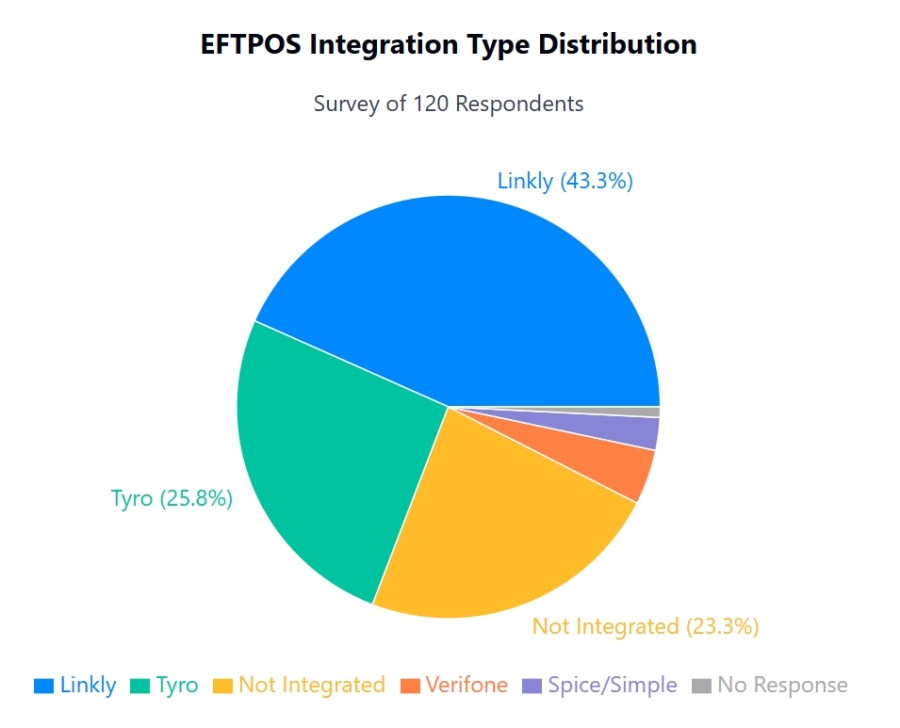
  • Integration Landscape: Linkly (most major banks) dominates with 43% market share, followed by Tyro (26%) and non-integrated solutions (23%).
  • Reliability Crisis: Despite being the highest-rated factor (9.6/10), reliability remains a problem, with 68% of retailers experiencing at least one outage in the past year.
  • Provider Comparison: Tyro users report significantly better reliability (45% with no outages) compared to Linkly users (21% with no outages), with Linkly users experiencing disruptions three times more frequently (31% had three or more outages vs. 10% for Tyro).
  • Fee Handling Divide: 72.5% of retailers absorb EFTPOS fees rather than passing them on to customers, despite being cost-sensitive.
  • Factor Correlation: Reliability and fast settlement to retailers are seen as operational necessities.

Survey Methodology This report analyses responses from 120 Australian retailers, not all of whom are our customers, who were surveyed in April 2025. Data includes integration types and importance ratings, with 10 being the highest. We asked them in our newsletter if they could fill out our online survey. It did take a long time to go through the analysis below. I want to thank Garth for his help in this survey.

Detailed Findings

What EFTPOS Integration Do You Use?

What it’s about:
This question asked retailers which EFTPOS system they use and whether it’s integrated with their POS (Point of Sale) software.

What retailers said:

Sample eftpos integrations in Australia retailers 2025


  • 43% use Linkly (the system behind most major banks’ terminals)
  • 26% use Tyro
  • 23% don’t integrate their EFTPOS with their POS at all
  • The rest use smaller providers like Verifone or Spice/Simple.

What does it mean:

Linkly dominates despite being generally the most expensive system because it’s bundled with most banks. 

How Important Is Integrated EFTPOS to You?

What it’s about:
Retailers rated how important it is for their EFTPOS to be connected directly to their POS system.

What retailers said:

  • Integrated users: Gave it a 9 out of 10 or higher score.
  • Non-integrated users: Only 2.3 out of 10.

What does it mean:
If you have an integrated EFTPOS system, you love it mainly because it saves time and reduces errors. If you don’t, you probably can’t justify the cost.

How Important Is Reliability (No Downtime)?

What it’s about:
Retailers rated how critical it is that their EFTPOS always works.

What retailers said:

Average: 9.6 out of 10
Reliability is the highest-rated factor.

What does it mean:
Retailers can’t afford for their payment systems to go down. It was the most critical issue. 

How Many EFTPOS Outages Have You Had in the Past Year?

Now, let's look at reliability in detail.

What it’s about:
Retailers reported how often their EFTPOS system stopped working in the last 12 months. What we found interesting here is that everyone remembered the outages.

What retailers said:

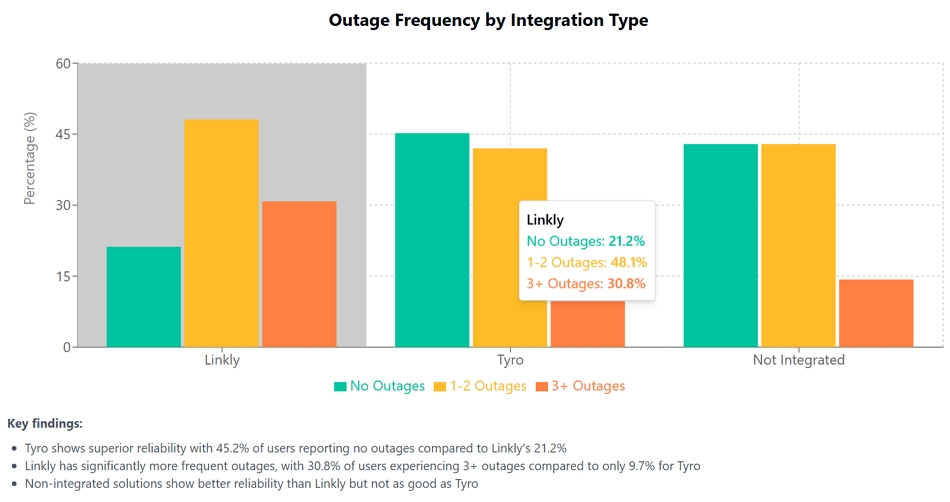
Outage frequency across all respondents shows major reliability issues; 68% of retailers experienced at least one outage in the past 12 months, with nearly a quarter suffering frequent disruptions (three or more outages). This is particularly problematic, given the top importance rating assigned to reliability above.

Integration method significantly impacts outage experiences:

EFTPOS_outage_by_integration_Australia

Integration Type No Outages 1 Outage 2 Outages 3+ Outages
Linkly 21.2% 26.9% 21.2% 30.8%
Tyro 45.2% 32.3% 9.7% 9.7%
Non-integrated 42.9% 25.0% 17.9% 14.3%

Tyro users report substantially fewer outages than Linkly users, with more than twice the percentage experiencing no outages at all. Linkly users suffer from the highest rate of frequent disruptions, with 30.8% experiencing three or more outages, three times the rate of Tyro users (9.7%). This suggests significant reliability advantages for Tyro. 

What does it mean:
Outages are common across all retailers and can seriously disrupt business, especially for those relying on Linkly.

Tyro users:

  • Nearly half (45.2%) of Tyro users reported no outages, the best among the three options.
  • Only 9.7% of Tyro experienced two or more outages, significantly lower than other options.
  • This suggests Tyro is the most reliable integration type in terms of uptime, aligning with its reputation for robust, integrated EFTPOS solutions in Australia.

Non-integrated users:

  • 42.9% reported no outages, similar to Tyro and much better than Linkly.
  • The proportion of users experiencing three or more outages (14.3%) is comparable to Linkly.

Linkly users:

  • Only 21.2% of Linkly users had no outages, the worst on the list.
  • A significant 30.8% experienced three or more outages, which is not good.

If reliability and minimising payment outages are your top priorities, Tyro appears to be the superior choice among the options compared. Non-integrated systems performed reasonably well, while Linkly, despite its dearer cost, showed a higher risk of outages based on this data.

How important is it that your bank offers EFTPOS?

What it’s about:
This asked if it matters whether their EFTPOS comes from their current bank.

What retailers said:

  • Average importance: 6 out of 10.
  • Only 38% rated it as “critical.”

What does it mean:
Retailers are open to using non-bank providers and are prepared to consider other providers if they offer better features, such as reliability.

How Important Are the EFTPOS Rates (Visa, Mastercard, Debit)?

What it’s about:
Retailers rated how much they care about the fees charged for EFTPOS transactions.

What retailers said:

  • Average rating: 9.2 out of 10

What does it mean:
Transaction fees were among the top concerns for retailers, where every cent counts today.

How Important Is Accepting Amex or Diners?

What it’s about:
Retailers rated the value of being able to accept American Express or Diners Club cards.

What retailers said:

  • Average rating: 3.7 out of 10

What does it mean:
Most retailers here are not that concerned with Amex/Diners

How Important Is Having No Lock-In Contract?

What it’s about:
Retailers rated how much they care about being free to leave their EFTPOS provider at any time.

What retailers said:

  • Average: 7.6 out of 10

What does it mean:
Flexibility matters; retailers don’t want to be tied down.

How Important Is Fast Settlement (Same/Next Day)?

What it’s about:
This asked how much retailers value getting their EFTPOS money quickly.

What retailers said:

  • Average: 9.3 out of 10
  • 87% want funds within 24 hours.

What does it mean:
A fast cash flow is vital; retailers want their takings in the bank as soon as possible. No one likes large sums of money somewhere in the banking cloud. They need it now, where they can use it.

How Important Is a No-Cost EFTPOS Option?

What it’s about:
This asked about the appeal of “no-cost” EFTPOS systems. Although generally dearer, it passes the cost from the retailer to the customer.

What retailers said:

  • Average: 8.1 out of 10

What does it mean:
Retailers like the idea of not paying fees themselves, but there are trade-offs: It raises their prices. Overall, it was not highly rated.

How Important Are Terminal Rental Fees?

What it’s about:
Retailers rated how much terminal rental costs matter.

What retailers said:

  • Average: 8.5 out of 10

What does it mean:
Ongoing device costs are a consideration, but other issues are more critical.

Are There Any Other Factors That Matter to You?

What it’s about:
This was an open-ended question for anything not covered.

What retailers said:

  • Only 17% filled in this question here
  • A few mentioned things like terrible customer support and Telstra's coverage in their area. We could see no pattern.

What does it mean:
The low figure and many responses here suggest we covered most mainstream issues.

How Do You Handle EFTPOS Fees?

What it’s about:
Retailers explained whether they pass EFTPOS fees to customers, absorb them, or consider a change.

What retailers said:

  • 72.5% currently absorb the fees 
  • Of those absorbing fees, 32.1% are thinking about charging

What does it mean:

Most retailers absorb card fees, but many consider passing them on to customers. Now this was surprising, which was not expected when we looked in detail, that although Linkly is generally the most expensive system, our analysis reveals an unexpected relationship between EFTPOS providers and fee-passing behaviours:

Tyro Users:

  • 57% currently absorb the fees 
  • Of those absorbing fees, 67.4% are thinking about charging

Linkly Users:

  • 80% currently absorb the fees 
  • Of those absorbing fees, 25% are thinking about charging

Why should a dearer EFTPOS have a lower charge rate? You tell me. I think it might be because this ability is inbuilt in Tyro, but this needs more research. 

Summary Table: What Matters Most to Retailers

The disparity in technical performance across integration types is significant. Tyro demonstrates superior reliability, with 45% of users reporting no outages compared to just 21% of Linkly users. Conversely, Linkly users report the highest rate of frequent disruptions, with 31% experiencing three or more outages, compared to 10% for Tyro and 14% for non-integrated solutions.

Satisfaction Drivers Analysis

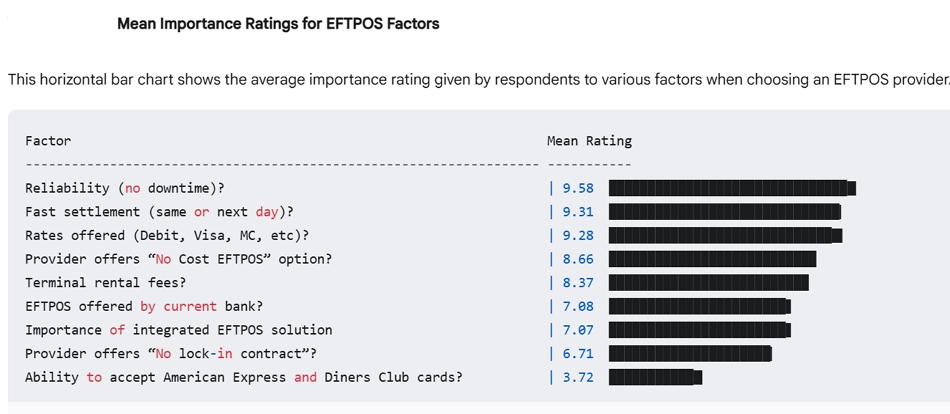
The survey data indicates a clear hierarchy of factors that drive retailer satisfaction with EFTPOS systems:

EFTPOS_issues_importance_by_retailers

The ranking reveals retailers prioritise operational efficiency (reliability, settlement speed), followed closely by financial considerations (rates, fees). The relatively low importance of Amex/Diners acceptance suggests most retailers view this as optional rather than essential.

Analysis of Key Metrics

This is done to see if any overriding themes emerge from the survey; the closer the value to 1, the more they fit into a theme.

Factor Pair Correlation
Reliability ↔ Fast Settlement 0.72
No-Cost Option ↔ Fast Settlement 0.37
No-Cost Option ↔ Terminal Rental Fees 0.34
Rates ↔ Reliability 0.29
No Lock-in Contract ↔ Fast Settlement 0.29


The extremely high figure for reliability with fast settlement indicates that retailers view these as the most critical points.

Other factors, although important, fall into the optional category. 

Conclusion

The survey data reveals critical insights.

  • Reliability and fast settlement times are non-negotiable for most retailers.
  • Integrated EFTPOS is highly valued by those who use it.
  • Outages are common, especially for Linkly users. Our poor electronic infrastructure will cause problems in cloud solutions.
  • Most shops absorb card fees, but many are considering passing them on.
  • Cost matters, but not at the expense of reliability and fast settlement.

If you’re a retailer, reliability and quick settlement will guide your system choice, even before considering transaction fees or rates.

If you’re an EFTPOS provider, the strongest levers for market share are minimising outages, offering transparent and competitive rates, and settling quickly.

If you’re a bank, bundling with Linkly may not be a long-term defence against competitors' better reliability and feature offerings.


Final note

I want to thank those retailers who helped us make this survey.


Written by:

Bernard Zimmermann


Bernard Zimmermann is the founding director at POS Solutions, a leading point-of-sale system company with 45 years of industry experience. He consults to various organisations, from small businesses to large retailers and government institutions. Bernard is passionate about helping companies optimise their operations through innovative POS technology and enabling seamless customer experiences through effective software solutions.
 

Add new comment

Restricted HTML

  • Allowed HTML tags: <a href hreflang> <em> <strong> <cite> <blockquote cite> <code> <ul type> <ol start type> <li> <dl> <dt> <dd> <h2 id> <h3 id> <h4 id> <h5 id> <h6 id>
  • Lines and paragraphs break automatically.
  • Web page addresses and email addresses turn into links automatically.
CAPTCHA This question is for testing whether or not you are a human visitor and to prevent automated spam submissions. Image CAPTCHA
Enter the characters shown in the image.

EFTPOS survey closing on Wednesday

POS SOFTWARE

Person filing out a survey

We're amazed by the overwhelming response to our EFTPOS survey. Although more responses are still coming in, we need to close the study on Wednesday. If you wish to participate, please do so immediately, as this is your last chance.

We will need to analyse the collected information, and due to the high volume of responses, this process will take some time. However, we are working to complete the analysis quickly, as we aim to have the findings ready before the upcoming elections. We believe the results could help inform and frame the public debate, which was the primary reason we were tasked with conducting this survey.

The processed information will be shared with relevant authorities and used to support decision-making in this area.

Thank you to everyone who participated.


Written by:

Bernard Zimmermann


Bernard Zimmermann is the founding director at POS Solutions, a leading point-of-sale system company with 45 years of industry experience. He consults to various organisations, from small businesses to large retailers and government institutions. Bernard is passionate about helping companies optimise their operations through innovative POS technology and enabling seamless customer experiences through effective software solutions.
 

Add new comment

Restricted HTML

  • Allowed HTML tags: <a href hreflang> <em> <strong> <cite> <blockquote cite> <code> <ul type> <ol start type> <li> <dl> <dt> <dd> <h2 id> <h3 id> <h4 id> <h5 id> <h6 id>
  • Lines and paragraphs break automatically.
  • Web page addresses and email addresses turn into links automatically.
CAPTCHA This question is for testing whether or not you are a human visitor and to prevent automated spam submissions. Image CAPTCHA
Enter the characters shown in the image.

Help shape the Future of EFTPOS Integration

POS SOFTWARE

Get ready to shape the future of EFTPOS integration

Today, EFTPOS payment plays a key role in retail! We need to hear your thoughts on what you need with FTPOS.

If you're a customer running our POS System, we need your feedback to help us create EFTPOS solutions tailored to your needs, making your business even more successful!

Understanding EFTPOS Integration

EFTPOS integration creates a direct communication pathway between your Point of Sale (POS) and payment systems. This seamless connection eliminates redundant data entry, reduces handling time, and reduces mistakes.

Why Your Input on EFTPOS Integration Matters

Implementing any EFTPOS integration is a significant investment for our team and your business. This goes beyond simply connecting a terminal—it involves creating systems that complement your workflow and work with the new system requirements errors. Each is a few months' work.

Prioritising Your Business Requirements

We want your priority for cost considerations, system reliability, support quality, contract flexibility, and feature availability. What factors are most critical for your business currently?

How Your Feedback Will Shape Our Development

Your survey responses will directly influence our approach to future EFTPOS integrations and determine which payment solutions we prioritise for development. It isn't merely a data collection exercise—your input will guide concrete improvements to our EFTPOS offerings for Australian retailers.

All responses remain confidential and will be used exclusively for service improvement.

Survey Completion Time

One minute!!!

We've designed the survey to take approximately one minute to complete.

Appreciation for Your Contribution

Your feedback will shape EFTPOS solutions that enhance efficiency, accuracy, and profitability for Australian businesses.

Thank you for partnering with us to create effective payment solutions.


Written by:

Bernard Zimmermann


Bernard Zimmermann is the founding director at POS Solutions, a leading point-of-sale system company with 45 years of industry experience. He consults to various organisations, from small businesses to large retailers and government institutions. Bernard is passionate about helping companies optimise their operations through innovative POS technology and enabling seamless customer experiences through effective software solutions.
 

Add new comment

Restricted HTML

  • Allowed HTML tags: <a href hreflang> <em> <strong> <cite> <blockquote cite> <code> <ul type> <ol start type> <li> <dl> <dt> <dd> <h2 id> <h3 id> <h4 id> <h5 id> <h6 id>
  • Lines and paragraphs break automatically.
  • Web page addresses and email addresses turn into links automatically.
CAPTCHA This question is for testing whether or not you are a human visitor and to prevent automated spam submissions. Image CAPTCHA
Enter the characters shown in the image.

Are EFTPOS and POS the Same?

POS SOFTWARE

EFTPOS vs POS Systems


No, EFTPOS (Electronic Funds Transfer at Point of Sale) and POS (Point of Sale) are not the same, though they are commonly used together. EFTPOS refers to the payment processing method, while POS is a broader system containing sales tracking, inventory management, and other business functions. People often confuse EFTPOS and POS systems. This is mainly because salespeople try to confuse the issue by claiming that EFTPOS is POS. It is not.

What is EFTPOS

The bank system links the proposed transaction from your shop to the banking system. It usually operates through a terminal that allows customers to use their cards to complete an electronic payment using debit or credit cards.

The main features of EFTPOS terminals are:

  • Secure payment processing
  • Support for multiple payment methods (debit, credit, contactless)
  • Encryption of payment data

What is a POS System?

It is the hardware and software used to run a shop.

Key features of POS systems include:

  • Sales management and transaction processing
  • Inventory tracking and management
  • Customer relationship management (CRM)
  • Reporting and analytics

How EFTPOS and POS Work Together

In modern retail POS Systems like ours, the EFTPOS terminals are often integrated into the Point of Sale Software. Here's how they typically work together:

  1. The POS system calculates the total sale amount.
  2. This amount is automatically sent to the EFTPOS terminal if integrated.
  3. The customer completes the payment on the EFTPOS terminal.
  4. The POS system gets a response from the EFTPOS terminal that the transaction has gone through.
  5. The POS System records the completed transaction.

This integration offers several benefits:

  • Reduced manual data entry, minimising errors
  • Faster checkout times, improving customer experience
  • Simplified end-of-day reconciliation
  • Real-time sales data for better business insights

Security Considerations

Both EFTPOS and POS systems must prioritise security to protect sensitive customer data. Integrating them makes them more secure.

Choosing the Right Solution for Your Business

A standalone EFTPOS terminal vs an integrated POS system

Faster

It's much faster, as the information exchange between the EFTPOS unit and the POS System is automatic.

Secure

Integrated systems mean that the merchant has an extra layer of security, as the POS Software and the EFTPOS are linked. The controls that enter the EFTPOS pass through the POS software checks first.

Fewer mistakes

People are in a hurry, and let's face it: almost everyone in retail is busy, so they make mistakes. POS Software makes fewer mistakes. For example, a person often misreads a one and a 7. Instead of $70 into the EFTPOS unit, they punch in $10. The retailer loses $60. Sometimes, this behaviour is not accidental; store attendants give discounts to relatives and friends.

Our users can have various EFTPOS leading providers in the Australian market.

Conclusion

While EFTPOS terminals are for the payment processing only, an integrated POS system offers a comprehensive solution for managing your entire retail operation.

FAQs

Q: Can I use an EFTPOS terminal without a POS system?

A: Standalone EFTPOS terminals can process payments independently but won't offer inventory tracking or sales reporting features.

Q: How much does an integrated EFTPOS extra cost?

A: Costs vary depending on the EFTPOS providers. We do not charge for the integration.

Q: What's the difference between contactless payments via EFTPOS vs credit cards?

A: EFTPOS transactions through savings/cheque accounts usually have lower fees than credit card transactions processed via Visa or Mastercard networks.

Q: Are there any security risks in integrating EFTPOS with POS systems?

A: Overall integration will enhance security by reducing manual data entry; however, some intelligence is still needed to reduce the risks.


Written by:

Bernard Zimmermann


Bernard Zimmermann is the founding director at POS Solutions, a leading point-of-sale system company with 45 years of industry experience. He consults to various organisations, from small businesses to large retailers and government institutions. Bernard is passionate about helping companies optimise their operations through innovative POS technology and enabling seamless customer experiences through effective software solutions.
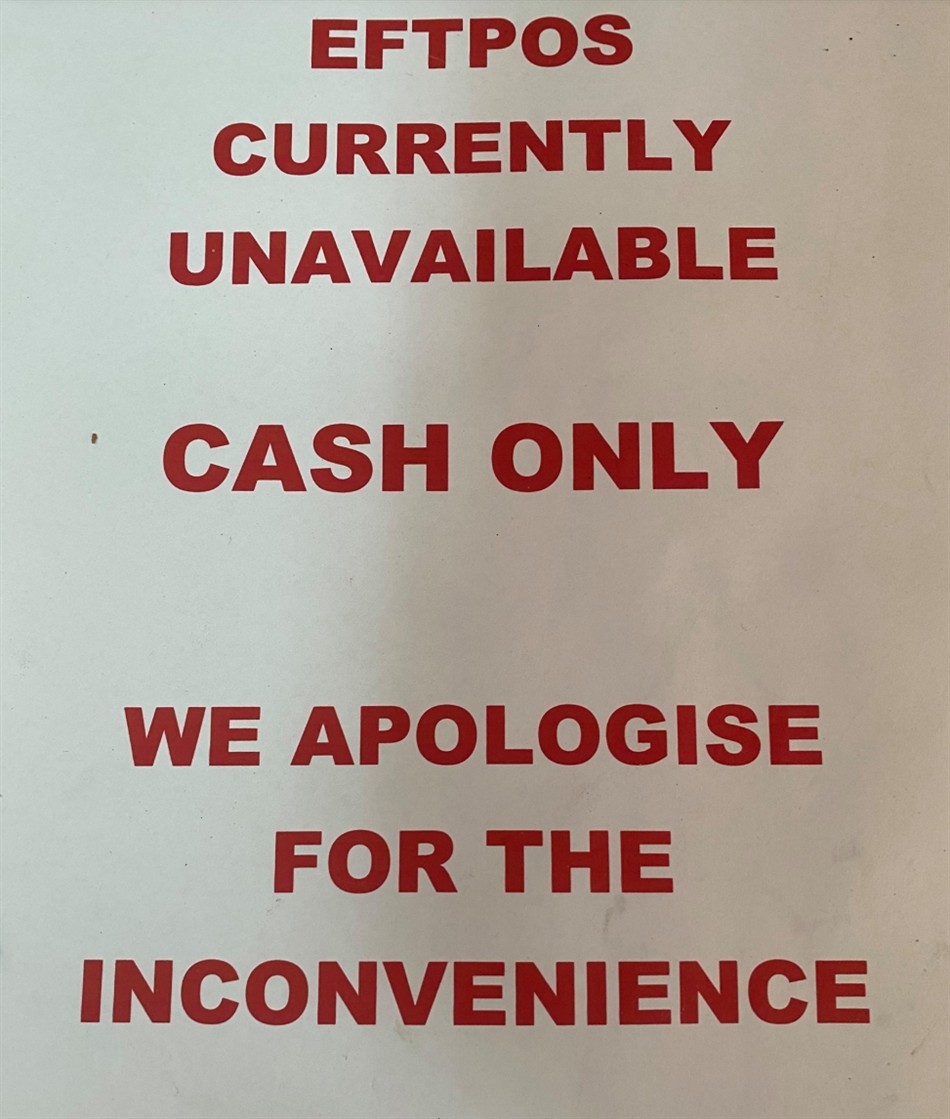
 

Add new comment

Restricted HTML

  • Allowed HTML tags: <a href hreflang> <em> <strong> <cite> <blockquote cite> <code> <ul type> <ol start type> <li> <dl> <dt> <dd> <h2 id> <h3 id> <h4 id> <h5 id> <h6 id>
  • Lines and paragraphs break automatically.
  • Web page addresses and email addresses turn into links automatically.
CAPTCHA This question is for testing whether or not you are a human visitor and to prevent automated spam submissions. Image CAPTCHA
Enter the characters shown in the image.

Where do we stand now on Smartpay EFTPOS

POS SOFTWARE

SmartPay

Smartpay is one of several Zero-Cost EFTPOS solutions that shift transaction fees from retailers to customers. Many of my customers use it.

I confess we have been wary of these systems.  So have others, as you can read here.

Some issues

Government regulatory challenges

The Reserve Bank of Australia (RBA) has discussed restricting such fee payment providers. That could significantly impact Smartpay's revenue model.

Fees

Their fees seemed high compared to other EFTPOS suppliers, and we were dubious of the claim that customers would not care about these higher fees. Your customers are not silly.

Ransomware attack

They were affected quite dramatically; this is no minor issue if you deal with EFTPOS.

However, the immediate issue with them has been some recent market developments.

Market Position and Financial Performance

Smartpay_graph_asx

It is not just us who have been wary. Despite Smartpay's strong financial performance, its share price has dropped from $1.42 about a year ago to about $0.55 recently. This decline reflects the market's uncertainty about the company's prospects.

Well, now Smartpay has received a takeover bid from Tyro Payments. Tyro has offered to buy 100% of Smartpay's shares for 91 cents a share, subject to due diligence, promptly driving the share price up to 78 cents. The difference between 78 cents and 91 cents is telling, probably due to the uncertainty of due diligence.

Then, another international buyer appeared to make an offer, and what is stunning is that, with this news, Smart Pay's share price fell. Figure that out!

Implications for Retailers

If Smartpay is acquired, retailers might face changes in their EFTPOS services. While existing contracts may be initially honoured, new terms or conditions will be introduced. These changes could include adjustments to fees, surcharging policies, or even the functionality of the EFTPOS terminals. Tyro systems are very different from SmartPay.

Actionable Recommendations for Retailers

  1. Stay informed about Smartpay's developments and industry news.
  2. If changes occur, you must review your contracts.
  3. Prepare for potential fee structure changes by assessing their impact on your business.
  4. I would wait until we know what is happening.


Written by:

Bernard Zimmermann


Bernard Zimmermann is the founding director at POS Solutions, a leading point-of-sale system company with 45 years of industry experience. He consults to various organisations, from small businesses to large retailers and government institutions. Bernard is passionate about helping companies optimise their operations through innovative POS technology and enabling seamless customer experiences through effective software solutions.
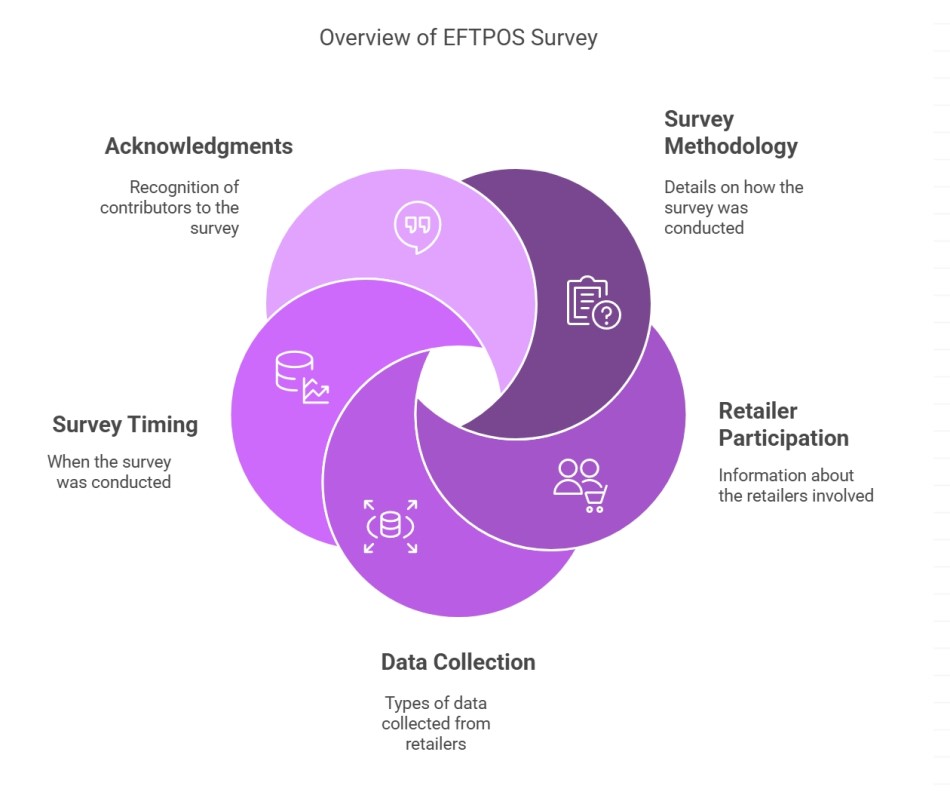
 

Add new comment

Restricted HTML

  • Allowed HTML tags: <a href hreflang> <em> <strong> <cite> <blockquote cite> <code> <ul type> <ol start type> <li> <dl> <dt> <dd> <h2 id> <h3 id> <h4 id> <h5 id> <h6 id>
  • Lines and paragraphs break automatically.
  • Web page addresses and email addresses turn into links automatically.
CAPTCHA This question is for testing whether or not you are a human visitor and to prevent automated spam submissions. Image CAPTCHA
Enter the characters shown in the image.

Steps to Calculate Your Costs of Card Payment Fees

POS SOFTWARE

EFTPOS

If you want to compare your current EFTPOS/Credit Card providers with others, there are a few simple steps to do:

Before you begin

I suggest you ask the following:

Speed of Fund Transfers

How quickly does the provider transfer funds to your bank account? This is very important if your main account isn't with one of the big banks. Delays can disrupt cash flow, especially during busy periods. It's aggravating to collect out-of-fund messages from the bank if you have the funds in another bank and are getting them into the required bank.

Service Quality

Poor service from a payment provider can cause unnecessary stress. You can always do an online search on customer reviews for the provider you are looking at. How many stars do they have? I have seen people pull out EFTPOS systems because of bad quality.

Contact terms

You can get better rates if you are willing to commit for a decent period.

Also, as you know, a contract does not lock the provider into terms. I have often seen my clients get a letter from the providers using the rate after a year in a three-year contract, and they are switching my customers to a different rate.

Transparency in Quotes

Please always ask for the total cost in writing for provider quotes. Some providers present attractive rates but do not or underestimate items that add up over time. Could you make sure this is in writing? If you get into a dispute, arguing over one figure in a total cost is much easier than a rate sheet.

Once you get this total cost, you still need to check. It's easy after you have done a few, like me.

Key Information You'll Need to Calculate EFTPOS Costs

To calculate your EFTPOS costs accurately, gather the following details:

Card Mix

You should get this from your existing EFTPOS statements or your total reports. You need a breakdown of transactions by card type: debit, credit (generally VISA and MasterCard), and international cards, e.g. AMEX.

  • Monthly transaction volume (number of sales)
  • Average transaction value

What the EFTPOS/Credit provider wants is

  • Monthly transaction total by type
  • Average transaction value

If this data isn't readily available, estimate based on past sales and your experience.

Fee Structure

  • Transaction fees: Fixed (e.g., 25¢ per transaction) or percentage-based (e.g., 1% of the transaction value)
  • Terminal rental fees: Monthly charges (e.g., $30/month) or upfront purchase cost
  • Other fixed fees, account fees, gateway fees, etc.

Additional Costs

  • Setup fees for new EFTPOS machines
  • Chargeback fees (typically $15–$35 per dispute)
  • Stationery costs (e.g., receipt rolls)
  • Equipment replacement or repair fees. Stolen EFTPOS units were a problem for our clients a short time ago.

Step-by-Step Calculation

Once you've gathered the necessary information, follow these steps:

Calculate Debit Card Fees

Debit card fees are often lower than credit card fees. Use one of these formulas:

  • Fixed fee: {Monthly Transactions} x {Debit Rate}
  • Percentage fee: Monthly Transactions} x {Average Transaction Value} x {Debit Rate}

Example:

  • 1,000 debit transactions/month
  • Average transaction value = $50
  • Debit rate = .8%

Calculation: 1,000 x $50 x .8%

Calculate Credit Card Fees

Use the same formula as above but with the credit card rate, which is usually more.

Example:

  • 300 credit transactions/month
  • Average transaction value = $50
  • Credit rate = 1.2%

Calculation: 300 x $50 x 1.2%

Calculate International Card Fees

International cards incur higher rates due to additional interchange and scheme fees, but the above formula is the same.

Add Fixed Costs

Include monthly terminal rentals and other fixed expenses like stationery or compliance fees.

Example:

  • Terminal rental = $27.50/month
  • Receipt rolls = $26/month

Total fixed costs: 27.50 + 26

Factor in Variable Costs

Some costs, like chargebacks, are unpredictable; I use a yearly estimate and calculate a monthly average. One point that helps here is having a camera recording the EFTPOS unit.

Example:
If I go about one chargeback a month on average, it might be
Chargeback fee estimate = $30/month


Here is a sample EFTPOS sheet, I made up.

EFTPOS Calculation Sheet


It adds up.


Tips for Managing EFTPOS Costs

Negotiate Rates

Many providers will offer better rates if you commit to a longer-term contract or demonstrate high transaction volumes.

Check Rates

For some reason, and I do not know why, different suppliers quoting the same rate somehow get different figures. When I was analysing some figures for a customer, I found that 1% from CBA and 1% from TYRO gave different results. If this happens to you, I suggest you make some enquiries. 

Push the payment methods with cheaper fees.

Do not forget that Cash has many advantages here.

Integration is great

But it does often cost extra

Use Least-Cost Routing

If it's not in effect, please put it on immediately. Check here for details.

Review Statements Regularly

Check for hidden charges or errors in billing.

Final Thoughts

Understanding your EFTPOS/Credit costs is needed to run an efficient business.

Add new comment

Restricted HTML

  • Allowed HTML tags: <a href hreflang> <em> <strong> <cite> <blockquote cite> <code> <ul type> <ol start type> <li> <dl> <dt> <dd> <h2 id> <h3 id> <h4 id> <h5 id> <h6 id>
  • Lines and paragraphs break automatically.
  • Web page addresses and email addresses turn into links automatically.
CAPTCHA This question is for testing whether or not you are a human visitor and to prevent automated spam submissions. Image CAPTCHA
Enter the characters shown in the image.

Why EFTPOS fees are costing you more

POS SOFTWARE

Why EFTPOS fees are costing you more then they should

Yesterday, I met with a bank representative about securing better EFTPOS rates for our clients. The subject of least cost routing (LCR) came up after I pointed out that our analysis of EFTPOS fees showed a big difference in fees between banks even though they had similar rates. I discovered that many merchants lost thousands of dollars a year last year in fees because of ignorance.

To understand why these unnecessary costs occur and how to avoid them, we must first understand the mechanics behind payment processing and the critical role of least-cost routing.

Least Cost Routing (LCR)

Least Cost Routing (LCR) is a payment processing feature that can significantly reduce your fees when processing debit/credit card payments.

When a customer taps their card, the payment can go in as an EFTPOS or credit card.

Now, some banks will often do a deal that both go through as 1%. Generally, this costs you more. So it's no wonder they offer it.

What is smarter is to have EFTPOS charged as a flat fee per transaction, say, $0.15-$0.30. Let us work here with 20 cents for this blog post. Visa/Mastercard generally go in as percentage-based fees, e.g., 0.8%-2% of the transaction value, say 1.2%

The exact charges will vary but generally depend on your average transaction value and the amount you send through the system.

Payment processing costs

Let's say I come into your shop, buy a $10 item, and tap. Your cost if it is EPTPOS is 20 cents. Your cost if it's Visa/Mastercard is 12 cents. It is better for you that it goes through as a Visa/Mastercard.

Now, if I brought a $50 item, your cost if it is EPTPOS is 20 cents. Your cost if it's Visa/Mastercard is 60 cents. It is better for you that it goes through as an EFTPOS here.

The EFTPOS flat fee model is usually cheaper for transactions, typically above $30-$40.

Without Least Cost Routing enabled, your payment terminal automatically processes contactless "tap-and-go" payments through Visa or Mastercard networks. If you have it enabled, you can direct them to the cheapest system.

Now, here's the kicker: There are two different types of Least-Cost routing, LCR and MCR, and although banks tend to call them the same, they are not.

LCR vs. MCR: The Critical Distinction

Let's start by untangling the often misunderstood terms.

With LCR enabled

  • Each transaction in real-time is analysed
  • Fees are automatically calculated for each route.
  • The payment is routed through the network that will cost you the least

The key advantage? There's no manual intervention required.

Merchant Choice Routing (MCR)

With MCR, you, as the merchant, have the choice of which payment network to route a transaction. You must understand the costs and select the route manually each time.

Reasons for the Financial Impact

Ignorance

Many merchants remain utterly unaware that LCR/MCR exists. Banks do not automatically set them up; you need to ask.

Misleading Marketing

Some payment providers market the MCR solutions as LCR, leading merchants to believe they automatically get the best rates when they do not.

The Complexity Conundrum

It's another thing to remember in retail when doing a transaction.

Set It and Forget It Fallacy

Merchants often assume that everything is fine once MCR is enabled. They don't realise that they must monitor and train their staff.

The Staff Apathy Factor

This is huge. Even if the owner understands the importance of the payment, if the staff member processing the payment doesn't understand or care about the difference, they will route the transaction through the most convenient (often most expensive) network.

The Hidden Cost of Inaction

The cumulative impact of improper routing is staggering:

  • A cafe processing 200 daily transactions could lose $15-20 per day, or over $5,000 annually.
  • A retail store with an average transaction of $80 could save up to 1% on each sale through proper routing—potentially thousands of dollars per year.
  • For a business with tight margins, these "invisible" costs can be the difference between profitability and loss.

Taking Control: How to Really Optimize Your Payment Processing

Become an Informed Consumer

If you have the least-cost routing, activate it and then find out how it works. If possible, demand LCR.

Work out the best system for a transaction to go through as debt or credit card.

Prioritise Staff Training

Provide your staff with clear, concise training on how to use the EFTPOS system correctly.

Monitor

Go through your statements that your instructions are happening.

Save on transaction fees

You can make substantial savings with a little effort and work.

Add new comment

Restricted HTML

  • Allowed HTML tags: <a href hreflang> <em> <strong> <cite> <blockquote cite> <code> <ul type> <ol start type> <li> <dl> <dt> <dd> <h2 id> <h3 id> <h4 id> <h5 id> <h6 id>
  • Lines and paragraphs break automatically.
  • Web page addresses and email addresses turn into links automatically.
CAPTCHA This question is for testing whether or not you are a human visitor and to prevent automated spam submissions. Image CAPTCHA
Enter the characters shown in the image.

Australian Retail Payment Trends: A comprehensive study Nov 2024

POS SOFTWARE

EFTPOS/Credit card being processed

The November 2024 RBA report here showed significant shifts in Australian retail payments directly impacting retail.

What are the payment trends in Australia?

Australian Retail Payment Trends: A comprehensive study Nov 2024


Card Payments: The Reigning Champion

Card payments continue to grow the most, with total purchases growing by 5.8% in value and 5.0% in number year-on-year. Notably, debit cards are slightly outpacing credit cards, I suspect mainly because merchant surcharges are cheaper.

Key statistics:

  • Total card purchases: $87.7 billion
  • Debit card growth: 5.9% in value, 5.0% in volume
  • Credit card growth: 5.8% in value, 4.8% in volume

I doubt anyone would be surprised to read here that credit cards are used for higher purchases.

Recommendations for merchants

  1. Ensure your POS system accepts all major card types.
  2. Consider incentives for debit card usage to align with consumer trends.
  3. Implement contactless payment options, as 39% of card transactions are now via mobile wallets.

New Payments Platform (NPP): Rapid Ascension

I was stunned by the high growth of Bill Payments and direct bank transfers. Merchants are clearly trying to avoid using cards by conducting direct bank transactions, and I am sure this is especially true of the bigger transactions.

NPP growth statistics:

  • Transaction value: +17.7% year-on-year to $168.7 billion
  • Transaction volume: +15.0% year-on-year to 142.1 million

Action items for businesses

  1. We are now working on expanding your NPP capabilities into your POS system
  2. Get ready for it.
  3. Clearly, the public now is accepting it. I would look into it with your bank.

Cash

Cash usage is up, not as much as card usage, but still up. Plus, clearly, there are fewer but larger withdrawals. The reduction in the number of ATMs forces people to take out more, and there is inflation.

ATM withdrawal statistics:

  • Value: +2.7% year-on-year to $9.0 billion
  • Volume: -2.2% year-on-year to 28.7 million transactions

Considerations for retailers

  1. Maintain sufficient cash reserves for customers who prefer it.
  2. Do not drop cash as people want it.

The Decline of Traditional Payment Methods

Traditional payment methods show a significant decline, which I doubt surprises anyone.

Cheques: A Rapid Descent

Cheque usage has plummeted; I know that now few people want to accept it.

Cheque payment statistics:

  • Value: -22.6% year-on-year to $15.4 billion
  • Volume: -30.9% year-on-year to 1.1 million transactions

Interestingly, the average value of each cheque is down now.

Recommendations

  1. I suggest that you seriously look into phasing it out.
  2. Communicate with your customers about transitioning to digital payment methods.

Merchant Fees: Understanding Transaction Costs

Average merchant fees for Debit, credit and charge cards

This part of the report was particularly interesting, and it's worth your time to compare what you are paying to the average. Note that if the customer is not present, the rate is generally higher.

Merchant fees vary significantly across card types. Understanding this is crucial for optimising your payment acceptance strategy.

Average merchant fees comparison (September quarter 2024):

{table}

Action items

  1. Review your current merchant fee structure against your costs. You can often get better rates if you take out a contract.
  2. Consider reducing fees by promoting Cash/EFTPOS as a preferred payment method.
  3. If you have not done it yet, implement least-cost routing to process transactions through the lowest-cost network automatically. Not having it is costing you money.

What are the future trends in payment systems?

The Australian retail payment ecosystem is rushing towards digital with its real-time solutions.
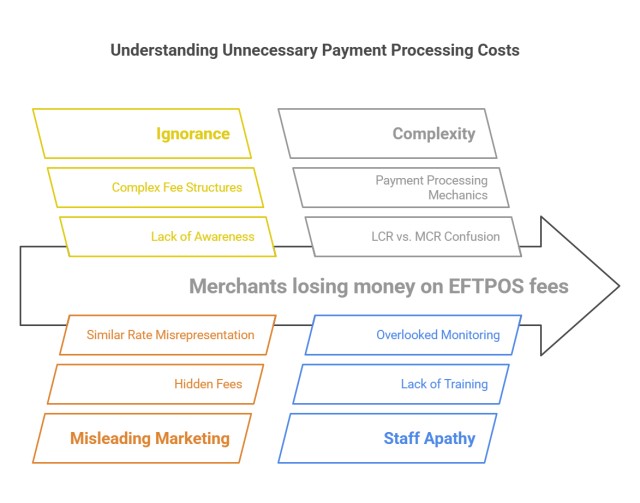
You must position your business for a digital retail environment.

If you want the details of this report, click here


Add new comment

Restricted HTML

  • Allowed HTML tags: <a href hreflang> <em> <strong> <cite> <blockquote cite> <code> <ul type> <ol start type> <li> <dl> <dt> <dd> <h2 id> <h3 id> <h4 id> <h5 id> <h6 id>
  • Lines and paragraphs break automatically.
  • Web page addresses and email addresses turn into links automatically.
CAPTCHA This question is for testing whether or not you are a human visitor and to prevent automated spam submissions. Image CAPTCHA
Enter the characters shown in the image.