
You work hard to find good stock deals all the time. You work all the time to reduce costs, so why give up years of EFTPOS payment flexibility for a deal that only looks good today? Things *will* very soon, and nobody really knows what's happening with EFTPOS. This uncertainty is exactly what puts small Australian retailers at risk of carrying the burden if things shift.
This is why our offer for EFTPOS and Credit Cards have no fixed terms. You do not like it you can walk away, no risk.
Key Takeaways
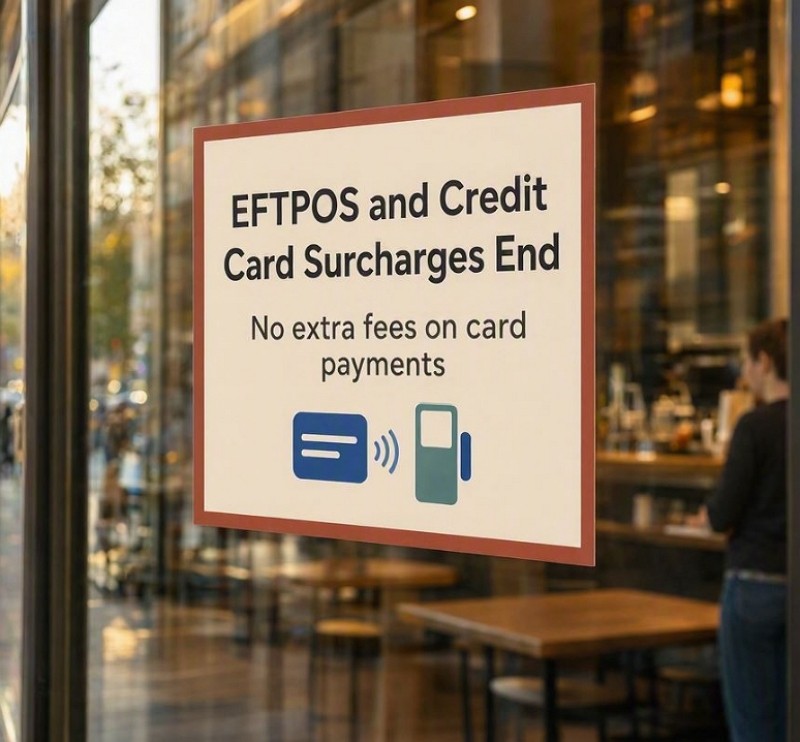
- Card surcharging ends across EFTPOS, Mastercard and Visa networks from 1 October 2026
- Interchange caps fall sharply on the same date.
- Standard fixed EFTPOS contracts let the provider vary fees on 30 days' notice, while the retailer stays locked in.
- Early termination fees on Australian EFTPOS contracts commonly run from $200 to over $2,000, depending on the provider and remaining term.
- Free terminal offers and rentals can change in 30 days.
- Banks and fintechs now offer no-lock-in EFTPOS plans, often at comparable or better rates than fixed-term deals.
Why This Is the Worst Time to Lock In
Fixed-term EFTPOS contracts tie you to one provider for generally 24 to 36 months. There are penalties if you leave early. Signing one now is betting that today's payment system will stay the same. We all know it won't.
On 1 October 2026, the Reserve Bank of Australia's payments reform takes effect nationwide. Wholesale interchange costs will drop significantly, new fees will soon be introduced.
Consider what this means if you sign a fixed-term contract today. You'd be locked into a rate, and right now, nobody, not a salesperson, a bank, or even your accountant can say what a fair rate will be after the changes. That's why flexibility matters more than ever.
The Contract Is a One-Way Street
Most standard EFTPOS agreements let the provider change your fees with little notice, but you don't get the same flexibility. Check the variation clause in your contract. You'll likely see that the provider can adjust rates or charges with just 30 days' written notice. In my experience, they often blame "third-party costs" or "operational changes," which turns out to be often just shifting costs from one part of the bank to another part.
It's a one-sided deal. If their costs increase, you pay more. If your situation changes and you need to switch, you pay the penalty not them.
In all my years working with EFTPOS providers, I've never seen a variation clause used to lower what merchants pay or risks. It's always used to pass on extra terms, cost increases or now we are seeing to add new fees. I've never heard of a provider calling a merchant to say, "Good news, your rate just dropped and we are passing it on to you." If wholesale interchange drops in October and you're on a flat or blended rate, don't expect your provider to pass on the savings. Now more than ever, you need the freedom to switch if you want.
The Free Terminal Isn't Free
A common offer is "$0 terminal rental for your first 12 months." It sounds generous, but once you calculate the costs for the remaining 24 months of a 36-month contract, it's not such a great deal.
After the promotional period, providers usually charge between $18 and $35 per terminal each month. Over two years with two terminals, that adds up to more than $1,000 in rental fees. Costs the promotional offer didn't mention upfront. Compare this to renting month-to-month with no extra fees.
It's simple: the banks *free* year is paid back, with interest, during the years you're locked in and can't leave.
What Happens When Your Business Changes
Businesses change over time. You might sell, downsize, move, or switch POS software, and any of these changes could cause problems if you're stuck in a fixed-term contract.
Sell your shop with 18 months left on the contract, and that bill lands on you. If you sell your shop with 18 months left on the contract, you'll be responsible for the remaining payments unless the provider agrees to transfer the contract which isn't guaranteed. Generally they will have a different bank which is often a problem. Also if you're on a bad deal, the new owners probably won't want to take it over anyway even if its the same bank.
Zero EFTPOS EFTPOS
That model dies on 1 October 2026, because the card schemes' no-surcharge rules will apply across the board. I think most people on this deal are looking at high fees.
You Lose Your Growth Leverage
If your card turnover increases and it likely it will after 1 October you should be able to get a better deal with lower rates. With a no-lock-in plan, you can renegotiate at any time or switch to a competitor offering a better rate. On a fixed contract, you don't benefit from your growth. You're stuck with the rate you signed up for. Major retailers, I know use flexible plans and so quietly negotiate better rates.
What to Insist On Instead
These days, there's little reason to sign a fixed contract when you can get the same or better pricing without the risk.
Before you sign anything, get these in writing:
- No minimum term, or at most a short one with a clearly stated, capped exit fee
- Transparent Interchange++ pricing; try to get details on the interchange, scheme fees and the provider's margin itemised separately.
- Terminal ownership or flexible rental: review the costs.
- Confirmed POS Software compatibility in writing, not just a verbal assurance from the sales rep.
- A matching notice period: if they can vary your terms on 30 days' notice, you should be able to exit on the same notice.
The Bottom Line
October 2026 will change the economics of card payments in Australia. Surcharging will end, wholesale costs will drop sharply, and real competition between providers will begin. Retailers who can move easily will benefit. Those locked into a 36-month contract signed today will spend the next two and a half years paying old rates in a new market.
When the next EFTPOS rep offers you a "great deal" with a fixed term for EFTPOS, there's only one answer that matters: NOT NOW
Written by:

Bernard Zimmermann is the founding director at POS Solutions, a leading point-of-sale system company with 45 years of industry experience. He consults to various organisations, from small businesses to large retailers and government institutions. Bernard is passionate about helping companies optimise their operations through innovative POS technology and enabling seamless customer experiences through effective software solutions.