Point of Sale Software

Here are some Articles from the Blog Subject - AI POS System -

Major AI POS Update

POS SOFTWARE

Your location details, traffic patterns, footfall drivers, profit categories, customer types, competitors, operational constraints, and growth goals.

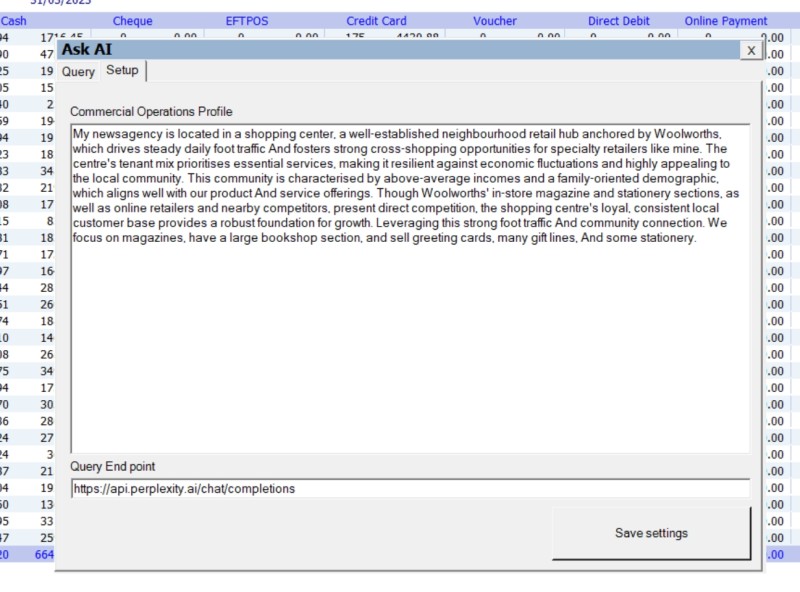
We’ve just launched a big update to our POS System’s AI reporting: the Commercial Operations Profile (COP). This new feature will make your AI reports much more useful. The COP gives a quick overview of your shop, including your location, traffic patterns, what brings people in, profit categories, customer types, competitors, operational limits, and growth goals. With this, your AI business analyst gets the context it needs to understand your business.

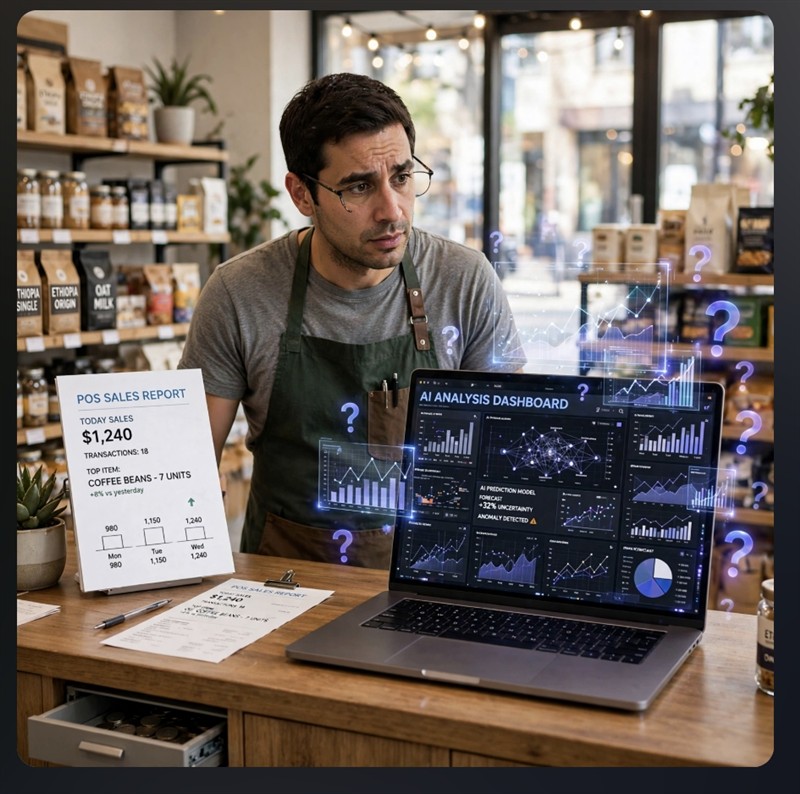
Let me explain. If you printed a POS report and showed it to a bank manager, accountant, or business analyst like me, they could read the numbers, but without knowing what your business does, the figures wouldn’t mean much. For example, selling five dog toys might be insignificant for a supermarket but great for a small kiosk near a train station. The COP adds this context. It turns your POS System’s AI from a simple calculator into a strategic adviser, helping it explain what your numbers mean for your shop, your customers, and your profits.

Info: Without the COP, the AI just gives you numbers. With the COP, your POS System provides tailored, realistic retail analysis every time.

The Reality of Retail Reporting Today

After years of working with independent Australian retailers, I know what the end of the month looks like. You find a quiet moment, sit in the back office, and open a spreadsheet or POS report. You see what you sold, but the data doesn’t clearly show what you should do next.

Recently, Artificial Intelligence (AI) promised to change all of this. Retailers were told that AI could look at their sales data and magically offer brilliant business advice. However, many who have tried asking the current AI for help have been disappointed. All they got was a textbook answer, typically "run a 50% off storewide sale" or "hire a social media manager." Those answers are useless for most analyses.

Now, why does this happen? Well, the simple answer is: there is no business context. Yes, the AI can summarise numbers, but it cannot explain what they mean. Until now, you had to manually add business context each time you wanted a deeper analysis. If you tried with AI, you had to type out your entire store history to get a good answer.

Our new AI POS reporting software changes everything. You now create a form for your business. You save it in your system, and it acts as your personal space.

Why Your POS System Needs a Commercial Operations Profile (COP)

A good AI retail software needs to understand the physical reality of your store. Here are five reasons why the Commercial Operations Profile turns basic reports into powerful POS business intelligence.

1. It Understands Your Normal Baseline

Raw data lacks context. Let's say a generic AI looks at your sales report. It notices that your "Greeting Card" sales dropped by 15% in February. The AI will immediately flag this as a major business failure and tell you to panic.

However, if your COP states that your store is located in a coastal holiday town, the AI understands the bigger picture. It knows you have a massive transient tourist population in January. Therefore, the AI realises that a drop in February is a normal seasonal baseline return. It is not a crisis. It will tell you that your sales are perfectly on track for the season.

2. It Focuses on Profit, Not Just Foot Traffic

An AI analysing a spreadsheet will naturally focus on the biggest numbers. If selling Lotto makes up 60% of your top-line revenue, an unguided AI will tell you, "Lotto is your most important category. Dedicate more floor space to it."

As an experienced retailer, you know this is terrible advice. The profit margins on Lotto are tiny. The COP explicitly separates your "Footfall Drivers" (what brings people in) from your "Profit Drivers" (what actually pays the rent).

When the AI reads your sales report now, it looks through a profit lens. It will give you actionable advice, like: "Your Lotto traffic was up 10% this week, but your premium gift sales remained flat. You are failing to convert that extra foot traffic."

3. It Highlights Cross-Selling Failures

When you look at basket-size data in your POS dashboard, you need to know what should be happening. This helps you spot what is not happening.

For example, your shop might act as an Amazon or Australia Post parcel collection point. That is a great footfall driver. If your COP lists your target cross-sell as "Parcel pickup + Greeting Card," the AI will specifically scan your transaction report looking for that exact combination.

It can then report back: "Only 2% of parcel customers bought a card this month. The counter-placement strategy is not working. Try moving the card spinner closer to the parcel pickup zone."

4. It Respects Your Operational Limits

Standard retail analytics software assumes you have unlimited resources. If an AI notices that Friday afternoons are your most profitable time, it might suggest, "Double your staff on Friday afternoons to capture more sales."

That is useless advice if you run a small family business. If your COP clearly states your constraints—such as "Owner-operated, no additional staff budget"—the AI adapts its analysis.

Instead of suggesting more staff, it will offer a practical solution: "Since you cannot add staff on Fridays, you must streamline your checkout operations. Pre-bundle your top-selling Friday items to speed up the queue."

5. It Aligns Data with Your Strategic Goals

A modern point-of-sale system captures hundreds of metrics every day. Without direction, the AI does not know which numbers you actually care about right now.

Because the COP includes your "Top 3 Goals" (for example, growing your parcel-to-purchase conversion rate), the AI prioritises that specific metric. It will ignore distracting data points, like a slight dip in newspaper sales, to keep you focused on your main objective.

How to Build Your Commercial Operations Profile

To help you create your COP quickly, we have built a simple questionnaire. To answer it, you do not need to look up exact numbers. A decent estimate is perfectly fine. It does not take long, one of the retailers using our newsagency POS software told me it took him eight minutes to complete the questionnaire.

Please take a few minutes to answer the questions below. I suggest you copy and paste this list into a blank document, then fill it out under each question.

Section 1: Business Identity and Premises

First, we need to establish the physical asset.

  • Trading Name: What is the name on your door?
  • Full Address: Include your suburb, state, and shopping centre name if applicable.
  • Business Structure: How many years have you been in operation? Is it owner-operated or managed?
  • Building Type: Select one: Strip shop / Internal shopping centre / Stand-alone building / Kiosk.
  • Positioning and Visibility: Are you a corner site, an end-cap, middle of the run, or right next to an entrance?
  • Visibility Assets: What draws the eye from the street? Do you have glass frontage, clear counter sightlines, or large window signage?
  • Lease Status: What is your tenure? (For example, 3+3 years remaining).

Section 2: Location and Traffic Mechanics

Next, we define how people move around your store.

  • Traffic Flow: Is your shop in a "high-flow" path where passing traffic is guaranteed? Or are you a "destination" location where customers must make a specific effort to find you?
  • External Anchors: List the top three nearby drivers bringing people to your area. This could be a Woolworths, a train station, a post office, or a popular cafe.
  • Immediate Neighbours: Who is immediately to your left, right, and opposite?
  • Peak Trading Windows: What are your busiest days of the week and busiest hours of the day?
  • Quietest Periods: What days and times are consistently dead?

Section 3: The Revenue Engine

This is the most critical part. We must separate traffic from profit.

  • Top Footfall Drivers: List the top three to five items or services that physically bring the most people in. Include them, even if they are low-profit (for example, Lotto, parcels, newspapers, or transport cards).
  • Top Profit Drivers: List the top three to five categories that generate your highest gross profit dollars. Think about greeting cards, premium gifts, printer ink, or educational toys.
  • Category Trends: Which categories in your store are currently growing, and which are declining?
  • Common Cross-Sells: What items do customers frequently buy together? (For example, "Parcel pickup + greeting card").

Section 4: The Customer Base

An AI needs to know exactly who it is talking to.

  • Traffic Split: Estimate the percentage of your customers. Are they Regular Locals (%), Passing Transients (%), or Centre Staff (%)?
  • Top 3 Customer Personas: For each, detail who they are, what they buy, and when they come in. For example: Persona 1: Elderly locals buying newspapers and Lotto on Saturday mornings.

Section 5: Digital Footprint and Promotions

We need to establish your current marketing baseline.

  • Google Business Profile: Do you have one? What is your approximate star rating and review count?
  • Social Media: Which platforms do you use, and how often do you post?
  • Website/E-commerce: Do you sell online? What platform do you use?
  • Customer Database: Do you collect emails or SMS numbers? What is your approximate list size?
  • Promo History: What specific promotions, bundles, or loyalty offers have worked well in the past? What failed?

Section 6: Operations, Competition, and Goals

Finally, we set the AI's boundaries.

  • Operational Setup: What point of sale system do you use? Are there any major bottlenecks in your inventory processes?
  • Constraints: Do you have strict limits regarding staff capacity, marketing budget, or shopping centre rules?
  • Local Competitors: List your top two local competitors for your high-margin items. What specific advantage do they have? (For example, "Officeworks beats us on ink range").
  • Top 3 Business Goals: What are your primary targets for the next 90 days? (For example, increase average basket size).

The Secret to Great AI COP

Once you have answered these questions, you should not just paste your conversational answers directly into your POS System, as some suggest; there is a much better way to do it. AI programs do not behave as humans do. To get the AI to perform perfectly, the output needs to be in what we software engineers call dense data-point formatting.

This means stripping away all grammar, conversational padding, and full sentences. We present the raw facts as compactly as possible.

Here is a clear example of the difference between human writing and computer formatting:

Narrative Formatting (How humans write and read):

"The store is a stand-alone building located on a busy corner. It gets a lot of foot traffic from the local train station every morning between 7 am and 9 am. Because of this, our biggest seller by volume is newspapers, but we don't make much money on them. We make most of our profit from selling premium Hallmark greeting cards."

This is 57 words. This has a high word count but not much actual data.

Dense Data-Point Formatting (How AI likes to read):

Premises: Stand-alone, corner position.
Key Anchor: Train station.
Peak Traffic: 7:00 am - 9:00 am.
Footfall Driver (High Volume): Newspapers.
Profit Driver (High Margin): Hallmark greeting cards.

This is only 28 words. We have a much lower word count, but we deliver the same information with perfect clarity.

Formatting your COP this way gives you two major advantages.

Memory space

It saves memory space. AI models have a limited working memory. Your COP must be short and sharp. Ideally, it should be between 300 and 500 words. The shorter and denser it is, the more "brainpower" the AI has left actually to analyse your sales reports.

AI hallucinations

This is the most important, as it reduces AI hallucinations. Have you ever noticed your AI making things up or guessing wildly? We call these "hallucinations." This usually happens because the AI gets confused. Strict data-point formatting creates absolute clarity. It forces the AI to stick to the facts you provided.

The Magic Prompt to Generate Your Profile

You do not need to write this type of dense format yourself; in fact, I recommend that you use a free AI tool (like ChatGPT or Gemini) to translate your human answers into computer-friendly data.

Copy the prompt below, paste it into your AI tool, and paste your filled-out questionnaire answers right at the bottom.

Role: Act as a Senior Retail Analyst.
Task: Analyse the provided Business Owner Questionnaire data and generate a highly accurate, concise Commercial Operations Profile (COP).
Formatting Rules: Output must be strictly under 2,000 characters (approx. 300 words). Use dense data-point formatting (e.g., Key: Value). Do not use introductory or concluding paragraphs. Eliminate all conversational filler. Use Markdown headers and bullet points.
Structure: Provide a structured summary of: 1) Business Identity & Premises, 2) Location Mechanics & Traffic, 3) The Revenue Engine (Highlighting the Gap between Footfall vs Profit), 4) Customer Personas & Digital Health, 5) Competitors & Operational Constraints, and 6) Top Growth Opportunities based on their stated goals.

Input Data:
[Paste your completed questionnaire answers here]

What Your Final Profile Will Look Like

When you hit enter, the AI will spit out a beautifully clean profile. Here is a sample of what the final COP looked like in a test store. I created Parkmore Newsagency. Notice how clean and sharp the data is.

Commercial Operations Profile: Parkmore Newsagency

1) Business Identity & Premises

  • Trading Name: Parkmore Newsagency
  • Address: Parkmore Shopping Centre (internal)
  • Structure: 5 years, owner-operated
  • Positioning: Middle-of-run, quiet section. Glass frontage is the only visibility asset.
  • Lease: 2+3 years remaining

2) Location Mechanics & Traffic

  • Flow: Mixed (some passing + destination)
  • Anchors: Coles, Woolworths, Post Office
  • Neighbours: Left – doctors surgery. Right – discount shop. Opposite – women's dress shop.
  • Peak: Saturday mornings
  • Quiet: Monday afternoons

3) The Revenue Engine

Gap: High-footfall/low-margin (Lotto, magazines, stationery) vs. high-margin/low-traffic (greeting cards, gifts).

  • Footfall drivers: Lotto, magazines, basic stationery.
  • Profit drivers: Greeting cards, premium gifts, high-end stationery.
  • Trends: Gifts are growing. Magazines are declining.
  • Cross-sells: Lotto + gifts. Gifts + greeting cards.

4) Customer Personas & Digital Health

  • Traffic Split: 45% regular locals | 50% passing transients | 5% centre staff.
  • Personas:
    • Elderly idle walkers (buy Lotto and magazines).
    • 35-year-old mums with kids (doing the weekly grocery shop).
    • 45-year-old women shoppers (looking for quick gifts).
  • Digital Health: Google 3 Stars (4 reviews). Facebook 1x/month. No website or customer database.
  • Promos: Christmas/Easter only (no proven winners yet).

5) Competitors & Operational Constraints

  • Key Rival: Nearby Dollar Store (beats us on card price, but has inferior quality).
  • Constraints: Marketing budget is severely limited. Centre management bans coffee sales.
  • Operations: Stable POS System, no inventory bottlenecks.

6) Top Growth Opportunities (Tied to Goals)

  • Drive gift sales via existing cross-sells (bundle Lotto with gifts).
  • Convert the 50% passing transient traffic on Saturday peaks into higher-margin basket sales.
  • Target the elderly and mum personas with quality card bundles to avoid a price war with the dollar store.
  • Quick digital wins: Boost Google reviews, increase Facebook frequency, and capture emails at the till.

The Final Step: Putting Your Retail Analytics Software to Work

Once you have your clean, dense profile, review it to ensure everything looks correct. If it has errors, you are asking for trouble. Now log into your POS System and paste that final profile directly into our AI reporting settings.

Once your COP is saved, you are ready to go. Run an end-of-month sales report and ask any specific business question.

For example, you can ask: "Based on my profile, why did my profit margin fall this month, and what low-cost actions should I take next week to fix it?"

You can also ask it for daily operational help: "Based on my peak traffic times and staffing constraints, write me an optimal staff roster for next week."

You will be amazed by how incredibly useful, realistic, and profitable the answers become. Once your AI truly understands your retail business, there is no limit to the insights you can discover. It stops being a calculator and starts being a true business partner.

If you are tired of generic advice and want a system that actually helps you grow, you need the right tools. Suppose you want to see exactly how our new AI POS reporting software can transform your business. Let's get your technology working harder, so you can focus on making sales.

Written by:

Bernard Zimmermann


Bernard Zimmermann is the founding director of POS Solutions, a leading point-of-sale system company with 45 years of industry experience, now retired and seeking new opportunities. He consults with various organisations, from small businesses to large retailers and government institutions. Bernard is passionate about helping companies optimise their operations through innovative POS technology and enabling seamless customer experiences through effective software solutions.



Add new comment

Restricted HTML

  • Allowed HTML tags: <a href hreflang> <em> <strong> <cite> <blockquote cite> <code> <ul type> <ol start type> <li> <dl> <dt> <dd> <h2 id> <h3 id> <h4 id> <h5 id> <h6 id>
  • Lines and paragraphs break automatically.
  • Web page addresses and email addresses turn into links automatically.
CAPTCHA This question is for testing whether or not you are a human visitor and to prevent automated spam submissions. Image CAPTCHA
Enter the characters shown in the image.

AI Retail Pricing

POS SOFTWARE

Retail pricing strategy


Can Artificial Intelligence take part of the headache out of pricing your stock? Answer: It can, but, as with everything, you need to use it carefully.

The Daily Struggle of Setting Prices

In a retail setting, the right retail price for your products is one of your most frustrating tasks. Supplier costs constantly change. You need to stay competitive with others; however, you also need to make enough profit to keep your doors open. Historically, people often have to walk down the street with a half-dozen items in mind to check competitor prices. It's a slow, clunky process.

Because of this, many retailers are excited about the promise of AI retail pricing. As with everything, you need to understand how retail AI technology works in the real world.

What Are AI Price Look-ups Supposed to Do?

When you hear about AI price look-ups, the pitch sounds like a dream come true. You press a button, you select an item, perhaps a popular brand of local honey or a top-selling magazine, and instantly, you get:

Checks your pricing history

It shows you what you charged for this item last year compared to today, helping you track how your prices have grown over time.

Calculates a suggested price

It uses your current wholesale cost to aim for a healthy profit margin. This stops you from accidentally pricing an item below cost.

The AI scans the local market

It gives you a broad view of what other local shops are charging, so you know where your price sits.

This sounds like magic, and it is not true.

Firstly, how AI Actually Thinks

To use AI safely, you must understand how it actually thinks. AI is not a living brain. It's not a tiny person sitting inside your computer.

AI, as a massive pattern-matching machine, reads millions of pages of text on the internet. When you ask it a question, it quickly searches its memory to find words that usually go together. It doesn't know the answer. It just predicts the most likely answer based on what it has read. This is a brilliant skill when you want the AI to write an email for you. It's fantastic at summarising a long lease document. However, this same skill makes it very dangerous when you need precise, factual, live numbers.

The Hidden Danger of the AI Illusion

AI is not a live data feed; it doesn't have a secret camera looking at the shelves of the shop next door. This is what we call the "Live Data Illusion." It's one of the biggest traps for retailers using AI retail pricing today. When you ask an AI tool to check a competitor's price, it scrapes public websites to find numbers and then guesses the price based on historical patterns. The AI is guessing based on what it read on the internet weeks or months ago.

A real-world example

Let's look at a real-world example to show the problem.

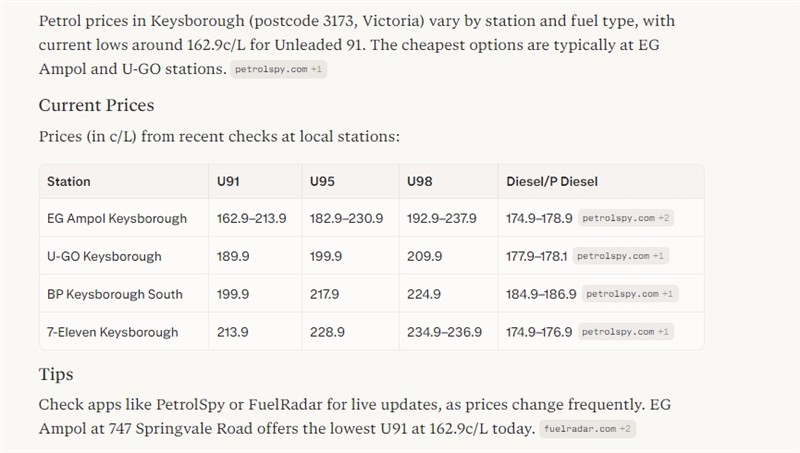
I asked an AI tool for the price of fuel in my suburb, Keysborough, Victoria, today. The AI confidently told me the following:

Using AI to get current petrol prices\


Now sounds like a sweet deal, but it's nonsense; no one will sell me petrol at 162.9c/L today.

I actually decided to drive down Springvale Road and look at a few petrol stations, the cheapest on offer I could find is

U91 at 236.9 c/L
U95 is 249.9 c/L
U98 is 259.9 c/L
Diesel 285.9 c/L

As far as the tip, 747 Springvale Road was not the cheapest and was offering U91 at 249.9/L.

Now, why did the AI get it so wrong? Because it reads an old price on a web page. It didn't plug into the live, real-time computer system at the petrol station. Then what the AI did was stitch together these pages it found on the internet and presented them as today's truth.

Now, the same flaw occurs when you check other retail stock prices in your POS system. Now petrol is a well-advertised product; imagine what it's doing to less-advertised prices like chocolates. There are several problems here. A typical problem is that the AI looks at an old web page showing $7.99 for a special Christmas promotion from three months ago. But that promotion is over, and everyone else is back to selling it for $12.99. The other issue is that, unlike petrol, companies actively block AI bots from reading their live prices online. This means AI can't see what these companies are charging today.

Info: If you unquestioningly trust the AI, you'll slash your prices for no reason. You'll throw away your hard-earned profit.

When Confident Answers Lead You Astray

Now it can be worse as AI is built to sound confident. Developers designed it to be helpful and polite, but not to say "I'm not sure, you should probably check this yourself." It's very hard to argue with AI because it is so emphatic.

How to Use AI Price Look-ups Safely

So, should you ignore AI price look-ups completely? Absolutely not. They're a powerful and exciting tool when used correctly.

You need to treat the AI like a very smart, but slightly inexperienced, junior assistant. You'd never let a brand-new staff member change all your prices without checking their work first. You must treat AI the same way.

Here are four golden rules for using AI retail pricing tools safely.

Rule 1: Use AI as a Guide, Not an Oracle

Treat any price suggested by AI as a second opinion. It's a helpful hint, not the final word. Never rely on an AI tool for live competitor pricing. You may still need to make a trip to see current prices. If the system suggests a price, pause and think about it. Does it feel right for your specific neighbourhood? Does it make sense for your typical customer? You know your local community better than a computer ever will.

Rule 2: Focus on Broad Patterns, Not Exact Numbers

AI is fantastic at spotting big trends. Instead of asking for an exact price, use the AI to look at the bigger picture.

For example, notice if the AI says prices in a certain category are trending upwards. If the software highlights that greeting cards are generally selling for more this year, that's valuable information. You can use that trend to raise your prices across the board gently.

Rule 3: Always Verify Your Own Data First

Before you change a price, you must cross-check the AI suggestion against your own numbers. Look at your current wholesale cost. Look at your minimum required profit margin.

If the AI suggests dropping a price to $10, ask yourself if you still make money at that price. If the answer is no, ignore the AI. Your software holds your true wholesale costs. Always let your true costs dictate your final decision.

Rule 4: Do Your Own Human Scouting

Nothing beats walking into a competitor's shop and looking at their shelves. You should still run a short, periodic scouting routine.

Pop into nearby stores once a month. See how they display their products. Look at their actual price tags. This real-world check keeps your AI tool honest. It gives you a realistic view of what's truly happening on your street.

Info: There is specialised software available for price look-ups; both Google and Bing have a shopping option, Amazon can be useful and has a very sophisticated price look-up system, and there are other specialised price look-up software like PetrolSpy, which I use a lot. Be careful, as they have errors too, but they can give you a guide.

The Final Word

The technology is moving incredibly fast. In the next few years, AI tools will get much smarter. They'll become better at understanding live data. They'll integrate even deeper into the retail software you use every day. Today, however, we can only use what we have.

In summary, AI price look-ups are a brilliant addition to your Point of Sale (POS) system, provided you know their limits. They're fantastic for spotting broad trends, catching pricing mistakes, and saving you from tedious spreadsheet work.

However, they're incredibly dangerous if you treat them as a live data dashboard. Always remember the petrol station trap above.

Written by:

Bernard Zimmermann


Bernard Zimmermann is the founding director of POS Solutions, a leading point-of-sale system company with 45 years of industry experience, now retired and seeking new opportunities. He consults with various organisations, from small businesses to large retailers and government institutions. Bernard is passionate about helping companies optimise their operations through innovative POS technology and enabling seamless customer experiences through effective software solutions.



Add new comment

Restricted HTML

  • Allowed HTML tags: <a href hreflang> <em> <strong> <cite> <blockquote cite> <code> <ul type> <ol start type> <li> <dl> <dt> <dd> <h2 id> <h3 id> <h4 id> <h5 id> <h6 id>
  • Lines and paragraphs break automatically.
  • Web page addresses and email addresses turn into links automatically.
CAPTCHA This question is for testing whether or not you are a human visitor and to prevent automated spam submissions. Image CAPTCHA
Enter the characters shown in the image.

AI Reporting vs POS Systems reporting today

POS SOFTWARE

AI reports vs POS Systems reports


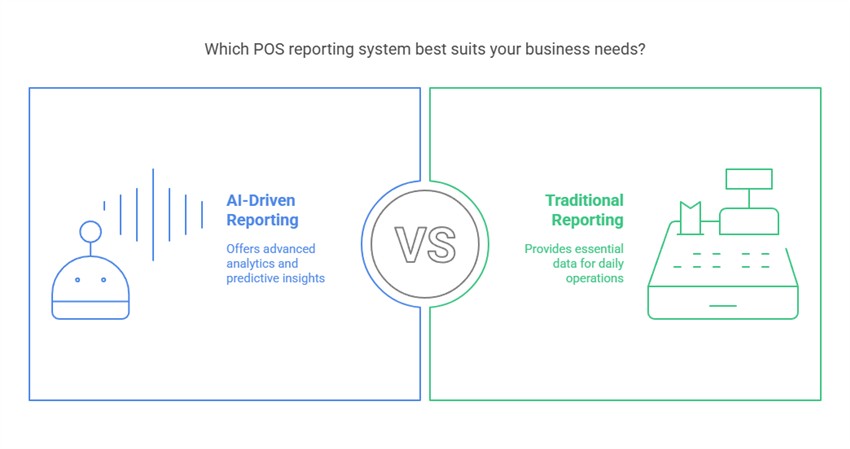
Today, AI-driven POS Systems are revolutionising the information flow to retailers. AI reporting offers advanced analytics and predictive insights compared to traditional POS system reporting. I love its ability to allow users to ask questions and research topics, enabling us to make more informed business decisions. Train your model with your information, and ask questions. If you do not understand something, you can ask for more information. It is brilliant. If anyone wants to attend a webinar on these functions, let me know.

While AI-powered analytics often deliver revolutionary insights, most users usually do not need them. Many retailers find that traditional POS reporting provides the information required for day-to-day business operations, which remains today's cornerstone of retail reporting.

The Trust Advantage of POS System Reporting

In business, POS systems have been refined over the decades, offering reporting functionality that captures actual transactions. Almost all errors have been worked out of the system, so retailers can confidently use this information to make business decisions.

The challenge with AI reporting systems lies in "hallucinations". These occur when the AI often generates plausible but factually incorrect information. Recent evaluations of advanced AI systems indicate hallucination rates of about 1.1% on simple tasks, and I have seen figures of 30-50% in complex tasks reported. What happens is that the AI, when asking your question, goes off track. It then moves along this track into nonsense. What is dangerous is that sometimes it appears plausible and can be hard to spot. It creates significant risks for retailers who might make substantial decisions based on inaccurate analysis. While doing a study, a pet shop retailer in Brisbane considered increasing its stock levels in dog toys based on an AI report trend. That trend did not exist. If they had followed it, they could have brought much excess inventory. Luckily, they picked it up. By contrast, when a POS system shows a 24-month history of a product sold, that figure represents a real figure.

Operational Speed and Accessibility

Timing becomes critical in retail environments where rapid decision-making directly affects sales outcomes. Our modern POS systems generate comprehensive reports within seconds for free. The system does not require an internet connection or an AI subscription.

Industry-Specific Relevance for Australian Retail

POS systems are designed specifically for retail operations. It incorporates Australian terminology and KPIs that align directly with Australian business practices. Standard POS reports include daily sales summaries, staff performance metrics, inventory turnover rates, and GST calculations, all of which conform to Australian requirements. An AI report, while powerful, often struggles with Australian-specific requirements. We have noticed that an AI analysis usually uses international accounting terminology that requires translation. When doing the report, we must do Google searches to determine what is being said. I have discussed this problem in depth here when we ran 100s of AI reports. 

Security and Compliance for Australian Businesses

We have a big problem here, as much of the information in your POS System is restricted. For example, in Australia, we have strict privacy laws. Your POS systems incorporate security features specifically designed for this retail environment. These security measures have evolved over many years and are focused on retail-specific security requirements. Using AI for business reporting typically involves transmitting all your business data to third-party cloud services, raising concerns regarding data storage locations, retention policies, and potential use of proprietary business information. More dangerous is that all your information can be accessed by people in your organisation. Its hard to restrict parts of your payroll information so some of your staff might get what others earn. 

Transparency in Reporting Methodology

When a POS system identifies top-selling products, the calculation methods are transparent and verifiable. You can do the calculation manually to figure out how it works. If the results appear unusual, you can easily check the report. This transparency builds confidence in the process.

AI-generated reports generally suffer from what we call "the black box problem." We get a result, but no one knows the reasoning behind its recommendations, making it difficult for anyone to understand the findings.

Consistent Reporting Over Time

POS reporting remains consistent over time. Once a retailer masters it, they know how to use it, what it gives them, and how to make meaningful comparisons over time.

AI systems face challenges with what we call "model drift." When you do the same thing, use the same prompts, you probably get different responses, each run of a report gives a different answer.Each run is an experiment. 

When to Use Each Reporting Type

The clear advantages of traditional POS reporting for day-to-day retail operations, POS reporting excels in managing daily operations, staff performance evaluation, inventory control, cash flow monitoring, tax compliance, and comparative performance analysis. These functions form the operational backbone of Australian retail businesses.

I like to think of AI reporting as going to see an expert. They often have great knowledge in a particular area of your business and can help you examine the situation. They can tell you about subtle patterns in the industry and what is likely to happen, giving you insights, but you need to be very careful about accepting their advice without further thought. What we love is its ability to allow you to ask questions and explore.

Implementation Recommendations for Australian Retailers

For Australian retailers considering their reporting, you need a robust POS System that provides the fundamental business metrics.

When evaluating AI tools, take their advice with a grain of salt. We expect that in ten years, AI reporting will take over, but not yet. We are all experimenting with it. Its a lot of fun but think of it as science experiment.


Written by:

Bernard Zimmermann


Bernard Zimmermann is the founding director at POS Solutions, a leading point-of-sale system company with 45 years of industry experience. He consults to various organisations, from small businesses to large retailers and government institutions. Bernard is passionate about helping companies optimise their operations through innovative POS technology and enabling seamless customer experiences through effective software solutions.

 

Add new comment

Restricted HTML

  • Allowed HTML tags: <a href hreflang> <em> <strong> <cite> <blockquote cite> <code> <ul type> <ol start type> <li> <dl> <dt> <dd> <h2 id> <h3 id> <h4 id> <h5 id> <h6 id>
  • Lines and paragraphs break automatically.
  • Web page addresses and email addresses turn into links automatically.
CAPTCHA This question is for testing whether or not you are a human visitor and to prevent automated spam submissions. Image CAPTCHA
Enter the characters shown in the image.

Testing AI Chatbot pricing in a retail shop

POS SOFTWARE

AI testing evaluation


Pricing products effectively remains one of the most challenging aspects of retail management. It's a problem. You get a product you have never handled; how do you price the item for sale now? Getting it wrong can significantly impact profitability and competitiveness. Many people today have suggested that the new AI Chatbots can help, but none, as far as I know, have shown any proof of this. So, to address this problem, we conducted a comprehensive evaluation of six free AI chatbots to assess their effectiveness in pricing recommendations for Australian retailers.

Our Testing Methodology

We tested a scenario of a small newsagency in Keysborough, a typical Melbourne suburb located in a strip shopping centre. The test focused on pricing a specific product: a Pilot Frixion Ball Erasable Gel Pen pack containing three pens (black, blue, and red) with a fine 0.7mm tip using only free CHATbots.

Why only Test Free AI Tools for Stock Pricing?

We restricted the test to free AIs because most retailers are only now experimenting with AI chatbots. Few have purchased an AI Chatbot plan, whose costs now vary from about $25 to $200 plus GST (I have a customer who uses AI in our POS Software and runs a bill of up to $10 daily). Once you get into paid plans, there is a massive difference in what you get.

Free tools can offer an accessible starting point, but not everyone is equal for all tasks, as you will see here.

So, we limited our evaluation to these six popular free AI chatbots:

ChatGPT (OpenAI)

Claude (Anthropic)

DeepSeek

Google AI

Grok 3

Qwen

We wanted to test meta AI, which had announced a significant update, but unfortunately, it was not available when this report was written.

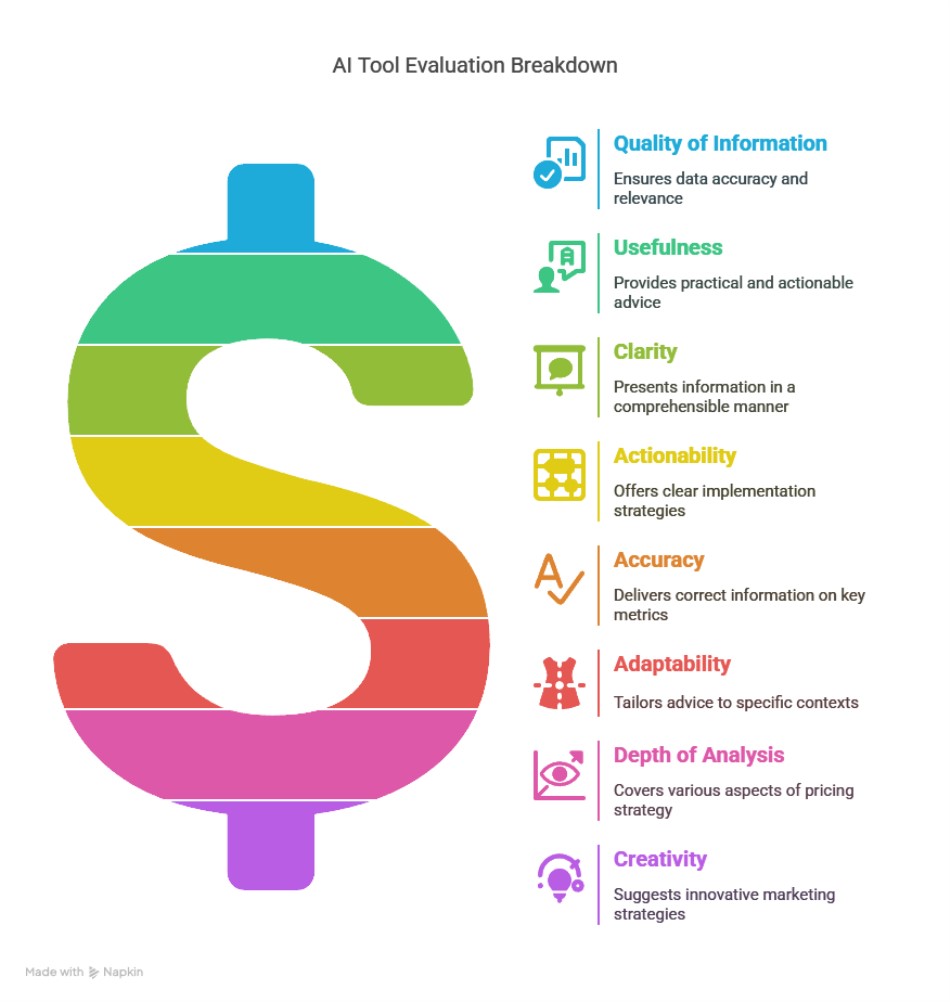
After multiple iterations to refine our approach, we developed a standardised prompt that described the retail location, business type, and product specifications. We then evaluated each chatbot's response based on nine key performance indicators. It all took a lot of time.

Evaluation Framework

Each AI tool was assessed across nine KPIs, with each scoring out of 10, giving us a maximum possible score of 90.

Quality of Information

Accuracy and relevance of data regarding the product, competitors, and market conditions

Usefulness

If the advice is impractical, what is the point of getting it?

Clarity

We are all busy people; we need something well laid out and comprehensible.

Actionability

We wanted clear, implementable recommendations

Accuracy

AI Chatbots do make errors and mistakes. We want correct information on costs, retail prices, and market trends

Adaptability

Not surprisingly, we found that to price appropriately in local retailing, the advice needs to be for a specific location and a store's customer demographics

Depth of Analysis

Besides price, we would like advice on various pricing strategy aspects

Creativity

It would be lovely to get information on innovative suggestions for marketing, e.g. bundling, promotions, or other sales strategies

Customer-Centric Approach

Not all customer segments react to pricing similarly, so we want to know how each responds. You rarely care if you get too much information.

Results Summary


Pricing products for different chatbots

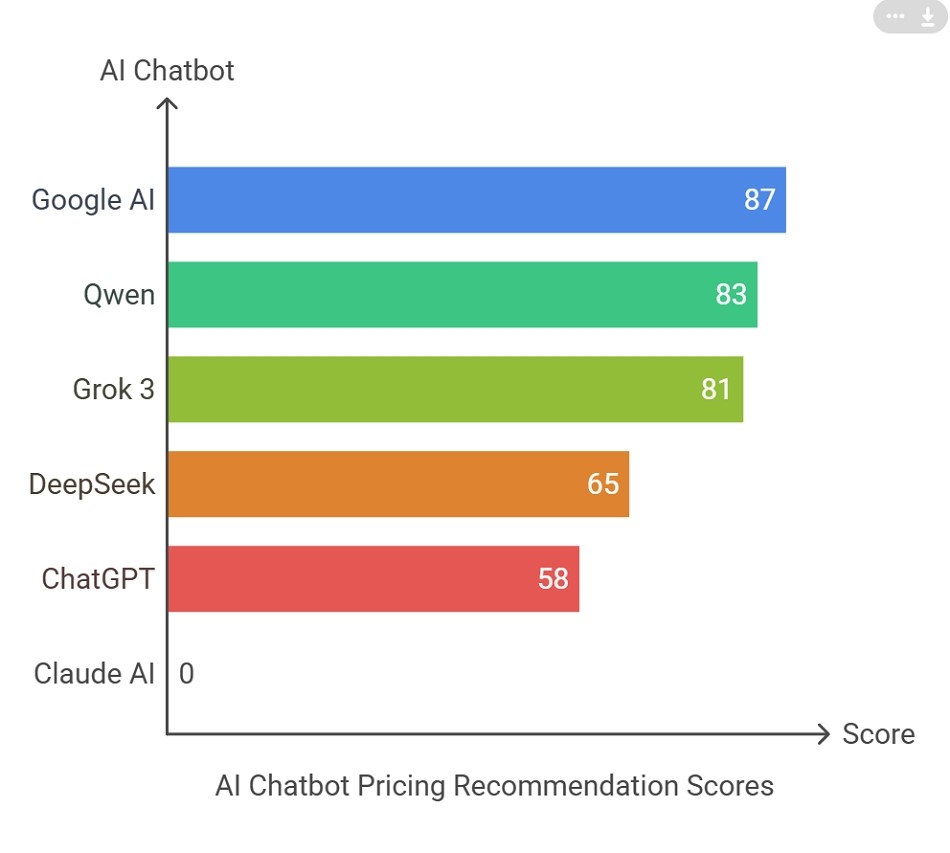
The performance of each AI chatbot is summarised in the table below:

AI Tool  Price Range  Score (out of 90)
Google AI $9.99–$10.99 87 (winner)
Qwen $9.99 83
Grok 3 $9.49–$9.99 81
DeepSeek $12.99–$13.99 65
ChatGPT $11.99–$12.99 58
Claude AI N/A Eliminated

Notably, the top three performers delivered remarkably similar price recommendations, suggesting a similar practical use by a retailer on the top tools.

Detailed Analysis of Each AI Tool

1. Google AI (Score: 87/90)

Strengths:

  • Provided accurate pricing recommendations based on local competitor analysis, correctly identifying Coles' price range of $9.50–$14
  • Suggested appropriate margins of 35–50%, aligning with industry standards
  • Delivered a logically structured report with clear reasoning

Areas for Improvement:

  • Some sections contained overly technical markup calculations that would be challenging to understand.
  • User interface could be more intuitive for retailers without technical expertise

Key Insight:

Google AI excels at tracking and analysing local competitor prices, making it highly effective for crafting a pricing strategy.

2. Qwen (Score: 83/90)

Strengths:

  • Proposed innovative bundling strategies, such as pairing pens with notebooks at $12.99 to increase perceived value
  • Included practical promotional messaging suggestions (e.g., "Save $1 vs Coles!")
  • Presented information in an accessible, actionable format

Areas for Improvement:

  • Assumed a wholesale cost of $6.50, which appeared to be unrealistically low based on market research

Key Insight:

Qwen's focus on bundling opportunities and targeted promotional strategies makes it particularly useful for retailers looking to maximise revenue through upselling techniques.

3. Grok 3 (Score: 81/90)

Strengths:

  • Provided detailed customer segmentation analysis, correctly identifying pensioners as a key demographic in the Keysborough area
  • Recommended a four-week price testing strategy to refine the pricing approach based on actual sales data

Areas for Improvement:

  • Suggested profit margins were lower than industry standards
  • Report contained unnecessary repetition

Key Insight:

Grok 3's demographic analysis capabilities make it particularly valuable for retailers to align pricing strategies with local customer profiles.

4. DeepSeek (Score: 65/90)

Strengths:

  • Effectively highlighted product features (such as erasable ink) as unique selling points
  • Suggested strategic product placement near complementary items to encourage cross-selling

Areas for Improvement:

  • Recommended pricing ($12.99–$13.99) significantly exceeded competitor rates
  • Technical terminology like "left-digit effect" was used without explanation. A left-digital effect charges a $10 item as $9.99. Did you know that? We did not know until we looked it up.

Key Insight:

DeepSeek appears better suited for premium or specialty product pricing than standard retail items with established market positioning.

5. ChatGPT (Score: 58/90)

Strengths:

  • Provided a well-written, easily comprehensible report

Areas for Improvement:

  • Wrong information, e.g. it inaccurately estimated competitor pricing ranges
  • Did not check the local pricing of the product
  • Lacked depth in analysis and failed to provide sufficiently actionable recommendations

Key Insight:

In our test, ChatGPT's generalist approach proved inadequate for the nuanced requirements of a retail pricing strategy in a shop in the Australian market.

6. Claude AI (Eliminated)

Claude AI was disqualified from the final evaluation due to its inability to access real-time data and lack of localisation features for the Australian market, rendering its recommendations useless.

Key Findings and Implications

If looking at an AI Chatbot, you need to look at:

Real-time competitor analysis

You will not be able to do a good job of pricing if you do not have local information; this led to a pricing recommendation by ChatGPT that was disconnected from market realities.

Value-added bundling recommendations

Does it offer ideas to sell the product

Demographic-specific insights

In most shops, there are several different customer demographics, and these when pricing needs to be considered.

Overly technical presentations

Some Chatbots made us feel that the complexity was excessive, making the report difficult even though we told them not to make it complex.

Conclusion and Recommendations

For Australian SMB retailers seeking to use AI tools for pricing, Google AI, Qwen and Grok 3 emerged as the best due to their accuracy in competitor tracking and logical approach to margin calculations. Any of these can do the job well. If I were pricing an item and wanted some advice, any of these three Chatbots would give me good advice. As there must be a winner, Google AI won.

If you are interested in looking into this technology, I would suggest:

  1. Testing multiple free AI tools to identify which best aligns with your specific business needs
  2. Please don't assume the chatbot knows your local market conditions; the more you tell it, the better. You are better off assuming nothing.
  3. Check the AI report, as wrong information was sometimes supplied.
  4. Gradually expand your AI Chatbot over time.

This research demonstrates that free AI chatbots can provide valuable pricing insights for Australian retailers, though their effectiveness varies significantly across tools. By selecting the appropriate AI assistant and providing relevant contextual information, retailers can enhance their pricing strategies without investing in expensive subscription services.

Have you tried any of these tools yourself doing this type of test? Please share your experiences in the comments below!

Written by:

Bernard Zimmermann


Bernard Zimmermann is the founding director at POS Solutions, a leading point-of-sale system company with 45 years of industry experience. He consults to various organisations, from small businesses to large retailers and government institutions. Bernard is passionate about helping companies optimise their operations through innovative POS technology and enabling seamless customer experiences through effective software solutions.
 

Add new comment

Restricted HTML

  • Allowed HTML tags: <a href hreflang> <em> <strong> <cite> <blockquote cite> <code> <ul type> <ol start type> <li> <dl> <dt> <dd> <h2 id> <h3 id> <h4 id> <h5 id> <h6 id>
  • Lines and paragraphs break automatically.
  • Web page addresses and email addresses turn into links automatically.
CAPTCHA This question is for testing whether or not you are a human visitor and to prevent automated spam submissions. Image CAPTCHA
Enter the characters shown in the image.

Testing AI you can use for free

POS SOFTWARE

Framework to access AI for retailers need

As a retail consultant, I am excited about how AI can be used to support small—and medium-sized business (SMB) retailers.

We decided to address the problem of receiving too much information today. No one has time to wade through the mountains of reports we are getting, so I decided to test which free AI solution will deliver results for your shop.

We chose free because most SMB retailers are currently experimenting with AI, and as a result, many are utilising free AI solutions. There is no point in testing something few are using.

We extensively evaluated six leading free AI tools to answer this question, testing them against real-world retail reporting scenarios. We made and rated over 200 reports in total. What we discovered might surprise you, but the results certainly did surprise me. This analysis will be helpful and save you a lot of time.

What the test is addressing

There is a significant gap between the data and the time and knowledge needed to use it effectively. A modern POS system like ours generates hundreds of reports, which require considerable time to review to identify sales patterns, inventory levels, supplier performance, and financial statements. However, finding time to extract meaningful insights from these reports is another matter.

Yet the promise is that AI tools can do this and quickly process reports, identify trends, spot anomalies, and suggest actionable improvements.

The Free AI Landscape

Like so much in the world, not all AI tools are equal; some are better than others, and each one has account limitations.

We tested six popular tools to help you navigate these options:

ChatGPT (OpenAI)

Claude (Anthropic)

DeepSeek

Google AI

Grok 3

Qwen

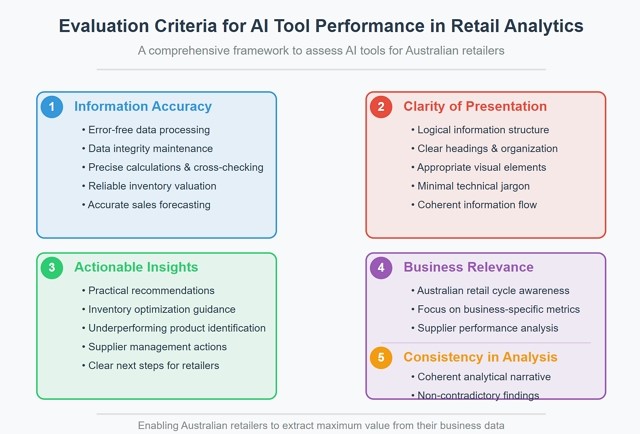
Evaluation Criteria for AI Tool Performance

Now, we know that all of them are good, but there is always a case where even the best six runners in the world have one who is better, and that is what we wanted to find out: the best free AI for retailers.

Each tool was evaluated on its ability to handle our tests based on these criteria:

Information Accuracy

Accuracy formed the cornerstone of our evaluation. Without accurate information, even the most sophisticated analysis becomes worthless for making informed business decisions. We meticulously verified whether each AI tool could process retail data without introducing errors or misinterpreting figures. This involved cross-checking calculations against known values and assessing whether the tools maintained data integrity throughout the analysis. In retail, where margins are often tight, minor inventory valuation or sales forecasting inaccuracies can lead to costly mistakes.

Clarity of Presentation

Accurate information is only valuable if presented in an understandable format. We assessed each tool's ability to structure information logically with clear headings, appropriate visual elements, and a coherent flow that retail managers could easily navigate. We examined whether complex data was transformed into straightforward insights that wouldn't require a data science degree to interpret. A good report should communicate the key points to a retailer without requiring them to wade through jargon.

Actionable Insights

Data without direction offers limited value to retail businesses. We evaluated each tool's ability to convert raw information into practical recommendations that retailers could implement. I am very proud that our POS system provides our customers with tools they can utilise. I want the AI report to do the same. I want to know what specific opportunities were identified in my inventory optimisation, which products are underperforming, and what concrete actions I need to take from my supplier. Good tools should describe what is happening and what should be done next.

Business Relevance

We evaluated each tool's ability to focus on issues that matter most to Australian retailers rather than generic business statistics. Did the AI for example identify seasonal trends in an Australian retail cycles, did it highlight my supplier performance to my business. Information that is not relevant creates noise rather than value.

Consistency in Analysis

Consistency in reporting is crucial for tracking performance over time and making reliable comparisons. We examined whether each AI tool maintained a consistent approach to analysis in its report and whether its outputs provided a coherent narrative. We do not want contradictory findings. Retailers need to trust that the insights they receive follow logical patterns and don't send them in conflicting directions. Inconsistent analysis can lead to confused decision-making and undermine confidence in the technology itself.

This comprehensive evaluation framework enabled us to assess each AI tool beyond its surface capabilities, focusing instead on how effectively it would serve the practical needs of Australian retailers wanting to extract value from their business data.

Test 1: Long Trend Stock Report Analysis

The first test was designed to evaluate how the AI would perform if it were given a vast amount of data that retailers are receiving. If the AI cannot handle the data, it's of minor use to retailers. Retailers have lots of data today.

Now, understanding inventory performance is critical for any retailer. Seasonal trends, slow-moving items, and bestsellers all impact their bottom line, so we ran a comprehensive stock trend report spanning hundreds of pages. It's the kind of data most retailers can obtain but rarely find the time to analyse correctly. Our test data spanned 12 months and exceeded 300 pages in length.

Tool Performance

ChatGPT

Failed almost immediately, as it ran out of credits, rendering it essentially useless for comprehensive stock evaluation. Even before hitting its limits, it failed to provide actionable insights that would aid practical retail decisions. The reality is that a retailer, after running this report, would almost certainly want to rerun it to see whether anything different changes the outcome. I might have tested this year and last year, but here I get nothing. As such, we immediately dropped ChatGPT.

Claude

Initially performed better. It identified some fundamental product trends on the first run. Then it ran into credit limits. However, it did identify some fundamental product trends, but its inability to handle follow-up questions made it impractical for the iterative nature of retailers' needs. As such, we dropped it immediately.

DeepSeek

Attempted a different approach to the credit limit problem. It took only a tiny section (6%) of the information. While this allowed it to complete the task without running out of resources, it did not give much.

Google AI

The first problem was that Google required CSV files, while all the others accepted Excel format, which we preferred. However, it did identify fundamental product trends; however, we all felt it lacked the depth needed for effective inventory management. Its surface-level insights wouldn't provide much of a competitive advantage for retailers looking to optimise stock levels.

Grok 3

Boy, were we impressed with this AI. It took the entire report without issues. It then provided a detailed trend analysis that would help retailers make smarter decisions. For example, it identified some products specifically for BBQs and reported that they sold well during the summer. It also spotted anomalies that would be easy to miss in manual review, such as products that underperform only during specific weather conditions.

Qwen

It performed admirably by identifying anomalies and supplier diversity trends, though it didn't match Grok 3's depth. It correctly helped identify problematic stock items. Unfortunately, it offers fewer actionable recommendations for improvement than Grok 3.

ChatGPT failed

AI Model Ave Score
Grok 3 9/10
Qwen 8/10
Google AI 7/10
Claude 7/10 Limited
DeepSeek 7/10

Test 2: Trial Balance Analysis

Accurate financial reporting is the backbone of retail success. The second test focused on a small compact trial balance dataset. What we wanted was an analysis that didn't require an accountant to understand.

Tool Performance

DeepSeek

It produced precise observations but struggled with depth when analysing discrepancies. Its summarised approach meant that nuanced financial issues, which could significantly impact a retail business, were overlooked.

Google AI

Here, we got straightforward summaries that aligned with our general ledger data but it lacked depth in identifying anomalies. We felt that although it was helpful for essential reconciliation, it wouldn't alert a retailer to subtle patterns.

Grok 3

Wow, it delivered a detailed financial summary with cross-referenced data for accuracy. It flagged discrepancies that required further investigation, allowing us to explore these issues. This capability could be invaluable for retailers without accounting expertise in maintaining the financial health of their business.

Qwen

It did a good job of highlighting significant balances and unexpected changes effectively. Again, it did not match Grok 3's level, but it did come up with much good stuff.

AI Model Ave Score
Grok 3 9/10
Qwen 8/10
Google AI 7/10
DeepSeek 6/10
Claude N/A

Test 3: Supplier Purchases Report

Managing supplier relationships is critical for maintaining healthy margins and consistent product availability. The third test examined a supplier purchases report to evaluate performance, track expenditures, and identify inefficiencies.

Tool Performance

DeepSeek

It did produce some quick overviews. It struggled with detailed metrics, such as cost per transaction or order accuracy. Its summarised approach meant it missed some critical inefficiencies; we did not think it was trivial, as these sorts of things directly impact margins.

Google AI

It did provide a structured summary but lacked in-depth spending analysis by category or supplier benchmarking. While helpful for basic understanding, we did not see key KPIs, such as identifying problematic vendors.

Grok 3

It did offer comprehensive supplier evaluations with detailed metrics. It identified inefficiencies. We thought it was suitable for managing dozens of suppliers. It was good, with its actionable tips.

Qwen

It did highlight anomalies as well as Grok 3 in the supplier but lacked actionable details.

AI Model Ave Score
Grok 3 9/10
Qwen 8/10
Google AI 7/10
DeepSeek 6/10
Claude N/A

Summary Performance 

When evaluating these tools specifically for retail applications, clear patterns emerged across all three test scenarios:

Tool Stock Analysis Financial Analysis Supplier Analysis POS Integration Overall Rating
ChatGPT We do not think its free version is suitable for retailers. Failed
Claude Limited Accurate but limited Decent but restricted Good 6/10
DeepSeek Partial (missed trends) Clear but shallow Quick but surface-level Good 6/10
Google AI Consistent but basic Straightforward Structured but limited Limited 7/10
Grok 3 Comprehensive Detailed Comprehensive Good 9/10
Qwen Good anomaly detection Highlighted changes Good diversity insights Good 8/10

Practical Implementation for Your Retail Business

Understanding how these tools perform in controlled tests is helpful, but implementing them in your daily operations is where real value emerges. Here's a practical approach to leveraging AI for business improvement.

Start Small and Focused

Begin with a specific business challenge rather than trying to analyse everything at once. Consider identifying your slowest-moving stock items for clearance, evaluating which suppliers offer the best value for similar products, or analysing sales patterns to optimise staffing during peak hours. Starting with a focused approach allows you to see tangible benefits quickly while building your comfort with the technology.

Prepare Your Data

Export relevant reports from your POS system in a format your AI tool can process. Depending on what tool you use, you need CSV or Excel. I prefer Excel but its your call. Check first that your data is clean and good. If you feed the AI rubbish, you will get rubbish back.

Ask Specific Questions

Frame your queries in specific, actionable terms rather than general requests. Instead of asking the AI to "Analyse my stock," try something more targeted, such as "Which product categories show seasonal patterns, and when should I increase inventory for winter?" Similarly, rather than requesting the AI to "Check my finances," ask, "Are there any unusual expense patterns compared to last year, and which categories show the largest percentage increases?" Specific questions yield specific, actionable answers.

We found that general queries often provided incorrect answers, requiring multiple attempts to obtain a satisfactory response.

Implement Findings Systematically

Test your questions systematically and record the question that yields the answers you want. This systematic approach ensures that AI becomes a valuable part of your business improvement cycle rather than just an interesting experiment.

Focus on applying insights

The best analysis is useless if it is not applied. Each of your analysis sessions should end with clear action items to be implemented and tracked.

Recommendations for Australian Retailers

Based on comprehensive testing and practical retail experience, here are my specific recommendations for retailers looking to leverage free AI tools:

Use Grok 3 as your primary analysis tool. I am told it will soon be charged, but now it appears to be the best in the free AI market. We were impressed with its ability to handle complex questions and our interactive questions, which is excellent if, like me, you like following your natural curiosity.

"A good question in business does not lead to an end; a good question opens doors you never knew existed."

Consider using Qwen; it's excellent. We found it helpful as it gave a good second opinion. It can be especially valuable when making significant business decisions.

If you're currently using ChatGPT or Claude, be aware of their significant limitations for business analysis. Their credit restrictions make them impractical for the iterative analysis that delivers real value. You may find yourself frustrated when analysis suddenly stops.

Conclusion: The Future of Retail Intelligence

Retailers, rather than using intuition alone, can use the Free AI tools now available to gain insights.

Written by:

Bernard Zimmermann


Bernard Zimmermann is the founding director at POS Solutions, a leading point-of-sale system company with 45 years of industry experience. He consults to various organisations, from small businesses to large retailers and government institutions. Bernard is passionate about helping companies optimise their operations through innovative POS technology and enabling seamless customer experiences through effective software solutions.
 

Add new comment

Restricted HTML

  • Allowed HTML tags: <a href hreflang> <em> <strong> <cite> <blockquote cite> <code> <ul type> <ol start type> <li> <dl> <dt> <dd> <h2 id> <h3 id> <h4 id> <h5 id> <h6 id>
  • Lines and paragraphs break automatically.
  • Web page addresses and email addresses turn into links automatically.
CAPTCHA This question is for testing whether or not you are a human visitor and to prevent automated spam submissions. Image CAPTCHA
Enter the characters shown in the image.

AI Musings: Introducing a new section here

POS SOFTWARE

AI software in a retail shop

It is estimated that in five years, AI POS will drive 55% of Australian consumer spending by 2030. This projection shows how AI will revolutionise retail in our country. As a retail and point-of-sale (POS) systems expert, it is essential to explore this transformation and its implications for small brick-and-mortar Australian retailers.

So, we will create a new section in this blog, "AI Musings," to explore artificial intelligence's musing on modern retailing. This space will blend AI-generated insights (approximately 80%) with my thoughts (20%) to delve into the most significant technological revolution in retail today.

The State of Modern Retail in Australia

AI dominates discussions at every retail conference today, signalling its emergence as the new frontier in retail technology.

Adopting AI in retail is not just a prospect; it's happening now. Many retailers already implement AI solutions to enhance customer experiences, optimise inventory management, and streamline operations. For example, our clients have been using AI for years in stock control, but no one is talking about it, and we need to.

I heard about chatbots handling customer queries in a retail firm a few days ago. It was expensive, but as AI becomes more accessible and affordable for businesses of all sizes, we will soon see it in almost all stores.

How AI is Transforming Australian Retail

Personalised Customer Experiences

AI will revolutionise how retailers understand and cater to individual customer preferences, offering a more personalised shopping experience. And it will not take long. If such a system is live in 10,000 shops in one month, that AI will have 800+ years of experience at the end of the month.

Smart Inventory Management

AI is already in our POS system and crucial in predicting demand and optimising stock levels, helping retailers reduce waste and improve efficiency. It has proven vital for retailers who often struggle with inventory management. AI-powered systems can analyse every stock item in the shop with its historical sales data, seasonal trends, and even external factors, like weather.

AI-Powered Customer Service

Chatbots and virtual assistants are improving customer support across online platforms. Currently, 47% of consumers feel comfortable using AI for product selection, while 75% remain cautious about AI handling high-value purchases.

Enhancing In-Store Experiences

AI is set to transform the in-store experience. Retailers use emotional recognition tools to detect customer frustration and seamlessly transfer to human support. This blend of AI and human interaction could be a game-changer for small retailers looking to provide personalised service while optimising staff resources.

Practical Considerations

Cost vs ROI for Retailers

Implementing AI solutions today requires a significant investment, but this is rapidly changing. DeepSeek-R1 is roughly comparable to ChatGPT GPT-4 Turbo, and it is $2.19/128k token, while ChatGPT is $30/128k token, a cost savings of about 93%.

Looking ahead, the future of AI in retail is bright. By 2030, AI is expected to create 200,000 jobs and $115 billion in economic value, which presents enormous opportunities for retailers of all sizes. That is almost 10% of the Australian economy now.

Voice Commerce

The growth of smart speakers and voice-activated shopping is expected to continue, offering new ways for customers to interact with retailers. I know some clients who now use them in the shop as a translator, and I do, too here. It has helped.

Conclusion

AI is undeniably reshaping the landscape of Australian retail. It is now transforming shopping experiences, retail operations, and customer engagement strategies. We intend to explore this topic here. I encourage our readers to share their thoughts on how they see AI shaping their shopping experiences or what trends they're most excited about.

Let's see how it goes forward together.

I hope you enjoy the new section, "AI Musings."

Comments

Add new comment

Restricted HTML

  • Allowed HTML tags: <a href hreflang> <em> <strong> <cite> <blockquote cite> <code> <ul type> <ol start type> <li> <dl> <dt> <dd> <h2 id> <h3 id> <h4 id> <h5 id> <h6 id>
  • Lines and paragraphs break automatically.
  • Web page addresses and email addresses turn into links automatically.
CAPTCHA This question is for testing whether or not you are a human visitor and to prevent automated spam submissions. Image CAPTCHA
Enter the characters shown in the image.