
From 1 October 2026, changes to card surcharge rules make it harder for many retailers to pass merchant fees directly to customers.
Payment providers know retailers are reviewing their options right now, so many are offering deals with features that I think are smoke and mirrors, designed to hide the real cost. Before you sign, take a breath. Yes, a good-looking rate can save you real money, but a bad deal will hurt badly. Here are the six checks I'd run on any offer.
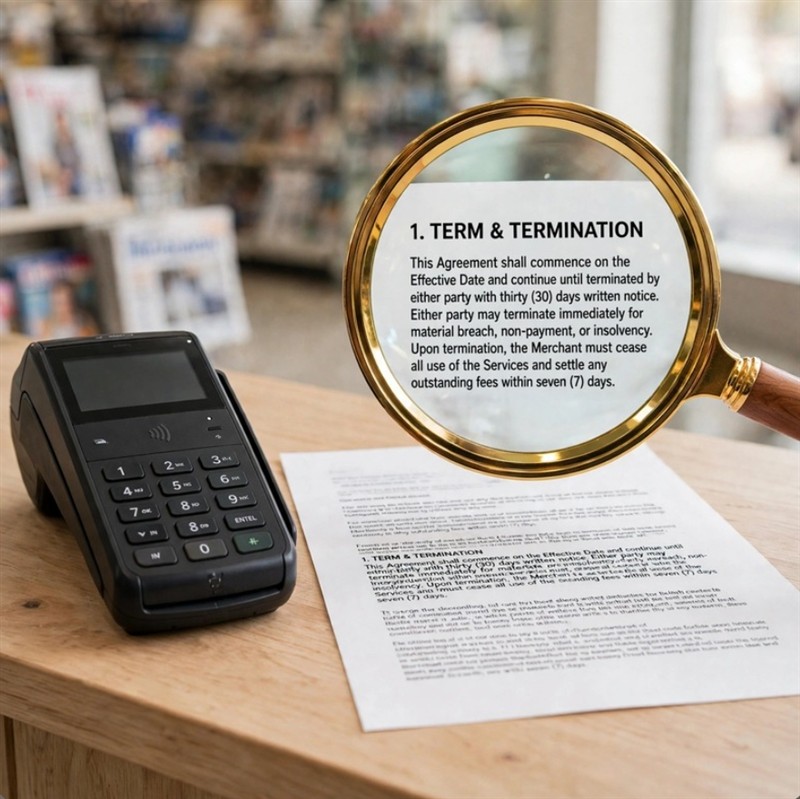
1. How Long Does the Contract Lock You In?
I've said this before: be very careful about signing a long-term contract now. Three-year merchant agreements are still the norm, so ask for a month-to-month agreement instead. If the provider insists on a longer commitment, ask what it will cost to leave, whether terminal rental continues after you stop using the terminal, and whether the provider can change its rates during the term. In my experience these long-term contracts are only long-term to you not the provider.
No one knows exactly how the market will settle after 1 October, and it will keep shifting. So you need flexibility more than ever.
2. Does the Quote Match Your Card Mix?
A provider can't tell you what its offer will really cost without knowing how your customers pay. As a working example, most of our retail clients process roughly 75% debit and 25% credit card transactions. Check your end-of-day POS reports and merchant statements for your own split.
Only once you have that figure should you ask the provider to price your debit and credit transactions specifically. A flat rate of 1.2% or 1.4% is easy to compare, but simplicity isn't the same as value. Always ask for the estimated total monthly fee in dollars, not just a headline rate.
3. What Does the Basket Size Cost on Your Actual Sales?
Your average basket size matters. For many of our retail clients it sits around $20 to $30, but a lot of smaller sales can change the result quickly. I have seen quotes based on $5 basket sizes. Clearly these are based on very old industry figures.
The facts are a 12-cent fee on a $25 debit sale works out to 0.48%. The same 12-cent fee on a $4 drink or newspaper works out to 3%. Some provider pricing models are still based on older transaction patterns, with far more small transactions than retailers typically see today. Check your end-of-day POS reports and merchant statements for your real basket size, then ask the provider to run the quote against those actual figures.
4. When Will the Money Reach Your Account?
A low rate isn't much use if your takings arrive after you need them. This matters especially if you sell lotto and need enough cash available by settlement day. The penalties will cost you more then the savings.
Ask the provider for its daily cut-off time and when funds from each day's sales will actually land in your bank account. Check Fridays, weekends and public holidays specifically. If faster settlement requires opening an account with a particular bank, factor that into your decision.
Don't accept "fast settlement" as an answer on its own. Ask for the schedule in writing, then compare it against the dates you need to pay lotto, suppliers and wages.
5. What Fees Sit Outside the Headline Rate?
If the offer uses interchange-plus pricing, ask the provider to show the interchange charges and any other fees separately. Don't assume interchange-plus will always beat a blended rate — always compare the final dollar amounts.
Also check least-cost routing (LCR). Ask whether it's available, whether it's switched on for your terminals, and how the provider decides which network to use for eligible debit taps. We recently reviewed a client's EFTPOS plan and found LCR had never been activated — they'd been paying more than they should. This isn't an isolated case: the RBA's own review found LCR is enabled for only around 84% of eligible in-person merchants, and switched on by just three of eleven large online payment providers, and that merchants with LCR enabled tend, on average, to have lower debit acceptance costs. Not all providers implement LCR the same way, so ask specifically how each one decides which network to route through, and get comparative numbers rather than taking "we support LCR" at face value.
Also watch for new fee structures. Some providers now split out security and interchange fees separately. Interchange fees may be coming down, but in some cases the added security fee eats up much of that saving — so check the combined total, not just the headline interchange figure. Terminal rental, security or PCI-related charges, setup costs and exit fees can all wipe out a saving on card rates.
6. What does the surcharge ban cover from your provider?
Officially, the ban only covers EFTPOS, Visa and Mastercard. However, many of the providers are including Amex, JCB and UnionPay. You need to ask do you need them. If so, how much will this unofficial ban cost you? This is important as you may be unnecessarily burnt.
What We Recommend
For now, we strongly recommend keeping your options open. Use your real POS figures, insist on clear settlement terms in writing, and avoid a long lock-in unless the complete offer makes a genuinely strong case for it.
Based on the offers we've reviewed, Swift Payments is one provider we're currently recommending clients consider, largely because of its month-to-month terms, If it does not work out you can change in 30 days. But don't take any recommendation, including ours, without testing the written quote against your own card mix, basket sizes and settlement needs.
If you have a new proposal and want to check what you're really paying, send your latest merchant statement or quote to our support team. We have written an AI to review EFTPOS rates and conditions. We can use that to break down your the charges, to compares them against your actual sales data and other EFTPOS rates, and gives you specific questions to put back to the provider.
If you'd rather run the review yourself, ask us for a copy of our AI so you can do it on your own computer. Either way: audit the offer before you sign it.
Written by:

Bernard Zimmermann is the founding director at POS Solutions, a leading point-of-sale system company with 45 years of industry experience. He consults to various organisations, from small businesses to large retailers and government institutions. Bernard is passionate about helping companies optimise their operations through innovative POS technology and enabling seamless customer experiences through effective software solutions.