POS Solutions at 43: Australia's Ultimate POS System Story
After 43 years, we have seen cash registers almost disappear, and we now have cloud- and network-connected POS systems. Cheques and cash are almost gone.
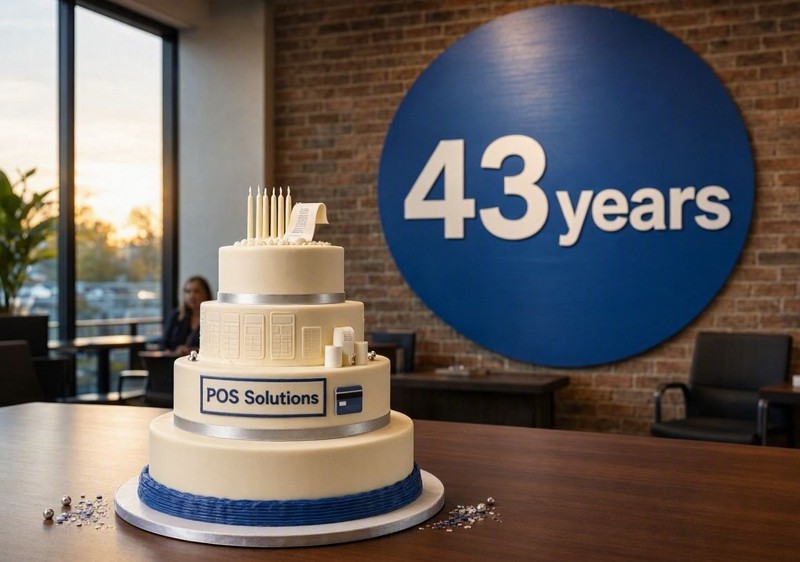
Today, , POS Solutions turns 43, and yet many retailers we meet are still missing the efficiency gains that four decades of point-of-sale experience can deliver.
Here's how a St Kilda bedroom startup became Australia's leading newsagency and POS System software provider and what that journey means for your business.
POS Solutions
POS Solutions is an Australian Point of Sale (POS) system provider founded on 8 September 1983 by self-taught programmer Bernard Zimmermann in a St Kilda flat in Melbourne. Today the company develops POS software and supplies POS hardware for independent retailers across Australia.
It operates from its head office at the Fiveway Business Centre in Keysborough, Victoria, supporting retailers across Australia and New Zealand.
Long before "point of sale" was a household phrase. We recognised that computers could transform how shops managed stock, sales, and customers.
Why Does 43 Years of POS Experience Matter?
Experience matters in POS software because retail punishes downtime. Every minute a till is offline costs money and real customers.
How Did POS Solutions Begin in 1983?
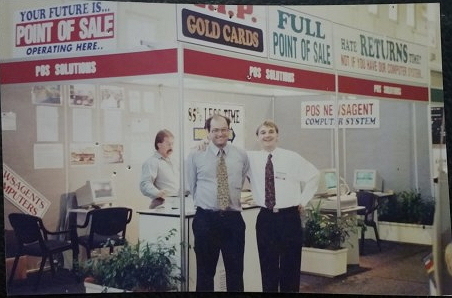
POS Solutions began on 8 September 1983, when its founder, me, started writing custom software from the bedroom of a St Kilda flat. I was a self-taught programmer with deep retail knowledge and a passion for technology. I believed computers could help retail run better and set out to prove it, one customer at a time.
At the time, most independent retailers ran their shops on paper, memory, and gut feel. I had a one-person philosophy that still shapes the company today. Every feature is from a real retailer's request. We listened to our customers first, then did our best to deliver. This founding habit has never left us.
My early program replaced shoeboxes of receipts with searchable records. I remember one of my first clients telling me he could finally see which product lines actually made money, rather than guessing.
43 years in, and I have loved every minute of it. Turns out they are right: if you love your work, you never work a day.
How Has Australian Retail Changed Since 1983?
Australian retail has transformed completely since 1983, shifting from cash and lay-by books to tap-and-go payments and real-time stock control.
Cards now account for roughly three-quarters of all consumer payments in Australia, while cash has fallen to just 13% of transactions. EFTPOS arrived and changed the checkout forever. Then came barcode scanning, the GST in 2000, and integrated card terminals. Then tap-and-go, online shopping, and soon QR codes. Each wave forced retailers to adapt within months, not years. Each wave rewarded retailers with flexible systems and punished those locked into rigid ones.
As a result, POS Solutions is the market leader in Australian newsagency and well established in POS systems.
How Did POS Solutions Grow into a Market Leader?
POS Solutions grew into a market leader by specialising deeply, supporting relentlessly. Our theme never changes: steady growth built on listening to retailers.
What Has POS Solutions Delivered for Retailers in 2026?
In the past year, POS Solutions has focused on payments, compliance, and practical support. These are the three areas where retailers feel change first. Sometimes the issues are unglamorous, such as when a recent Windows update broke receipt printers across many shops; that hands-on support, not just software, has kept the company relevant for over four decades.
What Can a Modern POS System Do for Your Shop?
A modern POS system manages your entire shop from one screen. It handles sales, stock, payments, staff, and reporting and pays for itself in the minutes it saves at every sale.
- It tracks every item from sale to delivery, flagging slow movers before they eat your cash flow.
- Sales can be completed in 1.6 seconds thanks to its commercial-grade SQL.
- It integrates EFTPOS, eliminating double-keying. Helps with end-of-day reconciliation errors.
- Reporting dashboards that turn your sales history into decisions.
Conclusion: Here's to 43 Years
Here's to 43 years of retail innovation and to the next chapter we'll write together.
Written by:

Bernard Zimmermann is the founding director at POS Solutions, a leading point-of-sale system company with 45 years of industry experience. He consults to various organisations, from small businesses to large retailers and government institutions. Bernard is passionate about helping companies optimise their operations through innovative POS technology and enabling seamless customer experiences through effective software solutions.