
My previous post received several enquiries about the surcharge ban on cards, particularly from lotto agencies. For lotto and other agency work, the ban is more significant than for most shops because retailers cannot simply raise the shelf price; the price of the goods is set by the operator. Officially the reduced interchange fee was supposed to pay for much of the cost, but as the recent ATO ban shows, this is not true. This is a different issue, which I will discuss in detail later, as we have been asked to join a group against it. This guide will cover what the ban actually says, why I think some proposed solutions are dubious, and the lawful ways to bring your payment costs down.
This article is general information, not legal advice.
- The ban started on 1 October 2026 and applies to eftpos, Visa and Mastercard credit, debit and prepaid cards. American Express and UnionPay are not formally part of the RBA regulation but have also removed surcharging from the same date (PayPal from 5 October).
- The change stems from the RBA’s final Conclusions Paper (March 2026), which removed the rule that stopped card schemes from banning surcharges. The ban is enforced under your agency and card contracts.
- A banned fee applies whenever a customer pays by card and the charge is linked to that choice of payment method. Calling it an “admin fee”, “service fee”, “platform fee” or anything else does not change the nature of the charge.
- Adding anything to goods, such as an official lottery ticket price, may also breach your lottery agency agreement. This fee is separate from the card scheme rules.
- The lower interchange caps should reduce your card fees, but only if your provider actually passes the saving on.
- Always obtain written confirmation from your merchant provider and your agency operator (e.g., Lotto) before changing any counter policy.
What the ban actually does
The RBA decided that card payment costs should be built into prices rather than added at the checkout. If a customer buys a $5 scratchie with a Visa debit card, you can no longer add 30 cents simply because they tapped a card.
The key test is whether the fee is charged because the customer chose to pay by card. Fees that have nothing to do with the payment method. A public-holiday surcharge that applies to every customer remains permitted.
Why do lotto retailers feel the impact of these fees more than other retailers?
Agency operators such as Lotto set the prices for tickets and your commission. A retailer can raise the price of a birthday card by 20 cents; a retailer cannot change the face value of a $10 Lotto ticket.
Illustrative example (use your commission rate and merchant fees):
- A $10 lottery sale at a 6% commission earns you 60 cents.
- A 1.5% card fee on that sale costs 15 cents.
- That single fee takes 25% of your commission before anything else.
Can you charge a flat fee instead?
Some retailers are tempted to add a “platform fee” on every transaction at the Lotto counter rather than a card-only surcharge.
The immediate commercial problem is that you become pricier than the Lotto app or other retailers. I doubt your customers appreciate that.
A new fee that appears only at the register also carries high risk:
- Card rules – If the fee applies only to card payments, it is a surcharge in disguise. It must apply to all payment methods. I had a discussion here with a bank. If you only have one payment method, then a fee is probably not permitted.
- Consumer law – Pricing must be clear. You cannot alter the official Lotto catalogue price so that an extra fee here suddenly appears when the customer is ready to pay.
- Lottery agreements – Many agency agreements prohibit charging more than the official price. Check yours carefully; most do. I have a client who has a dry cleaning agency and has been told that they are not increasing the price for his bank's higher transaction fees now.
A sign saying “2% card fee” or “40 cents on all transactions” does not fix any of these problems even if it is called a platform fee.
What can go wrong?
The lottery operator would almost certainly treat an unauthorised markup on a ticket as a material breach of your agency agreement. A single customer complaint can trigger a compliance review and put your agency or terminal at risk.
Your payment provider can review, suspend, or terminate your facility. Once the practice comes to their attention, it is common for them to take action. I have seen a case where a newsagent was fortunate that the matter did not proceed to court.
How to cut card costs lawfully
1. Check that your fees have actually dropped.
The RBA’s changes lower interchange fees, but these fees are only part of what you pay. The rest is your provider’s margin, and that is where small retailers often lose out. Please query the fees in writing if you have any questions.
2. Switch on least-cost routeing (LCR).
Make sure least-cost routeing is activated. It will not help with credit cards, but it can meaningfully lower debit costs with no change in customer experience.
3. Consider a minimum card spend.
Some retailers set a minimum card spend (e.g., “Cards accepted for purchases over $10” or “Cash only under $15”). This approach does not recover the fee on every sale, but it can help. Before you introduce it:
- Consider customers who may not carry cash, such as people with disabilities, younger customers, etc.
- Apply it consistently.
I think the best solution is to use a friendly sign.
4. A friendly sign
Here are three workable options:
Direct & empathetic (I prefer)
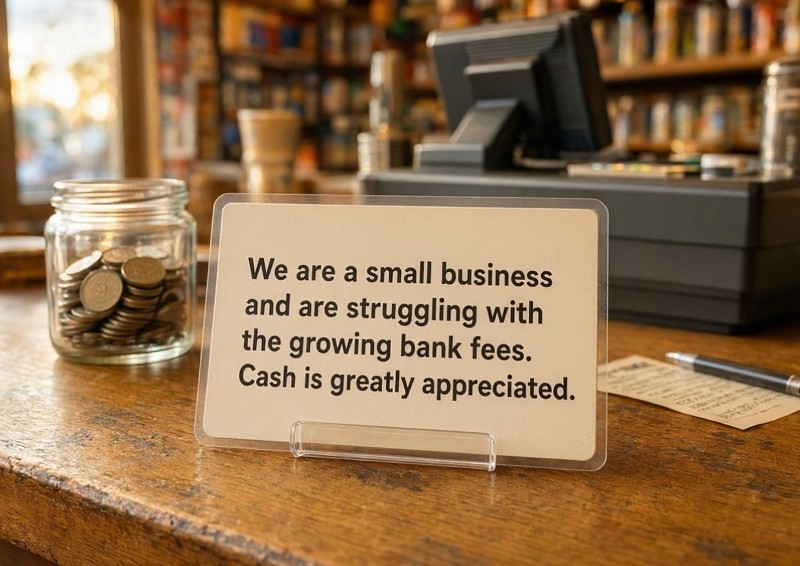
“We are a small business and are struggling with the growing bank fees. Cash is greatly appreciated.”
Why it works: Radical transparency. Customers generally dislike hidden corporate fees, but they sympathise with honest local shopkeepers. Framing cash as appreciation rather than a penalty encourages a voluntary shift without friction.
Hard margin shield
“We are a small business. We are struggling with growing bank fees. Cash is appreciated.”
Combines the psychological appeal for cash with a clear operational boundary.
Community-focused appeal (for many this is probably the best solution)
“As a local small business, rising bank fees impact us heavily. Cash is greatly appreciated to help keep our doors open. Thank you for your support!”
Frames cash as support for the local economy and reminds customers that their payment choice affects whether their favourite local agent can stay in business.
By now most customers understand the pressure on small retailers, so a well-worded sign usually generates fewer complaints.
4. PayID
I have discussed PayID in detail here, please read it if you want my thoughts on using it in your shop.
A personal note of caution: I recently disputed a PayID payment with a tradesman after an unsatisfactory job. He accepted the dispute promptly and returned to fix the work. If I were an owner of a Lotto agency, I would be wary of arguments with customers who have lost money on tickets purchased in my shop.
5. Use your POS system to see where the money goes.
A good POS system will show payment-method mix and average sale size. You may find that debit sales cost far less than credit, or that most of your card costs come from a handful of low-value transactions.
Payment method comparison
| Method | Typical cost | Best for | Watch out for |
|---|---|---|---|
| Credit card | Highest of the card types | Higher-value purchases | Fees may now be lower—check your rate |
| Debit card (LCR on) | Usually lower than credit | Everyday lottery sales | Confirm LCR is actually enabled. |
| PayID / NPP | Depends on your bank. | Larger or pre-arranged payments | Speed and reconciliation and possible arguments |
| Cash | No processing fee | Small purchases | Handling, banking and security costs |
Costs vary by provider and plan. Treat the table as a prompt for questions, not a rate card.
Your checklist
- Turn off any card surcharge in your terminal and POS settings.
- Check that nothing at the counter, on signs, or on receipts adds a card-only fee under a different name.
- Ask your provider, in writing, how the interchange cuts are being passed on.
- Confirm that least-cost routeing is active.
- Review your current statement.
- Compare your rates
- If you want a card minimum or cash-preferred sign, it is better to obtain written confirmation from your provider and your lottery operator first.
- Never add anything to an official lottery ticket price without written approval from the operator.
The bottom line
The surcharge ban closes one door, but lower interchange caps and greater transparency open another. Retailers are encouraged to review their statements now.
Be wary of workaround fees being suggested at present. Disguised fees put both your lottery agency and your merchant facility at risk.
Want a second opinion on your fees?
We offer a free merchant-fee review (powered by our AI tools) for retailers. It examines your current terminal costs, checks whether least-cost routeing is enabled, and provides a written comparison of available merchant facilities.
This article is general information only and is not legal or financial advice. Check your merchant agreement and lottery agency agreement, and speak to your provider, operator or industry body before changing any counter policies.
Written by:

Bernard Zimmermann is the founding director at POS Solutions, a leading point-of-sale system company with 45 years of industry experience. He consults to various organisations, from small businesses to large retailers and government institutions. Bernard is passionate about helping companies optimise their operations through innovative POS technology and enabling seamless customer experiences through effective software solutions.