
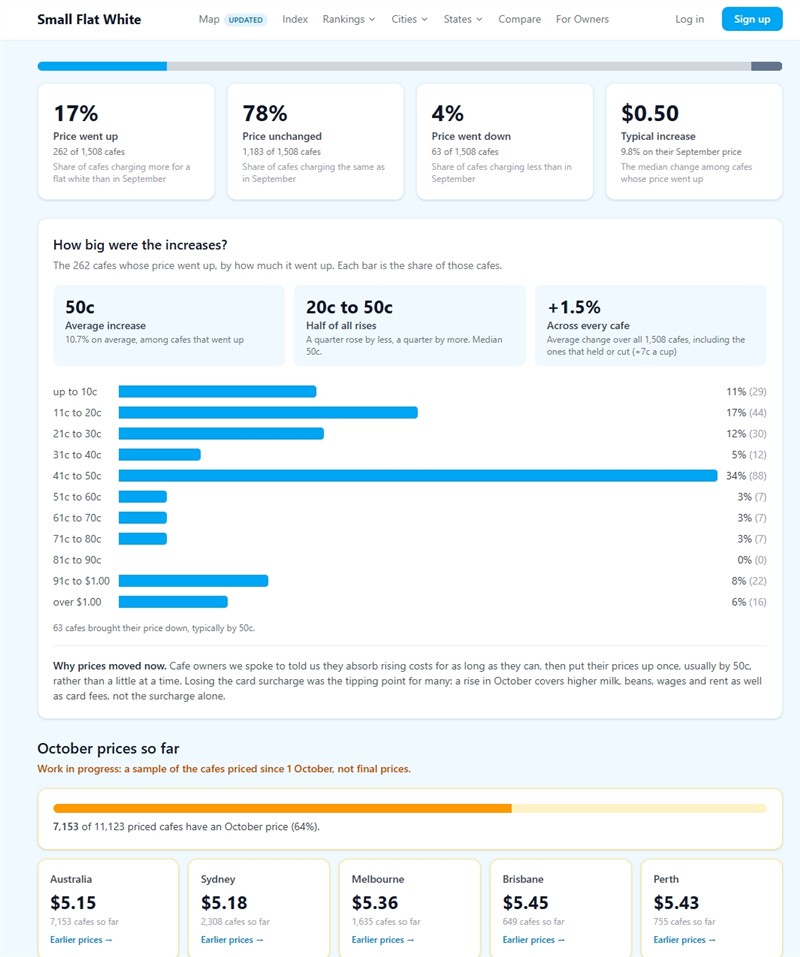
The key question is whether flat white prices in Australian cafés are rising and what the Small Flat White Surcharge Tracker can tell us about the effect of abolishing card surcharges.
There are two related but different issues to examine:
- The underlying price of a flat white refers to the actual cost charged by cafés. Are cafés increasing the price printed on their menus?
- Are customers paying more or less once the card surcharge ban happened? A café can remove a card surcharge while increasing its menu price. In that situation, the surcharge disappears, but the customer may see no reduction in the cost of their coffee.
1. What the tracker shows
The tracker shows prices for 1,508 cafés. These were checked in September prices vs October prices.
| Measure | Share | Cafés |
|---|---|---|
| Price increased | 17% | 262 cafés |
| Price unchanged | 78% | 1,183 cafés |
| Price decreased | 4% | 63 cafés |
| Typical increase among cafés raising prices | $0.50 | |
| Average change across all cafés | +1.5% | |
The figures tell us three important things.
- Most cafés have not raised their flat white prices since the ban. Nearly four in five retained the same menu price.
- A minority has made substantial increases. Among the cafés that raised prices, the typical increase was 50 cents, approximately 9.8% of their previous price; the reported average increase was also about 50 cents.
- The overall effect is much smaller than the increases faced by those customers. Across the entire group, including unchanged prices and reductions, the tracker reports an average increase of 1.5%, or about 7 cents per cup.
Source: Small Flat White
2. Are cafés using the surcharge ban to increase prices?
The most striking result is the size of the increases relative to the card surcharge that customers previously paid.
Consider a $5 flat white:
| Item | Amount |
|---|---|
| Previous menu price | $5.00 |
| Typical increase among cafés raising prices | $0.50 |
| New menu price | $5.50 |
| Menu price increase | 10% |
| Illustrative old surcharge at 1.5% | $0.075 |
A 50-cent increase is about a 7.5-cent surcharge on a $5 coffee.
This does not prove that cafés are exploiting the change. They may have been absorbing higher milk, coffee bean, wage, rent and other costs. But it does show that a 50-cent rise cannot be explained by simply adding back a typical 1.5% card surcharge.
There is an important qualification: the old surcharge varied between businesses and payment methods, and some cafés may have had higher payment costs. I suspect that we are looking at broader cost pressures, a delayed price adjustment and the ban as the excuse to raise prices.
3. The important question: were cafés already planning to increase prices?
This is one of the most important issues in interpreting the tracker.
We have three plausible explanations for what happened.
Scenario A: Cafés proceeded with the planned price increases.
Some cafés may have been absorbing rising costs for months but delaying increases because they feared losing customers. The surcharge ban then gave them a convenient opportunity to reset prices.
A 50-cent increase might therefore cover several accumulated cost increases, not merely card-processing fees. Small Flat White reports that café owners described this pattern in its research.
Scenario B: Some cafés increased prices in anticipation of the ban.
Clearly many café owners knew the surcharge would disappear on 1 October, so they raised it already.
This scenario is plausible, but the October tracker alone cannot establish how many cafés did raise prices. A price increase before 1 October would not appear as an increase in the September-to-October comparison.
Scenario C: Other cafés are waiting to see what happens.
Some owners may be keeping prices unchanged while they assess customer reactions, competitor prices and their actual payment costs under the new arrangements.
If so, the present data could understate the eventual proportion of cafés increasing prices. Equally, some cafés might decide not to increase prices at all. The tracker does not yet establish which outcome will prevail.
Of course, a café can have several reasons for changing the prices.
4. What were prices doing before the ban?
This is a crucial comparison because coffee prices were already changing before October.
It reports that, between April and September 2026, it compared 853 cafés that had been priced in both periods:
| Price movement | Share of cafés |
|---|---|
| Increased | 28% |
| Unchanged | 61% |
| Decreased | 11% |
| Average price change at the same cafés | +1.6% |
Source: smallflatwhite.com
This suggests that price increases were already occurring before the surcharge ban.
The more revealing question is whether the rate of price increases changes in the months following October.
If cafés continue raising prices in November, December and early 2027, that would support the possibility of a broader price-reset process. If the changes largely stop after October, that would suggest what the Reserve Bank thought would happen: a one-off immediate response to the ban.
5. What does the evidence say about customers?
There are two ways to assess the outcome.
Most customers (78%) did not face a menu-price increase. The tracker shows a 1.5% average increase. A customer paying by card would have paid the menu price plus a surcharge. After the ban, if the customer pays an increase in price without that card surcharge, the price may be the same.
Conversely, if a café that raises its menu price by more than offsets the surcharge, the customers will be worse off.
In both cases the customer who paid in cash is almost certainly worse off.
6. How reliable is the tracker?
The methodology has real strengths:
- It compares each café against its September price, reducing the distortion that would arise from comparing different cafés.
- It attempts to compare the same cup size.
- Prices were collected through phone surveys and menu extraction. The website says they did review and correct errors. So it looks legit.
One point here is that sometimes people do lie or say half-truths; this is always a problem.
However, it is important to consider the limitations:
- The sample may not be representative; we do not know which cafes were selected.
- These figures are preliminary.
- It measures prices, not quantity or motives. For example, a price increase does not prove the surcharge ban caused it, and we do not know whether customers bought fewer coffees.
7. My overall assessment
The tracker provides credible early evidence that the removal of card surcharges has coincided with a noticeable round of flat white price increases at some cafés. However, it does not establish that the ban caused those increases, or that cafés collectively are making larger profits.
The most intriguing finding is the combination of three facts:
- Nearly four in five cafés have kept their prices unchanged since September.
- Among those that increased prices, the typical increase was about 50 cents, considerably more than a typical card surcharge on a $5 coffee.
- Flat white prices were already rising before the ban, with 28% of the April–September comparison group increasing prices.
Taken together, these findings are consistent with a mixture of accumulated cost pressures, price increases brought forward or delayed until October, and possible attempts to recover payment costs. They do not tell us how much each factor contributed.
The central question is not simply whether flat whites became pricier after 1 October. It is whether customers ultimately pay more or less than they would have paid if the surcharge system had remained in place.
That question requires more evidence, but I doubt we will get it.
The big problem is that the surcharges were a symptom of the problem of high bank fees, not the cause. Based on these figures, the effect is probably that they raised prices for consumers, but we need more time to tell.
Look at the report and see what you think.
Written by:

Bernard Zimmermann is the founding director at POS Solutions, a leading point-of-sale system company with 45 years of industry experience. He consults to various organisations, from small businesses to large retailers and government institutions. Bernard is passionate about helping companies optimise their operations through innovative POS technology and enabling seamless customer experiences through effective software solutions.