
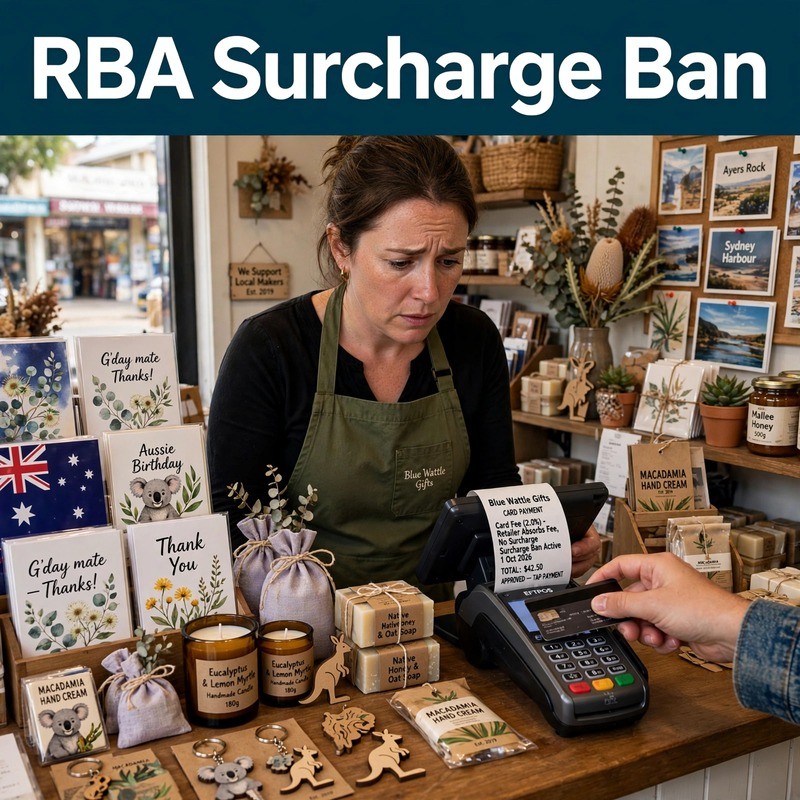
We're already absorbing rising rent, wages, and supplier costs, and now you will soon add new card processing fees. From 1 October 2026, the surcharge disappears, and despite what the RBA said, I don't think the banks will eat the difference.
Key Takeaways
- The surcharge ban removes your ability to pass card acceptance costs to customers at the till from 1 October 2026.
- Reduced interchange fees are meant to offset retailer losses.
- Banks are already adding new fees elsewhere.
- Rewards programs are shrinking.
- AMEX and other uncapped cards were left out of the RBA's review, yet many providers will stop you from surcharging on them in their system.
- Retailers could absorb fees as high as 2% with no way to claw that back at the register.
- Price-controlled products like Lotto put retailers in an impossible squeeze, since the price isn't theirs to change.
- Acting now is premature; the real numbers won't show up until your October and November merchant statements land.
What Is the Card Surcharge Ban?
The surcharge ban is a rule change stopping retailers from adding a fee when a customer pays by card, regardless of transaction size. Before this, a $4.50 coffee or a $12 lunch could carry a small surcharge that covered what the bank charged the retailer for accepting that card. The RBA calls this "removing an inefficient cost" and a "consumer win." I call it removing transparent cost recovery and ensuring no one notices where that cost goes instead.
Labor's election policy was narrower: ban surcharging on debit cards only. That part made sense to me as most people pay by debit now, so pricing should reflect the payment type most customers actually use. But the RBA didn't stop there. It extended the ban to credit cards too.
Why Does This Matter for Retailers?
This matters because the RBA's promised savings are theoretical. Currently, they are talk. The RBA claims retailers will save $910 million a year once interchange fees drop. I don't believe that, but I am prepared to accept it if I see it reflected in my own processing costs, not before. Let us see what shows up on your merchant statement too.
I expect providers will modify their fee structures to claw back margin. I've already seen one supplier add a standalone "security fee". Conveniently, the security fee was included in the interchange fee. Now I see they have stripped that cost from interchange and made it its own fee. Tell me, do you think your bank fees will move down? From what I see, every major bank has announced changes effective 1 October 2026; from the list, little is down, and I think a fair chunk of those changes exist to recover exactly what the RBA estimates they'll lose.
What's Happening to Rewards Programs?
Here too, the card rewards are shrinking as issuers adjust for lower interchange income, and I've felt this personally. My own rewards program cut back significantly, and the change that stung most: I can no longer convert points into Coles Gift Cards. That was one of the few ways to turn points into something close to cash that my family could use.
Why Did AMEX Get Left Out — And Does It Even Matter?
The RBA's interchange review didn't cover AMEX and other overseas-scheme cards, so they remain technically uncapped. For some reason, the RBA didn't touch them. Yet plenty of credit and debit providers will stop surcharging on these cards anyway in their system. If you want to surcharge on these items, you need to do it yourself. Our POS system lets you do that.
How Will This Change Customer Payment Behaviour?
Retailers will now be forced to absorb fees as high as 2%.
Now I predict a measurable shift toward credit cards, away from debit and cash. Why wouldn't customers switch? No surcharge, up to 55 days interest-free, better chargeback protection, I get some free repairs too in some cases, and better rewards points. The thing that used to push many people to debit, the surcharge, is gone. I'd go further: I think many cardholders will upgrade from regular to premium credit cards specifically to chase better rewards, now that there's no price penalty.
I suggest that you watch your POS End of Day reports over the next few months to see if your debit card share drops and your credit share climbs.
What Should You Do Before October?
Little, I wouldn't act in a rush now. There's nothing to gain by guessing now, as it's too early to make good decisions. Plenty of retailers are already raising shelf prices in anticipation. The cafe near me that I like has already increased its prices.
One issue concerns me the most: Many products like Lotto, where retailers don't control the price. You can't raise a lottery ticket price to cover a higher card cost, so any margin hit there comes straight out of your fixed commission. If you are in Lotto, I would ask them about that.
My advice: wait till October. Let your first couple of merchant statements come through under the new rules, then work from actual numbers instead of dubious RBA projections or bank press releases.
Conclusion
The surcharge ban sounds like a consumer win on paper, but for retailers, it's a cost shift dressed up as reform. Keep an eye on your merchant statements, watch how your payment mix moves, and don't rush shelf-price decisions before you've got real data in hand.
For a rundown of specific bank changes, ahead of the October ban, click here:
Details of credit and Debit card overhaul ahead of October surcharge ban
Written by:

Bernard Zimmermann is the founding director at POS Solutions, a leading point-of-sale system company with 45 years of industry experience. He consults to various organisations, from small businesses to large retailers and government institutions. Bernard is passionate about helping companies optimise their operations through innovative POS technology and enabling seamless customer experiences through effective software solutions.