
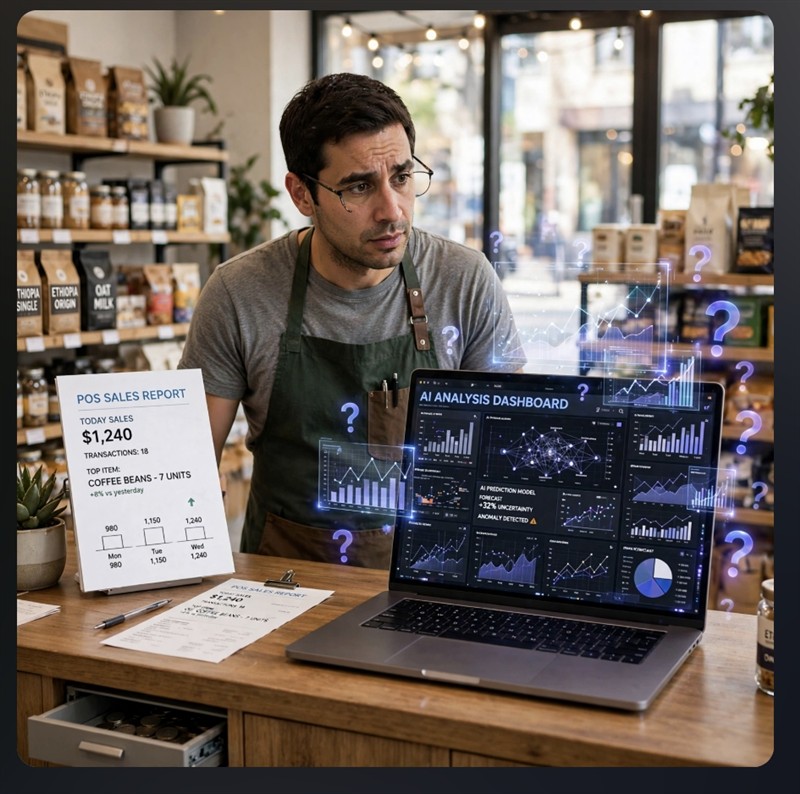
You are almost certainly used to your POS reports being "fire and forget." You press a button, get one neat report, and move on with your day.
Yet, when you switch to AI reporting on your POS sales data, you will notice something different: it suddenly feels much heavier. Every answer creates three more questions. The hidden culprit? AI reporting introduces a massive, unacknowledged mental load.
Key Takeaways for Retailers
- AI is interactive: AI reporting demands continuous decisions and prompts.
- Beware of decision fatigue: nonstop complex questioning will hurt your judgment and lead to mental exhaustion (decision fatigue).
- AI insights are theories, not facts: What makes it especially exhausting is that they often sound plausible yet are wrong.
- Use the 50-minute rule: Keep AI analysis sessions to about 50 minutes, then take a break.
- Always interrogate the AI: Build a habit of asking it to show its numbers and reasoning step by step.
- Your existing POS reports are your ground truth: They are more reliable for raw facts. Always refer to them.
What Is AI Reporting for POS Systems?
AI reporting for POS systems uses AI tools to interpret your business information, such as sales, margins, basket sizes, and category performance, through queries.
Unlike your existing POS report, which gives you a snapshot, AI reporting lets you ask questions about your business data.
For example, instead of pulling a standard "Top 100 Items" report, you might ask, "What patterns do you see in these top items over the last six weeks?" You can then refine your query by day, promotion, or weather as the conversation unfolds with the AI.
Why Does AI Reporting Matter for Retailers?
AI reporting matters because it can reveal what your standard POS reports never show, such as subtle cannibalisation between product lines or emerging trends.
For example, your standard POS report might show that a "Stocktake promo" was a massive success because total revenue went up. But an AI analysis might point out a hidden problem: the heavy discounting on some items. Total revenue was up, but you were working for nothing on many items.
How Does AI Reporting Increase Mental Load?
First, unlike your existing POS reports, AI produces errors. You always need to be aware that what it is telling you might be wrong. In fact, it is often wrong. This is the major problem, made worse because AI often sounds incredibly confident and may look plausible, yet it can be wrong, misleading, or entirely fabricated.
Consider this hallucination: Your AI might confidently tell you, "Sales of umbrellas spiked 400% in July due to the rain." It sounds perfectly logical. But if you check your actual POS data, you might see no umbrellas were sold. I have seen it.
The second issue is decision fatigue. You drive the conversation, ask the questions, and decide where it goes. After a while, making non-stop complex decisions gets exhausting. You can quickly reach a point of cognitive depletion. Once there, you lose attention and make costly errors.
The tension increases dramatically if you are doing the task for a stressful situation eg taxation, legal, etc
The 50-Minute AI Retail Routine
Don't just chat with your AI aimlessly. Time your AI session to prevent burnout. Here is the routine:
- Minutes 0–10 (The Baseline): Start by looking at your existing POS reports. Study it before giving the info to the AI. Make sure you know your subject.
- Minutes 10–30 (The Exploration): Ask the AI for ideas and patterns. Ask away for 20 minutes.
- Minutes 30–45 (The Interrogation): This is where you fight hallucinations. Ask the AI to prove its comments.
- Minutes 45–50 (The Action Plan): Summarise the session. Write down at least one idea you got.
- Minute 51: STOP. Walk the shop, fill the shelves, tidy up, or, probably better, chat with a customer.
Have a break.
The Bottom Line: AI is the Analyst; You are the Customer
AI reporting isn't here to replace your traditional POS reports; it's here to ask the questions.
What's the most surprising insight an AI has found in your retail data? Or what was its most hilarious "hallucination"? Let us know in the comments below!
Written by:

Bernard Zimmermann is the founding director at POS Solutions, a leading point-of-sale system company with 45 years of industry experience. He consults to various organisations, from small businesses to large retailers and government institutions. Bernard is passionate about helping companies optimise their operations through innovative POS technology and enabling seamless customer experiences through effective software solutions.