Point of Sale Software

Here are some Articles from the Blog Subject - eofy -

A tip for this End of Financial Year

POS SOFTWARE

EOFY_June

The End of the Financial Year (EOFY) can create timing issues that come back to bite years later—this year, it’s tomorrow.

The Perils of EOFY

Here's the potential snag: some businesses close their books on Tuesday night, while others finalise them the next morning. This creates timing differences, where the same transaction can be recorded in different financial years by different organisations.

This means invoices, credit notes, and payments may not align. Add Australia Post delays or processing delays, and important documents might not appear in your records until after EOFY. As a result, your figures may not match those of your suppliers or customers.

This may become a problem during an ATO audit. The ATO may compare your records with other businesses and ask why the figures differ. Since audits often occur years after the fact, it can be difficult to explain what caused the discrepancy. You end up trying to reconstruct events you barely remember.

We experienced this firsthand. A supplier issued a credit note to us just before EOFY, but we didn’t receive it until a few days later. During an ATO review, that timing difference worked against us, and it ended up costing us. The ATO argued that we should have known about the credit note in the previous financial year.

Taking Control

You can reduce the risk of these issues with a few simple steps:

  • Ensure your POS and accounting systems can clearly explain your figures if needed. Putting notes in can be a big help.
  • Contact suppliers now if there are large or outstanding amounts.
  • Start chasing missing invoices and credit notes.
  • If timing cannot be resolved, get written confirmation (email is ideal).
  • Where possible, delay closing your EOFY slightly to allow final documents to come in.

One advantage of our POS system is that it allows adjustments after EOFY, so you can continue processing and correcting entries as information arrives.

Written by:

Bernard Zimmermann


Bernard Zimmermann is the founding director of POS Solutions, a leading point-of-sale system company with 45 years of industry experience, now retired and seeking new opportunities. He consults with various organisations, from small businesses to large retailers and government institutions. Bernard is passionate about helping companies optimise their operations through innovative POS technology and enabling seamless customer experiences through effective software solutions.



Add new comment

Restricted HTML

  • Allowed HTML tags: <a href hreflang> <em> <strong> <cite> <blockquote cite> <code> <ul type> <ol start type> <li> <dl> <dt> <dd> <h2 id> <h3 id> <h4 id> <h5 id> <h6 id>
  • Lines and paragraphs break automatically.
  • Web page addresses and email addresses turn into links automatically.
CAPTCHA This question is for testing whether or not you are a human visitor and to prevent automated spam submissions. Image CAPTCHA
Enter the characters shown in the image.

Accounting for 2024-25

POS SOFTWARE

Accounting for 2024-25

There are few key differences and notable changes for EOFY 2024/5 to 2025/6

As such this is still valid for your EOFY accounting.

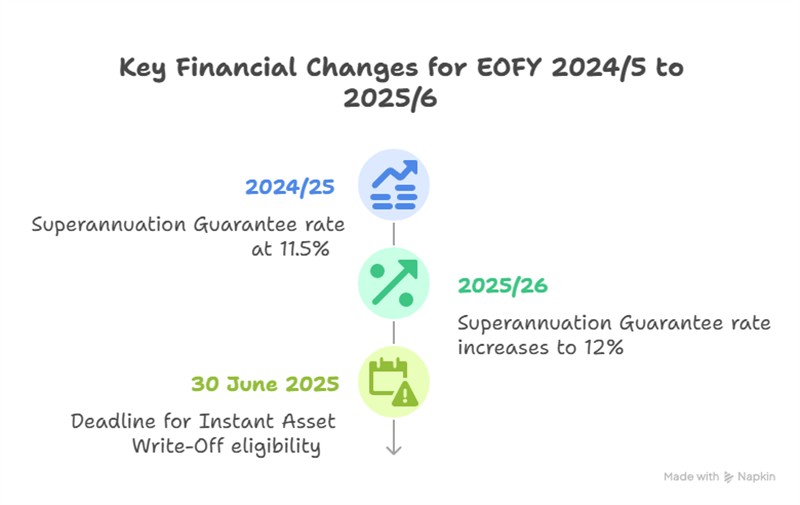
The only major change for SMB retails is that you need to adjust the Superannuation Guarantee (SG) rate as it rises from 11.5% in 2024/25 to 12% in 2025/26. This is the final step in the legislated SG increases, so you must update payroll systems and budgets accordingly.

You must act now if you want to use the Instant Asset Write-Off for this year's tax return. The $20,000 threshold for eligible businesses (with less than $10 million aggregated turnover) only applies to assets first used or installed ready for use by 30 June 2025. Purchases after this date may be subject to different rules or thresholds.

Written by:

Bernard Zimmermann


Bernard Zimmermann is the founding director at POS Solutions, a leading point-of-sale system company with 45 years of industry experience. He consults to various organisations, from small businesses to large retailers and government institutions. Bernard is passionate about helping companies optimise their operations through innovative POS technology and enabling seamless customer experiences through effective software solutions.

 

Comments

Great EOFY update! Key takeaway: Super Guarantee rate increases to 12% in 2025/26—update your payroll systems. Also, act fast to claim the $20,000 Instant Asset Write-Off before 30 June 2025. Clear and helpful advice from Bernard Zimmermann!

Both your points are right on. What people seem to be missing is that the SG calculations also affect their quarterly obligations, so it's worth reviewing those forecasts too.

Hope this helps with people's planning!

You can actually claim costs for things you add to an asset later, like an upgrade. For example, after we bought our display shelves and wrote them off, we discovered that we needed custom lights because the shelves covered up the light. That lighting cost us $3,000, and we were allowed to claim it as an instant write-off too, since it was a modification we made after buying the shelves.

Add new comment

Restricted HTML

  • Allowed HTML tags: <a href hreflang> <em> <strong> <cite> <blockquote cite> <code> <ul type> <ol start type> <li> <dl> <dt> <dd> <h2 id> <h3 id> <h4 id> <h5 id> <h6 id>
  • Lines and paragraphs break automatically.
  • Web page addresses and email addresses turn into links automatically.
CAPTCHA This question is for testing whether or not you are a human visitor and to prevent automated spam submissions. Image CAPTCHA
Enter the characters shown in the image.

Preparation and webinar on the end of year reporting 2023

POS SOFTWARE

Today is the EOFY, the last day of the financial year. So it is the last day to review your bookkeeping. Then make some last-minute adjustments.

As a minimum, I would suggest you get these reports in order:

Sales reports

Stock Valuation (this may depend on when your stocktake is done)

Customers Outstanding Subagents Outstanding (if relevant)

Creditors Outstanding (if you do it from the point of sale software)

It would be best to consider what can be written off in the debts and stock to claim a tax deduction for this year. Otherwise, these will be profit this year.

Click here for a webinar on End of Financial year reporting from your point of sale software. It discusses in detail these reports.


Add new comment

Restricted HTML

  • Allowed HTML tags: <a href hreflang> <em> <strong> <cite> <blockquote cite> <code> <ul type> <ol start type> <li> <dl> <dt> <dd> <h2 id> <h3 id> <h4 id> <h5 id> <h6 id>
  • Lines and paragraphs break automatically.
  • Web page addresses and email addresses turn into links automatically.
CAPTCHA This question is for testing whether or not you are a human visitor and to prevent automated spam submissions. Image CAPTCHA
Enter the characters shown in the image.

Backup your EOFY data

POS SOFTWARE


I suggest that come the end of the financial year, you save a backup of your financial data for this year and store it somewhere safe, even though our system does not require it. Over the years in my experience, this has proved to be very handy in the future. I suggest you use a USB stick.

If you do not want to do this, run your financial reports and send them to your personal email accounts. These reports include:

Debitors
Creditors
Stock
Payroll reports


Add new comment

Restricted HTML

  • Allowed HTML tags: <a href hreflang> <em> <strong> <cite> <blockquote cite> <code> <ul type> <ol start type> <li> <dl> <dt> <dd> <h2 id> <h3 id> <h4 id> <h5 id> <h6 id>
  • Lines and paragraphs break automatically.
  • Web page addresses and email addresses turn into links automatically.
CAPTCHA This question is for testing whether or not you are a human visitor and to prevent automated spam submissions. Image CAPTCHA
Enter the characters shown in the image.

EOFY Countdown is on: Your Questions Answered

POS SOFTWARE

We need to be ready to hit the ground running as preparing a business for the End Of the Financial Year (EOFY) can be daunting.

As a minimum, you need to do the tax stuff, but while doing this, you can do the management reporting too. This can be time-consuming, but luckily much of the information required is built into your POS Software. Before you go to the accountant, it is worthwhile to go to this webinar to review what reports our Point of Sale Software can produce. This will give you a feel of what you can supply to the accountant.

Here's a checklist of reports that you will need.

Sales reports
Stock Valuation (you will need to do this after your stocktake)
Customers Outstanding
Creditors Outstanding (if you are running creditors)
Subagents Outstanding (use only if applicable)

Click here for a webinar on the End of the Financial year reporting. It discusses in detail what reports our system can produce. 

Although not required from our software, I do recommend that you do make a special End of Year Backup to store in case you need to refer to it. The 30/of June this year is Thursday.

Add new comment

Restricted HTML

  • Allowed HTML tags: <a href hreflang> <em> <strong> <cite> <blockquote cite> <code> <ul type> <ol start type> <li> <dl> <dt> <dd> <h2 id> <h3 id> <h4 id> <h5 id> <h6 id>
  • Lines and paragraphs break automatically.
  • Web page addresses and email addresses turn into links automatically.
CAPTCHA This question is for testing whether or not you are a human visitor and to prevent automated spam submissions. Image CAPTCHA
Enter the characters shown in the image.

The End of the financial year is coming up.

POS SOFTWARE


For most of us, the End of the Financial Year (EOFY) is on the 30 June. For most businesses, it is a significant time. The immediate problem is super which has to be in by the 28 July. Then what we need to do is prepare by 31 October. If you do not use an accountant, you must lodge to the ATO by then but you often get some more time often with an accountant.

Here are some tips for now:

1) Make an EOFY sale. Get rid of as much stock as you can. Useless stock, if kept, generally goes into the stock figure at a wholesale value. That will increase your profit.

2) Review your debtors and creditors. Be careful here as if debts that need to be written off are not written off, it increases your profit. If creditors are written off, it increases your profits. As such most people write off the debtor now and the next financial year the creditor.

3) Review your records; are they up to scratch? If it is not, you can have with the ATO a real problem. I have seen problems with people whose POS systems has errors with the ATO.

4) Start planning a date for your stocktake. Although it is not an ATO rule, it is a valuable method of stock control. It's the best way of determining what stock has been lost to theft, spoilage or taken for personal use. I recommend that all businesses do a stocktake at least once a year. Also, without one, you may have a dispute with the ATO over your stock holding.

Good preparation is the key to stocktaking as it is a lengthy and often expensive operation. Typically a shop is looking at four (4) days of work.

We will be doing webinars to help you prepare soon for the EOFY.

"By failing to prepare, you are preparing to fail." — Benjamin Franklin.

Add new comment

Restricted HTML

  • Allowed HTML tags: <a href hreflang> <em> <strong> <cite> <blockquote cite> <code> <ul type> <ol start type> <li> <dl> <dt> <dd> <h2 id> <h3 id> <h4 id> <h5 id> <h6 id>
  • Lines and paragraphs break automatically.
  • Web page addresses and email addresses turn into links automatically.
CAPTCHA This question is for testing whether or not you are a human visitor and to prevent automated spam submissions. Image CAPTCHA
Enter the characters shown in the image.