Point of Sale Software

Here are some Articles from the Blog Subject - Magazines -

Are magazines still profitable for retailers?

POS SOFTWARE


Readership vs. Unit Sales


Readership of magazines vs sales in 2025


Years ago, I tracked official magazine sales figures religiously. I stopped because the magazine industry shifted from reporting verified sales (copies sold) to readership (estimated readers). The result became increasingly disconnected from retail reality.

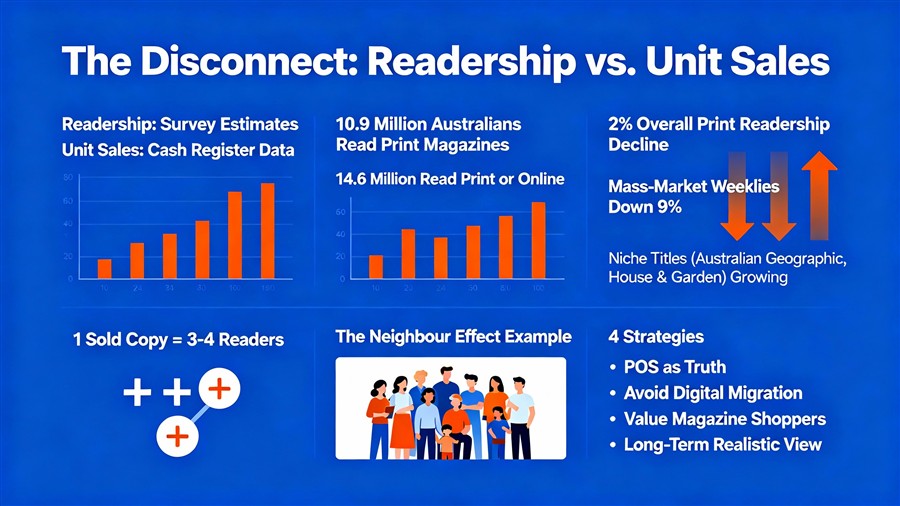
The doubts many retailers feel are justified, as readership figures are derived from surveys. Far removed from cash register data. A single sold copy might be counted as three or four "readers" if it is passed around a household. If it is left in a waiting room, it's even better for advertisers who only care about how many people saw their advertisement.

Despite this, we must work with the data we have, so I decided to look into it. So, let us look at the latest Roy Morgan figures for the 2024/25 financial year by Roy Morgan.
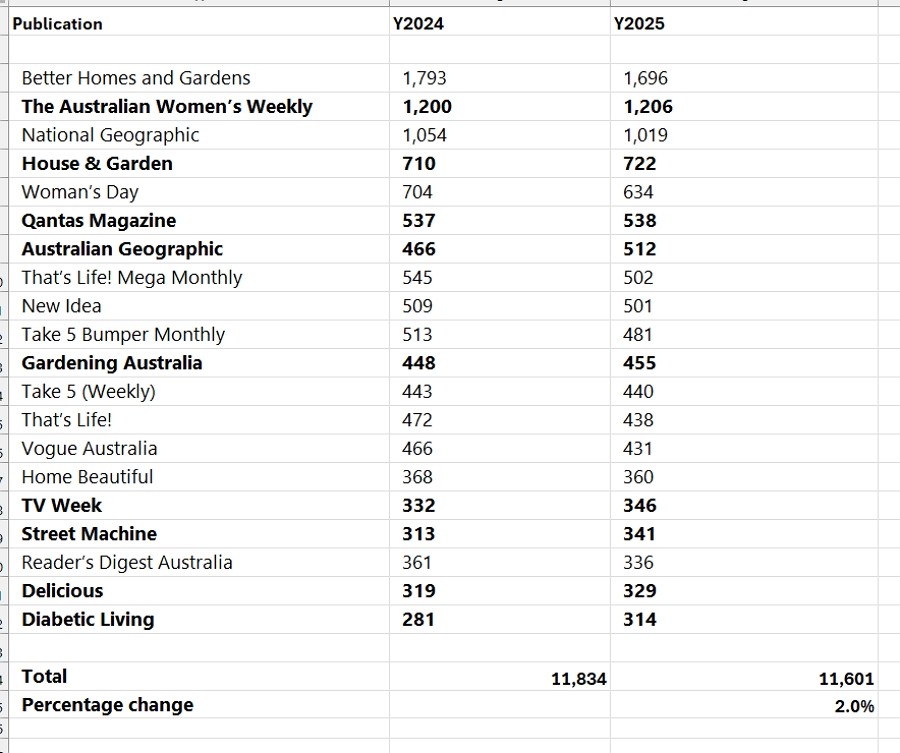
Roy Morgan magazine readership 2024/25


Roy Morgan 2025 Data: Niche Growth vs. Mass Market Decline

Analysing the "Top 25" magazines by print readership (excluding free titles like Coles Magazine), the market is seeing a slow squeeze rather than a cliff-edge drop. Across a sample of 20 major paid titles, the total print readership declined by approximately 2% year-on-year.

This aligns with broader market data showing that print readership is holding surprisingly steady. As of late 2025, over 10.9 million Australians (nearly half the population) still read a print magazine, and when digital audiences are included, that number jumps to over 14.6 million .

However, the stability is uneven. The market has split into two distinct directions:
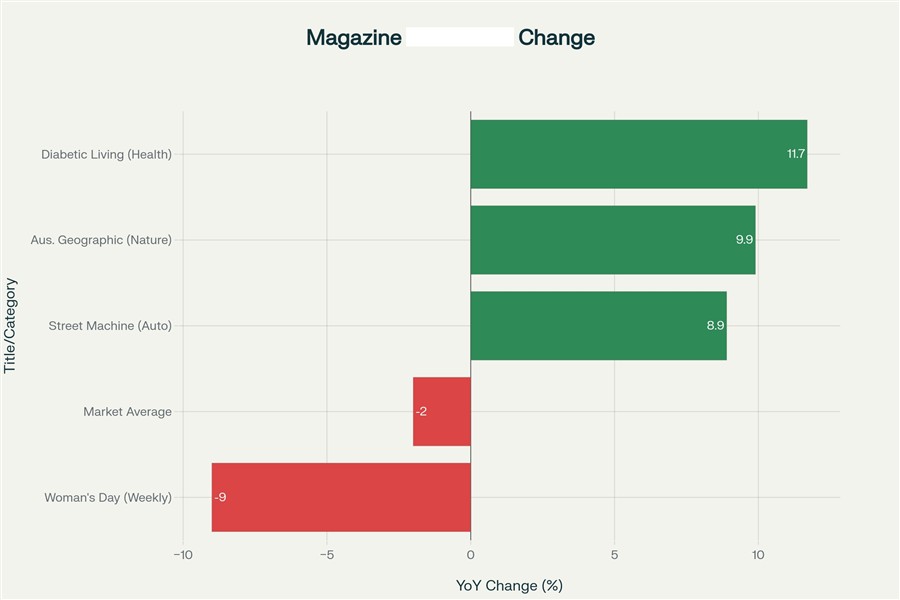
Change in magazine readership in 2024/25

  • Mass-market decline: General interest weeklies and "catch-all" lifestyle titles are under pressure. For example, major weeklies like Woman's Day have seen readership dips of around 9% in recent reports.
  • Niche growth: Specialist titles are thriving. Enthusiasts are still buying content they cannot easily find for free. We are seeing significant gains in titles such as Australian Geographic and House & Garden, as well as automotive titles such as Street Machine .

The "Neighbour" Effect

The 2% overall decline is so minor that most retailers wouldn't notice. The fact is that a store's performance depends more on local competition for retail profitability than on national trends.

Interestingly, here, benchmarks showed more than 50% of newsagents reported magazine sales are up in 2025.

I have seen this firsthand with a client whose magazine sales actually increased this year. Why? A nearby competitor drastically reduced their magazine display, effectively handing those customers over. The demand was still there; the competitor just stopped serving it. This proves that magazines can still be a viable category for those who commit to maintaining a proper range.

4 Strategies to Increase Magazine Profit in 2025

To make magazines work in this environment, you need to look less at official "readership" surveys. The relationship between a half-billion-dollar industry and your own shop is not much. Trust and use your own data.

1. Treat Your POS as the Source of Truth

Do not stock based on what publishers push; stock based on what sells. Use your POS system to run a monthly selling report by units sold and gross profit.

  • Expand facings for high-performing niche titles (hobbies, health, motoring).
  • Cut returns ruthlessly on titles that haven't performed for three consecutive months. These are just taking up space that could be used to sell magazines that do sell.

2. Avoid Driving Digital Migration

Warning: A critical mistake many retailers make is actively promoting publisher apps or digital subscriptions. When you display QR codes or marketing material for a "digital edition," you are training your customer to bypass your store.

3. Value the Magazine Shopper

Basket analysis consistently shows that magazine buyers are valuable. They rarely buy just a magazine. They over-index in high-margin impulse items such as greeting cards, stationery, and lotteries.

4. Long-term

Looking at magazine sales over 20 years, it's clear that magazines aren't a viable long-term investment. So I wouldn't suggest spending a lot of money on it based on long-term future growth, I know I would not, but you can still make money from it now.

Looking Ahead

Millions of Australians still pay for print magazines; it's still a big market. A magazine customer can be a good, repeat and loyal customer. We must be realistic: we cannot expect the boom times of the past, but with a data-led range focused on enthusiast niches, we can maintain a profitable category well into the future.

Written by:

Bernard Zimmermann


Bernard Zimmermann is the founding director of POS Solutions, a leading point-of-sale system company with 45 years of industry experience, now retired and seeking new opportunities. He consults with various organisations, from small businesses to large retailers and government institutions. Bernard is passionate about helping companies optimise their operations through innovative POS technology and enabling seamless customer experiences through effective software solutions.



Add new comment

Restricted HTML

  • Allowed HTML tags: <a href hreflang> <em> <strong> <cite> <blockquote cite> <code> <ul type> <ol start type> <li> <dl> <dt> <dd> <h2 id> <h3 id> <h4 id> <h5 id> <h6 id>
  • Lines and paragraphs break automatically.
  • Web page addresses and email addresses turn into links automatically.
CAPTCHA This question is for testing whether or not you are a human visitor and to prevent automated spam submissions. Image CAPTCHA
Enter the characters shown in the image.

XchangeIt Outage This Morning

POS SOFTWARE

XChangeIT

This morning, the popular communication system XchangeIt experienced an outage that left users unable to access the platform. Understandably, this caused frustration and confusion among users who rely on XchangeIt to get invoices.

One of the more concerning aspects of this outage was the lack of communication from the XchangeIt team. Besides a brief recorded message acknowledging an issue, no status updates or explanations were provided when we checked. This left users in the dark about what was going on and how long the problems might persist.

More transparency would have helped.

Now the problems are fixed. 

If you still have problems, please let us know.

Add new comment

Restricted HTML

  • Allowed HTML tags: <a href hreflang> <em> <strong> <cite> <blockquote cite> <code> <ul type> <ol start type> <li> <dl> <dt> <dd> <h2 id> <h3 id> <h4 id> <h5 id> <h6 id>
  • Lines and paragraphs break automatically.
  • Web page addresses and email addresses turn into links automatically.
CAPTCHA This question is for testing whether or not you are a human visitor and to prevent automated spam submissions. Image CAPTCHA
Enter the characters shown in the image.

XchangeIT, is it a fair and reasonable option?

POS SOFTWARE

Introduction

XchangeIT is a digital platform that enables newsagents to get electronic invoices for publications, among other things. It saves considerable time and work. Today businesses are seeking ways to optimise their processes and boost efficiency. Thus many have resorted to XchangeIT services to streamline their operations. Although widely used, XchangeIT has some vocal critics. In this post, I will explore my personal views on some of their comments.

Discussion points

Time-saving

The most significant advantage of using XchangeIT services is the time it saves people that sell magazines. To manually enter the information is very time-consuming. With XchangeIT services, they can automatically send you and receive your electronic data, freeing up valuable time for other tasks. It is a significant time saver for sellers of magazines.

Easy to use

XchangeIT services are straightforward to use. It does not need tech-savvy people to work it. The system is user-friendly and requires minimal work once set up. Other solutions tried, such as OCR, were much more complex.

Reliable

On balance, XchangeIT's services have been reliable. The platform seldom experiences downtime, although some significant problems have happened. Users can rely on the platform to receive their invoices on time.

Quality of data given by XchangeIT

The next common issue about XchangeIT is data quality by users. Bad data can result in them having to spend time manually rectifying these inaccuracies. The errors are mainly caused by the publishers, not XchangeIT's service. Still, it would be nice if XchangeIT introduced a better service to filter the publishers' data and flag them for errors. Our software includes such a service but can only aid so much. Ultimately, it is up to the publishers to improve the integrity of their data.

Cost

There is a cost for such services; someone must pay for it. The most controversial issue with XchangeIT services is the cost is primarily to the user. The user must pay to use this service. That the user must pay for this service has been disputed for many years. So why do newsagents have to pay for electronic invoices? The primary explanation is that this is how XchangeIT has operated for decades.

Monopoly

In my experience, only some retail sectors have such services where they exist; such services do not charge SMB retailers for using their services. Generally, suppliers often provide these services to gain customers' favour in competitive industries. Overall the accessibility of electronic invoicing isn't widespread in retail. But here, XchangeIT is a monopoly service. It is the only provider of electronic invoicing services for magazines to newsagents in Australia. If they want the info, they have no alternative but to use it to receive electronic bills and send return data for publications. The question raised here, which I don't know, is others, such as supermarkets being charged for this info; I suspect NO. This leads us to the next question raised so commonly with monopolies!

Fees

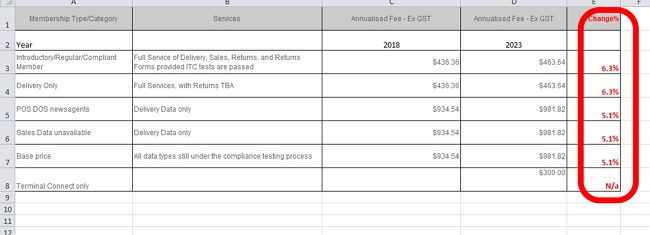
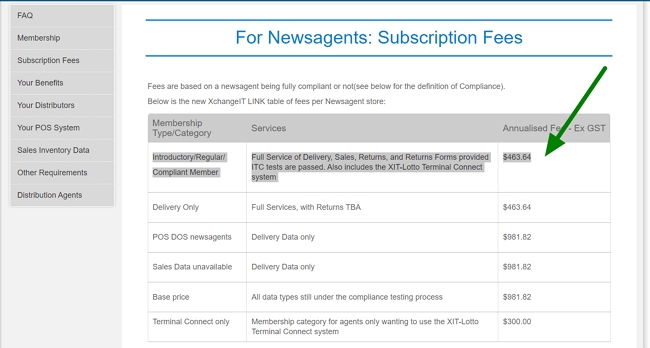
The fees themselves are not exorbitant, a regular client of ours spends about $10/week, and for the service, it is well worth it. See the fee structure below with the regular charge highlighted. This cost is a reasonable expense for a user for what it is. 

XchangeIT fees

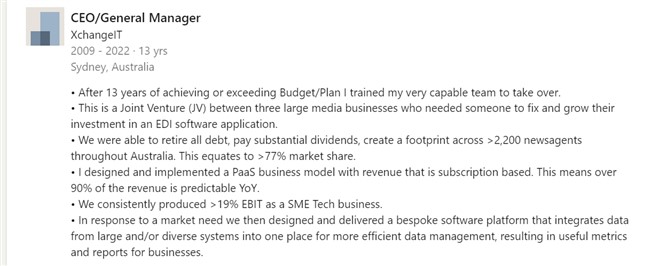
Yet the issue of whether the fees are fair is another point. While XchangeIT financials are not available to the public, the former general manager's report of XchangeIT states its EBIT (earnings before interest and taxes) is around 19%

General manager XchangeIT

This is an excellent score for a service claimed to be a service to the industry.

The other point is that for what it is, it does not seem to be such a complex task. I am sure my programmers can create a similar system to send user invoices at a lower price.

No wonder there are complaints that XchangeIT's services are exorbitantly priced.

Increasing fees

This complaint, I doubt, is valid that the fees are unreasonably going up. In the last five (5) years, the increase has been about 5%; this works out to about 1% yearly, much less than inflation.

Increase in XChangeIT charges

Users supply Sales Data for free. 

The claim that our clients give sales data to XchangeIT free is false. XchangeIT pays newsagents who give good data $500 annually for their data. See the table of costs above. By the way, it was only due to our concerns and arguments many years ago that newsagents got this $500. It was not part of the original plan. We had to go to the top to get it. At the meeting, no one else but us showed up to represent newsagents.

Conclusion

XchangeIT is a good service, well worth using. The costs are reasonable; I leave it to you to decide whether they are fair. 

Executive Summary

> XchangeIT is a digital platform for newsagents to get electronic invoices for publications and improve their operations.

> It saves time and effort for newsagents by automatically processing information.

> It is easy to use and reliable, with little technological difficulties.

>The cost to use this service has been disputed for many years, as users must pay.

>Data quality concerns exist.

>XchangeIt should strengthen its filtering system to improve data quality.

> It is a monopoly service that is highly profitable. This always rings warning bells with the public.

> The fees are affordable, and the rate of increase has been below inflation in the last five years.

> Clients are not obliged to supply sales data and are paid $500 yearly if they choose to provide it.

Add new comment

Restricted HTML

  • Allowed HTML tags: <a href hreflang> <em> <strong> <cite> <blockquote cite> <code> <ul type> <ol start type> <li> <dl> <dt> <dd> <h2 id> <h3 id> <h4 id> <h5 id> <h6 id>
  • Lines and paragraphs break automatically.
  • Web page addresses and email addresses turn into links automatically.
CAPTCHA This question is for testing whether or not you are a human visitor and to prevent automated spam submissions. Image CAPTCHA
Enter the characters shown in the image.

Transition of IPS Distributed Publications to Wrapaway

POS SOFTWARE

We have been talking to The Australian Lottery and Newsagents' Association about our thoughts that today, in 2021, it is unacceptable for publishers to make bids for the distribution of their titles without providing some form of EDI support to the sellers of these titles.

This is urgent as many of these titles are big sellers so producing a lot of *unnecessary* work.

Currently, these titles are affected. 
ERA
Highlife
The Saturday Paper
Best Bets
Winning Post
The Guardian Weekly
Scottish Banner
Swell; and
Ladies Golf

It appears, though, that many more titles are going to be affected.

Can you please contact the publishers of these titles to explain what this means for your company if you are affected? 

We would be very grateful.

The ANLA has sent the following newsletter out here, please read.

Add new comment

Restricted HTML

  • Allowed HTML tags: <a href hreflang> <em> <strong> <cite> <blockquote cite> <code> <ul type> <ol start type> <li> <dl> <dt> <dd> <h2 id> <h3 id> <h4 id> <h5 id> <h6 id>
  • Lines and paragraphs break automatically.
  • Web page addresses and email addresses turn into links automatically.
CAPTCHA This question is for testing whether or not you are a human visitor and to prevent automated spam submissions. Image CAPTCHA
Enter the characters shown in the image.

Magazine distribution report on newsagents

POS SOFTWARE


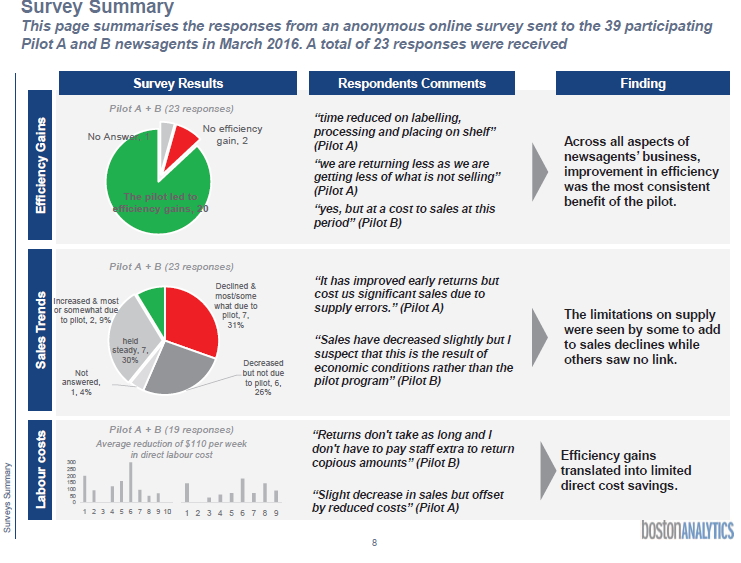
The magazine distributors requested the ACCC that they be allowed to do a magazine distribution trial. This resulted in many responses from many interested parties. As a result, they decided to make a hearing. I was invited to attend. Where it was decided to allow the magazine companies to do trials on magazines. The Magazine Networks then engaged Boston Analytics to assess the results of their tests. This report of these trials is starting to be released. We received an advanced copy today as we have been closely involved probably more than anyone else, and I expect in a few days everyone interested will be able to get their own copy [[ here]].

Overall what will happen at present is in doubt, as it has greatly changed magazine distribution recently with the exit of Bauer Media, leaving Gordon & Gotch, which has taken over much. Gordon and Gotch never seemed greatly interested in this project, so what happens from this moment in time on this is unclear.

Overall, I would like to make some comments.

What the Magazine companies did was divide about 60 shops into three groups, the first group (A) Stores, they limited supply to those magazines that they thought could sell, and they gave additional layout and range advice. The second group (B), all they did was limited supply to those magazines that they thought could sell and the last group (C) they did nothing but made sure that they were similar shops, so they could compare the results.

What they found as a result of the trial.

Group A - Sales dropped 8%, and its return rate was 39.2%

Group B - Sales dropped 13%, and its return rate was 38.5%

Group C - Sales dropped 3%, and its return rate was 47% (these figures, I averaged)

Now before you think between A & B groups that there is a big difference, one shop in group A in the middle of, the trial gained a huge subagent, so increasing its sale of magazines by 58%. So I think it should have been removed, but it was not and if you remove this shop from the mix, I get Group A and B as having an almost identical result say about 11% drop.

To me, these figures do not look that good. Yes, there is an 18% drop in returns, which would save a shop much in time and work, but I think most would say that saving is not worth an 8% drop in sales.

It is interesting to read the comment at the end of the report by newsagents here which I think agrees with my conclusion.


Update: Although in what many involved in this project would consider bad faith and a blatant violation of trust, this document was recklessly published early by a competitor. You should not do things like this. In any case now the document, however, is available at the above address for viewing and discussion.