Point of Sale Software

Here are some Articles from the Blog Subject - Cloud Backup -

Please Do a Proper Backup of Your Information
POS SOFTWARE

POS Backup safety


I've spent years fixing point-of-sale problems for SMB retailers, and I can tell you that all lost data disasters come down to one thing: no real backup. A computer is a mechanical device, and mechanical devices fail. When that happens, what happens to the years of information you've built up? In this guide, I'll walk you through what actually works, based on what I've seen go wrong in real shops.


Key Takeaways

  • Computer hardware failure is the leading cause of lost retail data.
  • USB drives left plugged into a till get destroyed by the exact same fire, flood, or theft that destroys the computer.
  • Free OneDrive cloud backup gives you an automatic, off-site copy of your POS database.
  • Retail is one of the most common targets for ransomware.
  • Use the 3-2-1 backup rule to protect your business.
  • Australian tax law requires you to keep business records, including backups, for at least five years.
  • Regular test restores are the only reliable way to know your backup actually works.

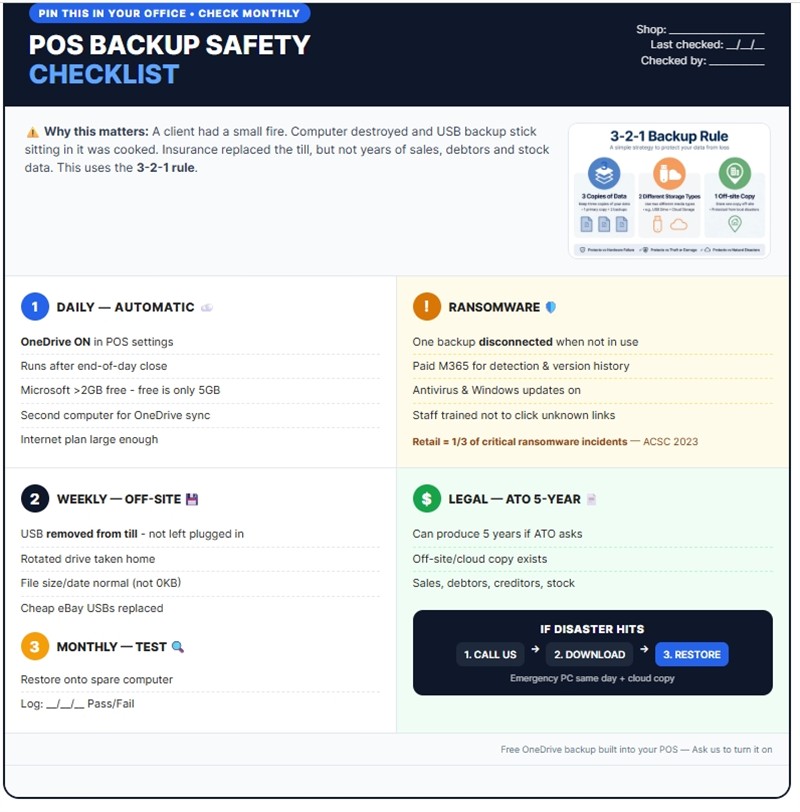
Yesterday, one of our clients had a small fire. The computer was destroyed, and the backup on a USB stick sitting in the computer was cooked. Their information is probably gone for good. We are trying to save the hard drive. What you need in your shop at all times is a proper backup system, something to keep a copy of your information safe if something goes wrong. 

We can send a new computer out with fresh software installed within a day or two. Insurance may pay for it, but what no one can replace is the years of information stored on your computer.

Your POS system is your information hub. From my experience, most lost information comes down to computer hardware failing. When your computer stops working, you lose access to everything stored on it. For example, if your debtors list only lives on your till, a single hardware failure could leave you with no idea who owes you money or how much. Now add the loss of your stock quantities, sales history, and supplier records on top of that, and you've got a genuine crisis on your hands. To stop this from happening to you, there are three questions worth asking yourself honestly:

Here Are Some Questions You Need to Answer

  • How much information are you willing to lose? A day's worth? An hour's worth?
  • How fast do you need your data back? This is what we call your Recovery Time Objective.
  • How much are you actually prepared to pay for this protection?

In my experience, most retailers find daily backups sufficient. They're willing, in the worst case, to lose one day of trading data. Retailers who feel they need tighter protection generally have to stop trading briefly during the day to run a quick manual backup. Some businesses want continuous, real-time backup, but that's not cheap, and in practice it can get messy fast.

Let's go through the common backup methods retailers actually use, starting with the one I recommend most often. Here is a table of the pros and cons of each:

Backup Method Cost Off-Site Protection Ransomware Risk Best Use
USB drive Low, one-off None (if left plugged in) High Quick file transfers
Free OneDrive Free Yes Medium (free tier) Daily automatic backup
Paid OneDrive (M365) Subscription Yes Low (with ransomware detection) Full protection
External SSD (rotated off-site) Moderate, one-off Yes (if rotated) Low (if disconnected) Local + off-site mix

How Does Our Free OneDrive Cloud Backup Work?

Our free OneDrive cloud backup is a built-in feature that automatically copies your POS database to secure cloud storage, at no extra cost or effort on your part. There are other cloud services our clients use, but out of everything I've tested, Microsoft OneDrive gives the best mix of reliability, security, and ease of use. Setting it up doesn't take long through your POS software settings. Once it's switched on, the backup runs quietly in the background after each trading day closes, so nobody has to remember to do anything.

The big advantage of a cloud solution like this is that it stores your backup files completely off-site, away from your shop. That's exactly what protects you against fire, flood, or theft, because your files simply aren't in the building when disaster strikes. What I also like is that you can access your information from anywhere, whether you're at home or at the shop. It's genuinely handy if you do any of your admin work from home.

What I find is that cloud backups cut business downtime greatly, as our hardware department can obtain a copy of your data immediately. We can set up an emergency computer and have it shipped to you, often on the same day.

Free, off-site, and automatic. That's a hard combination to beat.

What You Still Need to Watch With OneDrive

Setting up OneDrive doesn't mean you can switch your brain off completely. You still need to monitor it regularly to make sure your Microsoft account has enough free storage space, since OneDrive's free tier has quite limited storage. You also need to test it regularly to confirm the backup file actually works properly. We had a client whose OneDrive backups, we discovered, were only capturing part of their information, silently, for months.

A simple method I've found works well in practice is backing up your till's information to a second computer in the shop, then using that second machine to run the OneDrive backup. This approach doesn't fully protect you against ransomware, although it does help. To get full protection on OneDrive, you need to use a paid OneDrive subscription. Many retailers use Microsoft 365, which includes such a paid subscription. OneDrive also uses a fair amount of your computer's processing power, which is another reason I recommend running the OneDrive backup from a separate machine, and it will chew through your internet data too. If you're on a small internet plan, this setup simply won't work well for you.

USB Drives for Backup

USB drives are the most common backup method retailers use, and they're fast, portable, and cheap. They're genuinely useful tools, they don't rely on any ongoing subscription fees, and they don't need an internet connection to work at all.

The Serious Drawbacks for Retail Backup

Today, there are too many cheap USB drives being sold, and while not every cheap USB stick uses low-quality parts, plenty do. One client bought some on eBay, and they worked fine for a few uses before failing completely. Be careful where you buy them, and don't assume a low price means a bargain.

This ties into a bigger issue: all USB drives have a limited life expectancy, and older drives become steadily less reliable over time. That's not a huge problem by itself, since they're cheap to replace. The real problem is that a USB stick usually doesn't warn you when it has failed. You might genuinely believe you're backing up your data every night, when you're not backing up anything useful at all. Any backup system needs regular checking, and USB sticks are no exception to that rule.

In practice, I see people leaving USB drives plugged into the till all day. If the computer is stolen or destroyed, that USB drive goes with it. Do not do this.

How Does Ransomware Target USB and Cloud Backups?

Ransomware today mostly targets small and medium businesses, and retail is one of its favourite hunting grounds. "The retail and trade sector accounted for approximately one-third of all critical ransomware incidents recorded nationally — Source: Australian Cyber Security Centre, 2023". Once ransomware gets into your system, it will attack everything it can reach if you let it.

What ransomware actually does, once it's inside your computer, is search for everything connected: external hard drives, USB sticks, and shared online folders. Then it locks all of it at once. Both free-tier OneDrive and a USB stick plugged into your till are easy targets for this kind of attack. Once your files are locked, your computer is effectively useless unless you pay the ransom, and even then there's no guarantee.

This is exactly why the 3-2-1 system exists.

How Does the 3-2-1 Backup Rule Protect a Business?

The 3-2-1 backup rule protects your business by making sure you always have three copies of your data, stored across two different types of storage, with one copy kept permanently off-site. This well-known rule means no single fire, flood, or cyberattack can wipe out every copy of your data at once.

Have Three Backups at All Times

Keeping three separate backups means that if something goes wrong with one copy, you've still got two others to fall back on. This redundancy is what actually saves your business when disaster strikes.

Store Backups on Two Different Types of Storage

Using different storage types means that if one kind of backup develops a fault, you've got a completely different system to fall back on in an emergency. For instance, a USB drive and a cloud backup fail in totally different ways, so relying on both gives you protection a single storage type can't. Mixing storage types is one of the simplest ways to remove a single point of failure from your business.

Keep One Copy Off-Site at All Times

An off-site backup protects your data because it's physically cut off from your shop's computer network, so hackers, ransomware, and power surges simply can't reach it. For example, a rotated external drive kept at home, or a cloud backup like OneDrive, both satisfy this rule in different ways. Being disconnected from your local network is the single strongest protection you have against a targeted cyberattack.

Why Should You Run Regular Backup Test Drills?

You should run regular backup test drills because it's the only reliable way to know how your backup will actually perform before you're forced to rely on it in a real emergency. There's no getting out of this step, no matter how confident you feel about your current setup. I've seen backups that looked perfectly fine on paper fail completely the moment someone actually tried to restore them.

Every few months, take the time to restore a recent backup onto a spare computer and check that everything opens properly.

What Does Australian Law Say About Backing Up Your Data?

Under Australian tax law, you're legally required to keep business records, including backups, for at least five years. If your backups fail for any reason and you can't produce the records the ATO asks for, you can face penalties or have deductions denied outright . One client of mine found this out the hard way recently, telling the ATO he couldn't confirm certain figures because he had no backup of his data, and it proved genuinely expensive.

"Businesses must keep records of all transactions relating to their tax, super, and registration obligations for five years Source: Australian Taxation Office, 2026"

This isn't just a good idea. It's a legal obligation, and the ATO explicitly recommends keeping an off-site or cloud copy of your records as part of meeting that obligation.

Conclusion: Protect Your Shop Before Disaster Strikes

Point of sale system disaster recovery isn't optional. It's a basic part of running a safe, stable retail business. The fire that hit our client this week could happen to any shop, on any day, with no warning at all.

Your insurance will replace a burnt-out till overnight, but it won't replace years of sales records, customer accounts, or supplier invoices. Take the time this week to turn on your free OneDrive backup, stop relying solely on that USB stick in the back of your till, and build yourself a proper 3-2-1 backup routine. It takes minutes to set up, and it's the difference between a bad day and a business-ending disaster.

Written by:

Bernard Zimmermann


Bernard Zimmermann is the founding director at POS Solutions, a leading point-of-sale system company with 45 years of industry experience. He consults to various organisations, from small businesses to large retailers and government institutions. Bernard is passionate about helping companies optimise their operations through innovative POS technology and enabling seamless customer experiences through effective software solutions.

 

Add new comment

Restricted HTML

  • Allowed HTML tags: <a href hreflang> <em> <strong> <cite> <blockquote cite> <code> <ul type> <ol start type> <li> <dl> <dt> <dd> <h2 id> <h3 id> <h4 id> <h5 id> <h6 id>
  • Lines and paragraphs break automatically.
  • Web page addresses and email addresses turn into links automatically.
CAPTCHA This question is for testing whether or not you are a human visitor and to prevent automated spam submissions. Image CAPTCHA
Enter the characters shown in the image.

How to keep your Business Records Safe in the Long-Term

POS SOFTWARE

As a retailer, you need to keep records for years. Government regulations, legal needs, or even access to old customer data are all important! I sometimes had to access very old information just for commercial reasons, 20+ years ago.

Now, have you thought about how long your digital records will last?

Sadly, the hard drives and discs we use aren't built to last centuries, unlike the old carvings archaeologists have been uncovering up to today. Let's look into long-term storage, so you make the right choices.

How Long to Keep Retail Records

In Australia, retailers should keep POS system records, invoices, receipts, daily reports, and end-of-day summaries for at least five years. However, seven years is safer under Australian Tax Office guidelines. Keep payroll records for a full seven years, too. Extend that period if the records relate to assets, warranties, or legal disputes.

Tip: Plan on a minimum of 7 years, longer if any risk or court matter exists.

Here is a detailed table of the times required, I have put together and by who wants it 


Business Record Retention & Disposal Schedule

Record Category Specific Record Examples Retention Period Governing Body (Link) Suggested Action After Period
Tax & Revenue Invoices, receipts, bank statements, BAS, GST records. 5 Years from the date of lodgement. ATO Secure Destruction
Depreciating Assets Receipts for equipment, vehicles, or property used for business. Life of Asset + 5 Years after disposal. ATO Secure Destruction
Employee Records Pay slips, hours worked, leave balances, tax file declarations. 7 Years from the date the record was made. Fair Work Secure Destruction
Superannuation Proof of payments, choice of fund forms, contribution reports. 5 Years ATO Secure Destruction
Company Governance Minutes of meetings, registers of members/directors. 7 Years ASIC Archive permanently if historical
Customer Personal Data Contact details, marketing preferences, IDs for verification. Destroy immediately once the purpose is fulfilled. OAIC (Privacy Act) Secure Deletion / De-identify
Work Health & Safety Incident reports, risk assessments, training logs. 5 Years (varies by State, e.g., WorkSafe VIC). State Govt / Cyber Security Archive
Legal/Contracts Signed contracts, leases, insurance policies. 7 Years after the contract ends. General Law Review/Destroy

I will add that, personally, I am not in favour of deletion unless you have to, as you never know when you might need the information. For example, a client of mine is involved in a case linked to 2006. When records this old are missing, courts accepted that as reasonable, but then it becomes their word against the other party's. This is not a good position to be in! 
 

We call this a Potential Litigation Hold.

What Lasts, What Doesn't, and How to Make it Better

  • Cloud storage: Theoretically, it lasts forever, but there will be issues.
  • Magnetic Tapes to the Rescue? These can, under ideal conditions, last a long time, but few of us actually have the specialised equipment. Besides, it's often a pain to use.
  • Old-fashioned Hard Drives: Most last about 3-7 years, though a lucky few last longer. To keep them, you need to use them; otherwise, they deteriorate after about two years.
Warning: Most SSDs won't outlive their 5-10-year warranties and, if left unused, will deteriorate faster than old-fashioned hard drives because they need to be powered on occasionally to refresh their data.
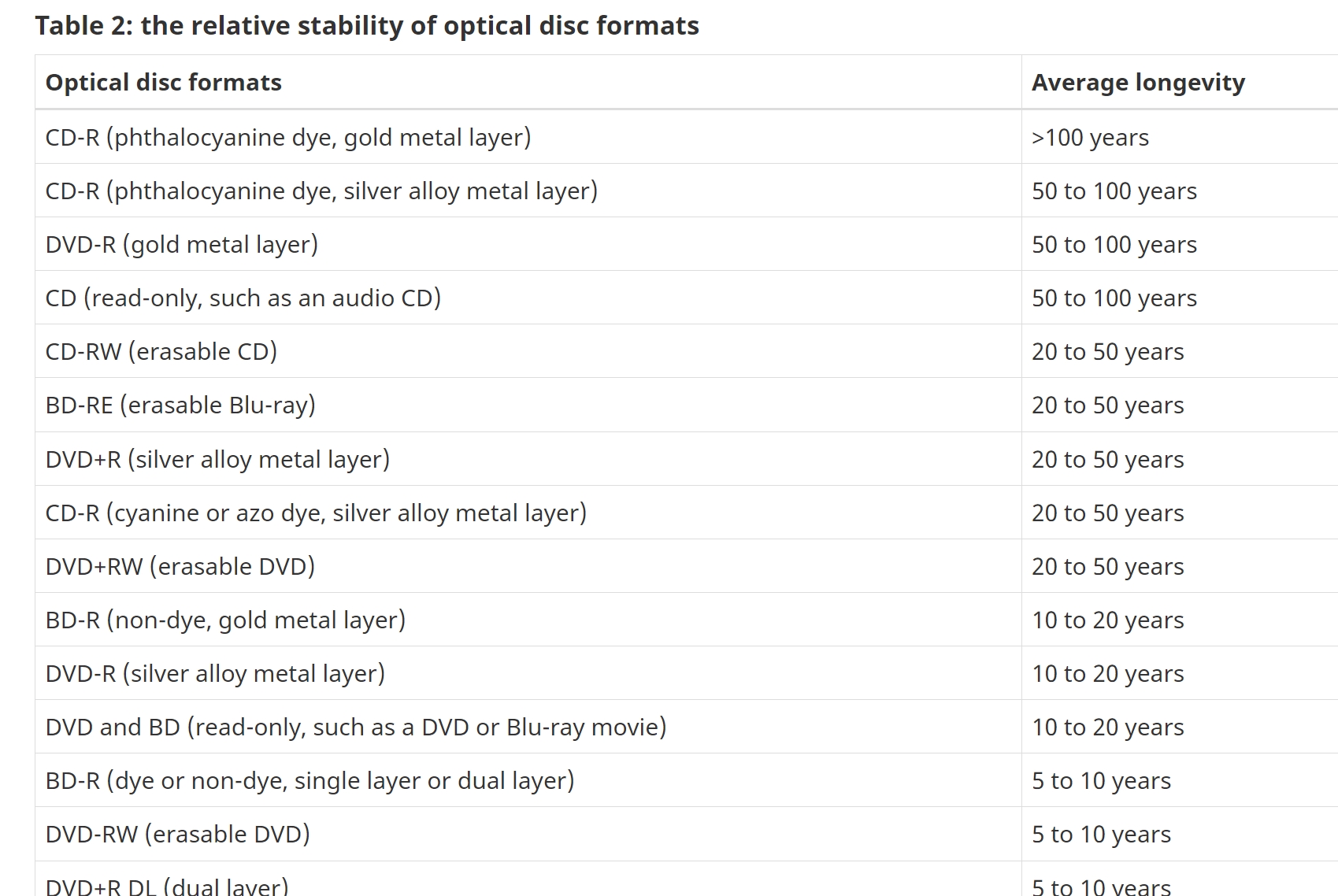
  • Optical Discs: Please aim for quality; write-once media like Verbatim Gold have longer longevity, and the cheaper ones have much less. For CDs and DVDs, you are looking at 5 to 100 years, depending on the type. When I went to the Verbatim website and looked at their warranty here, I noticed they only offer a 2-year warranty, which does not include a data retention guarantee. The courts may have something to say about that, but few people want to have to argue this in court.

Most people today, when considering very long-term storage, look to DVDs because they are both convenient and economical. If you go this route, here is how to do it:

Protecting Your Precious Data on CDs and DVDs:

It depends on three main factors:

  1. Have more than one backup. I argue that you do not have a backup if you have only one. These two backups should be stored in different locations so that if anything happens to one, the other is safe elsewhere.
  2. You need good-quality DVDs. There are good reasons why they are a bit dearer. This comes from a Canadian government study, which you can find here.

Long term CD and DVD life

  1. Environment matters! Pick a place:
  • Cool & Dry: Store items at around 20°C with about 40% humidity.

Caution: Heat and humidity are the silent killers! This can be a problem, as we often exceed this in the summer. Do you have a cellar? Avoid garages or attics where temperatures can swing wildly!

  • The Dark Side: Store discs in cases out of direct sunlight. I put a sealed plastic bag over them.
  • Peace & Quiet: Avoid putting the discs where they will be moved or dropped.

Using DVDs for archiving business and POS records has distinct advantages and drawbacks, especially compared to modern hard drives or cloud storage.

Pros of DVD Storage

  • Long lifespan: High-quality, archival-grade discs (such as those with a gold metal layer) can last 50 to 100 years when stored in the right environmental conditions.
  • Tamper-proof: Standard recordable DVDs (DVD-R or DVD+R) are write-once media, meaning that once your data is burned onto the disc, it cannot be accidentally deleted, overwritten, or infected by ransomware.
  • True offline security: DVDs provide "air-gapped" cold storage. Because they sit on a shelf rather than being connected to a network, they are completely immune to online hacking or cloud policy deletions.
  • Excellent for chunking: DVDs are great for archiving specific, yearly projects (like a disc labelled "FY2025 Accounts"); other methods, like the cloud, tend to mix up your data.

Cons of DVD Storage

  • Low capacity: A standard DVD holds 4.7 GB, dual-layer 8.5 GB. Suitable for text reports and spreadsheets but insufficient for larger files, requiring the management of multiple discs.
  • Slow write speeds: Burning data is slower than on fast SSDs and USB drives.
  • Vulnerable to damage: DVDs degrade within 5-10 years due to heat, humidity, sunlight, or scratches, often going unnoticed until it's too late.
  • Limited hardware support: Modern computers rarely have built-in DVD drives.

Cloud Storage

As the limitations of physical storage have become increasingly apparent, cloud storage emerges as a compelling solution for preserving your digital legacy. In theory, entrusting your data to a reputable cloud provider can overcome many of these problems.

Pros:

  • Accuracy: Today, many Cloud storage providers offer an astonishing rate of accuracy in their storage capacity. One I saw doing an online search offering 99.999999999% (that's 11 9s!) data durability. That far exceeds the reliability of any physical media.
  • Dispersed storage: Many Cloud providers store your data across multiple geographically dispersed data centres, ensuring redundancy and resilience.
  • Easy access: Your data is available on demand from any internet-connected device, anytime, anywhere.

Cons:

  • Cost: Generally, it costs, though many, like Google and Microsoft, offer a limited free plan.
  • Future uncertainty: Considering the time frame we are looking at here, a cloud provider could go out of business, change its policies, and who knows what else.
  • Policy: Some cloud providers, e.g. Google, state that they "reserve the right to delete an inactive Google Account and its activity and data if you are inactive across Google for at least two years." So every two years, you have to log in to your account and say, "Hey, this account is still active." It's not a big ask, but it's not entirely set-and-forget.
  • Remembering passwords: Cloud accounts rely on account names, passwords, and, increasingly, mobile numbers. Over the next 10 to 20 years, how will you remember these details? Will you have the same mobile number then? If someone else has access to your account and its passwords, they can also access your data.
  • Control: In an overall sense, you do lack control.
  • Privacy concerns: Be aware of potential changes in data privacy laws or a provider's terms of service. Although few of my clients have an issue here now, the privacy laws are slowly turning to the idea that much data businesses store must be held in Australia, not an issue now, but who knows in 10 to 20 years.

Summing up:

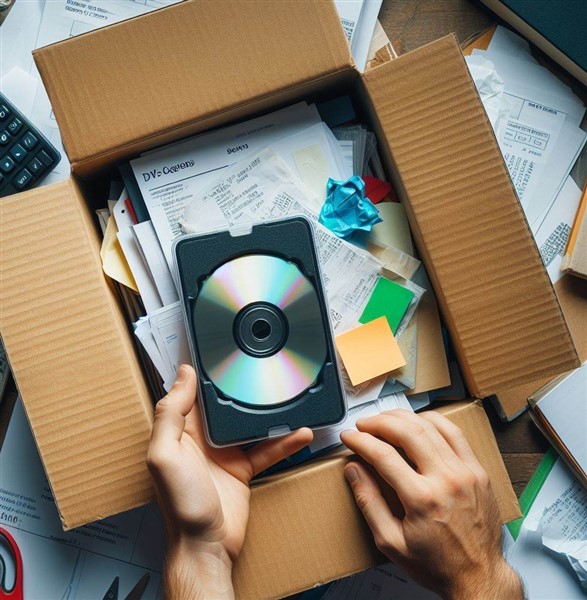
Overall, my preference would be to burn two copies of my business records onto a good-quality DVD. Put them with your business records in a safe place in your house in a protective box, as seen here:

Long term storage

I would then put a copy on a free service like Google, which I could access anytime, anywhere.


If you decide to go this route, here is a suggested policy

Management of Archived Physical Media (DVD/CD)

Effective Date: [Insert Date]

Objective: To ensure business compliance with the Privacy Act 1988 and ATO record-keeping requirements when using non-rewritable storage media.

Access Controls (Security)
Physical Lockdown: All archived DVDs containing personal or financial information are stored in a secured room, fireproof cabinet or safe.

Restricted Access: Only [Insert Job Title, e.g., Business Owner] is authorized to access the archive.

No Active Use: Staff are strictly prohibited from accessing, copying, or disclosing personal data from archived discs for marketing or general business operations.

Labelling & Warning
Every archived disc or its protective sleeve must be clearly labelled with a Generic Warning.
Label Template: “ARCHIVED DATA: [Year Range]. Contains personal information. Access restricted. DO NOT USE. 

Final Disposal (Destruction)
If you decide to destory the disc, it must be irretrievably destroyed. 

Note: Simply throwing a disc in the general waste or scratching it by hand is not sufficient.

Conclusion

Long-term record storage isn't just about compliance; it's about keeping your retail history available and trustworthy for years to come.

Want to get your data storage sorted? Contact us for a free consultation!

Frequently Asked Questions (FAQ)

Q: Can I leave my POS backups on a USB thumb drive in a drawer?
A: No, I highly advise against this. USB flash drives use similar technology to SSDs. If sitting unpowered in a draw for years, they can lose their charge, and your data may silently corrupt or vanish. They are great for moving files around today, but terrible for 10-year storage.

Q: Does the ATO accept digital copies, or do I need the original paper receipts?

Info: The Australian Tax Office (ATO) accepts digital copies of your records and receipts, provided they are true, clear, and complete copies of the original. Once you have securely backed up the digital file (like on a DVD and in the cloud), you don't necessarily need to keep the fading paper thermal receipts.

Q: What is the best brand of DVD for long-term archiving?
A: Look for "Archival Grade" or "Gold" DVDs. Brands like Verbatim (specifically their Gold Archival range) or CMC Pro are widely trusted. They use a gold reflective layer that resists oxidation and degrades much better than the cheap silver discs you buy in bulk at the supermarket.

Q: Is it enough to email the backup to myself?
A: I do that, and it's okay for a quick, temporary backup, but it shouldn't be your only long-term strategy. Emails can be accidentally deleted, end up in junk folders, or become inaccessible if your email provider changes policies or you get locked out of your account 10 years from now.

Written by:

Bernard Zimmermann


Bernard Zimmermann is the founding director of POS Solutions, a leading point-of-sale system company with 45 years of industry experience, now retired and seeking new opportunities. He consults with various organisations, from small businesses to large retailers and government institutions. Bernard is passionate about helping companies optimise their operations through innovative POS technology and enabling seamless customer experiences through effective software solutions.


Comments

Great advice on long-term data storage! I agree that having multiple backups in different formats—like quality DVDs and cloud storage—is crucial. Ensuring your data is stored in a cool, dry place, away from sunlight, can make a significant difference in its longevity. Cloud storage, while convenient, does come with some risks.

Add new comment

Restricted HTML

  • Allowed HTML tags: <a href hreflang> <em> <strong> <cite> <blockquote cite> <code> <ul type> <ol start type> <li> <dl> <dt> <dd> <h2 id> <h3 id> <h4 id> <h5 id> <h6 id>
  • Lines and paragraphs break automatically.
  • Web page addresses and email addresses turn into links automatically.
CAPTCHA This question is for testing whether or not you are a human visitor and to prevent automated spam submissions. Image CAPTCHA
Enter the characters shown in the image.

THE IMPORTANCE OF BACKUPS

POS SOFTWARE

Throughout my years in computers and retail. However, nothing beats the gut-wrenching moment when you discover your data is lost. I want to share a recent situation that drove home the essential nature of backups for a retail shop.

The Fire That Changed Everything

Recently, I answered a call that left me feeling sick. One of our customers had experienced a catastrophic fire, with their store's computer caught in the destruction. The technician's voice was heavy with dread as he shared the grim reality: No backups. It's incredible how those eight letters can spell disaster.

The Waiting Game

Now, we're playing a nerve-wracking waiting game. Will the computer survive? Sometimes, they do. I've witnessed hard drives burnt with their data intact. Once, we even rebuilt a drive in Perth by a company specialising in salvaging precious information on hard drives. But it's all a point.

The Harsh Reality

If only they had a backup. With a backup, we could have sent them a new computer, and they'd be up and running in no time. Even with the shop closed, they could've sent out customer statements, keeping their business ticking over.

Legal Responsibilities

Many retailers don't realise it's your legal responsibility to have backups. The big tech companies make this crystal clear in their terms of service.

Take Apple, for instance. Their contract states:

"TO THE GREATEST EXTENT PERMISSIBLE BY APPLICABLE LAW, APPLE DOES NOT GUARANTEE OR WARRANT THAT ANY CONTENT YOU MAY STORE OR ACCESS THROUGH THE SERVICE WILL NOT BE SUBJECT TO INADVERTENT DAMAGE, CORRUPTION, LOSS, OR REMOVAL IN ACCORDANCE WITH THE TERMS OF THIS AGREEMENT, AND APPLE SHALL NOT BE RESPONSIBLE SHOULD SUCH DAMAGE, CORRUPTION, LOSS, OR REMOVAL OCCUR. It is your responsibility to maintain appropriate alternate backup of your information and data."

Microsoft is even more blunt:

"You are wholly responsible for configuring your Customer Solution to ensure adequate security, protection, and backup of Customer Data."

I've heard that US courts have ruled that not having a backup is considered misuse. It's an obligation.

In Australia, while no single comprehensive law mandating backups, various regulations and industry standards effectively require or strongly recommend maintaining adequate backup systems. The responsibility for implementing and managing backups generally falls on the business or organisation.

Backups and Your Point-of-Sale System

In retail, your Point-of-Sale (POS) system information is the heart of your business. That's why a backup is essential. At the very least, you should back up your data daily, and many of our clients do it even more frequently.

The Cost of Neglect

Let's break down what you stand to lose without a proper backup:

  • Sales Records: You could lose your entire financial history, leading to significant tax compliance issues.
  • Inventory: You're looking at a reordering nightmare without accurate stock levels.
  • Customer Information: Say goodbye to your loyalty programs and valuable contact details.
  • Employee Data: Prepare for payroll headaches and scheduling chaos.

Making Backups a Habit

Here's how you can protect your business:

  1. Schedule daily backups: There are automated systems that use cloud storage that allow you almost to set and forget.
  2. Use multiple backup methods: The cheapest and most popular methods are external hard drives and USB sticks.

Whichever way you need to

  1. Test your backups regularly: A backup is useless if you can't restore from it.
  2. Train your staff: Make sure everyone knows the importance of data protection.

Remember, it's about protecting against catastrophic events.

The Bottom Line

Invest in a robust backup system today. Trust me, your future self will thank you.

Add new comment

Restricted HTML

  • Allowed HTML tags: <a href hreflang> <em> <strong> <cite> <blockquote cite> <code> <ul type> <ol start type> <li> <dl> <dt> <dd> <h2 id> <h3 id> <h4 id> <h5 id> <h6 id>
  • Lines and paragraphs break automatically.
  • Web page addresses and email addresses turn into links automatically.
CAPTCHA This question is for testing whether or not you are a human visitor and to prevent automated spam submissions. Image CAPTCHA
Enter the characters shown in the image.

What if cloud backup fails?

POS SOFTWARE

Let's be honest: technology isn't perfect. Even the most reliable cloud backup plans to protect your point of sale (POS) data can sometimes have hiccups. As a business owner, the last thing you want to worry about is your information because your POS system is a lifeline!

Why You Need a Backup... Even for Your Backup

Computers aren't invincible. Hardware fails, drinks get spilled, and sometimes random glitches happen. Having an off-site backup (stored somewhere other than your shop) gives you peace of mind. If something goes wrong with your POS, that backup can help you recover quickly. Cloud backups are amazing, but they are not foolproof.

Reasons Why Cloud Backup Might Let You Down

Power's Out

If your shop loses power and your device isn't plugged in, no backup will happen.

Storage Limits

Some cloud plans don't offer enough space. Big updates or lots of inventory can eat up your storage.

Internet Woes

If your internet is slow or cuts out, that backup could get stuck.

Service Issues

Even big cloud providers sometimes have technical problems on their end.

It's not about scaring you away from the cloud, but about being prepared!

Backup Plans for Your Backup Plan

Check It Regularly

Don't just assume it's working. Log in and make sure those backups are happening.

Consider a portable Hard Drive

An old-school portable hard drive adds an extra layer of protection.

Use your home computer

This is what I do, I make a backup of my cloud once a week on my home computer

The Dreaded Ransomware

Yikes, even your cloud backup can be at risk from nasty ransomware attacks. Here are a couple of smart moves:

Turn It On/Off Strategically

If you're worried, turn cloud backup off while you work. It can hog your internet anyway.

Version Control

Some cloud services let you keep older versions of files, just in case something is corrupted.

How Much Does Cloud Backup Cost?

You can get by with many free plans, and for not much more you can get plenty of storage. Some popular options include:

OneDrive

If you need a lot more space than their basic free 5GB plan, they have much bigger plans for $2 a month.

Google

They also have competitive deals worth checking out.

One good thing about Google and Microsoft is that they often throw in many extras with their cloud offerings so check them out.

The Importance of Good Internet

Cloud backup relies on a strong internet connection. Make sure you have a solid plan that can handle the data you need to back up.

We're Here to Help!

Feeling a bit overwhelmed? Don't stress! Our POS company is here to guide you through finding the most secure, fail-proof backup plan for your small business.