The POS Solutions AI Chatbot Surcharge Schedule
Australia’s card-surcharging rules changed on 1 October 2026. Today we can no longer add surcharges to payments made through designated card networks, while lower domestic interchange caps also began applying.
The difficulty for retailers is that the full effect on merchant-service costs will not be clear immediately. The first industry data is due by 30 October 2026, pass-through information from large acquirers is due from 30 January 2027, and enhanced merchant statements will begin from 1 April 2027.
This staged release is frustrating for retailers who need to understand their costs now. In the meantime, the most practical approach is to establish a reliable baseline and review the available information as each official milestone arrives.
The POS Solutions AI chatbot schedule is designed to help retailers do that. It can organise the available information, compare payment costs over time and help identify questions to put to a payment provider. However, a retailer’s own contract, pricing plan, transaction volume and card mix will determine the final result. If you send us your quotes or contracts, we will run them through the AI.
Why is the information released in stages?
The information is being released in stages because different parts of the changes depend on different reporting periods, and the change has set implementation dates.
The first reports provide industry and network data. Later reports are intended to show how changes in interchange fees flowed through to merchant-service fees. From April 2027, we should receive enhanced merchant statements that hopefully will make payment-cost information easier for retailers to identify and compare.
The first report, due by 30 October 2026, covers the quarter from 1 July to 30 September 2026. This period ended before the new rules began, so it provides a pre-change baseline rather than a direct measure of the effect on a retailer’s costs. The information will be useful for comparison, but it will not automatically determine what an individual retailer should be paying. A retailer’s result will still depend on its payment contract, pricing model, provider charges and card mix.
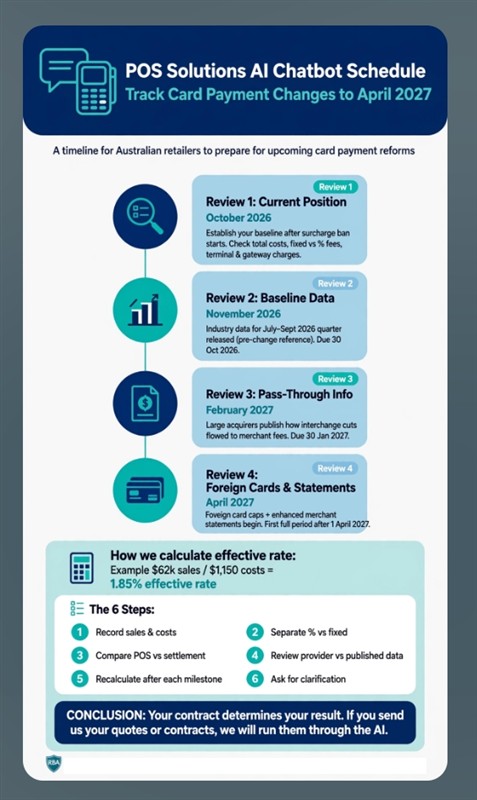
The review schedule
POS Solutions plans to release the available information approximately two weeks after each milestone. This allows time for relevant reports and provider information to become available and a distillation to be done and checked.
| POS Solutions AI review | Timing | What it examines |
|---|---|---|
| Review 1: Current position | October 2026 | Whether the retailer’s statements and POS data provide a reliable starting point |
| Review 2: Baseline data | November 2026 | Industry and provider data published after the 30 October reporting deadline |
| Review 3: Pass-through information | February 2027 | Published information about how interchange reductions flowed through to merchant-service fees |
| Review 4: Foreign cards and statements | April 2027 | Foreign-issued card caps and enhanced merchant-statement information |
Review 1: October 2026
The first review establishes the retailer’s current position after the new rules began on 1 October 2026.
The review can examine whether the retailer’s statements contain enough detail to identify:
- Total card-acceptance costs.
- Domestic debit and credit transactions.
- Foreign-issued card transactions, where applicable.
- Fixed fees and percentage-based charges.
- Terminal, gateway, platform and account charges.
- The relationship between POS sales and settlement totals.
A reliable starting point is important because a retailer needs its own baseline before it can measure any changes.
Review 2: November 2026
The second review follows the first reporting deadline of 30 October 2026. The report covers the quarter from 1 July to 30 September 2026. Because this information is before the surcharge ban and related changes began, it only provides a pre-change reference point. We hope that this information will help our clients compare themselves to the broader market conditions, hopefully giving us a precise calculation of what an individual business should have saved.
Review 3: February 2027
Large acquirers must begin publishing information about how reductions in interchange fees flowed through to merchant-service fees. The big question is how the answer to the government will be framed. The justification for the changes. We expect that it will be only partly true as we think that other fees like merchant-service costs may be increased or added, such as security fees, scheme fees, acquirer margins, fixed charges, terminal costs, gateway charges, etc.
In any case the published information will give retailers a stronger basis for asking their provider to explain changes in pricing.
Review 4: April 2027
From this date, foreign-issued card interchange caps and enhanced merchant-statement requirements should make international-card costs easier to identify and compare. Only then will enhanced statement requirements apply. It's unbelievable seven months later.
How POS Solutions AI reviews payment costs is explained below.
If the information supplied to the retailer meets expectations, POS Solutions AI can compare:
- POS sales data.
- Payment reports.
- Merchant statements.
- Provider pricing information.
- Regulatory milestones.
- Card volumes and transaction values.
The system does not rely on one advertised rate. It compares total costs with the value and number of card transactions.
For example, a retailer may process $62,000 in card sales and pay $1,150 in total card-acceptance costs during a month. The effective cost is approximately 1.85 per cent.
If the previous month’s cost was $1,200 on $60,000 in card sales, the previous effective rate was 2.00 per cent.
This evidence would show that the effective rate has fallen. The review can then investigate why. Possible explanations may include:
- A change in the retailer’s card mix.
- More or fewer foreign-issued cards.
- A change in average transaction value.
- A new monthly or account charge.
- A change in the provider’s pricing.
- Differences between POS sales and settlement totals can also be useful.
As you can appreciate, although a lower effective rate is useful information, it does not by itself prove that the retailer’s pricing has improved.
What the reviews can identify
At each scheduled review, POS Solutions AI may help identify:
- Changes in total card-related costs.
- Changes in the effective payment rate.
- Unusual increases in provider charges.
- Differences between POS sales and settlement
- Changes in average transaction value and card volume.
- Missing or unclear card-category information.
- Possible differences between provider claims and the retailer’s own records.
- The date of the next scheduled update is also included.
Most importantly, the system can compare the retailer’s POS data with the payment provider’s reports and pricing information. If the figures do not match, the system can flag the difference for further investigation.
The chatbot helps to organise and analyse information. It does not replace the retailer’s payment provider, accountant or financial adviser, and it cannot determine the meaning of a contract where the underlying information is incomplete or unclear.
Questions to ask your provider
If the figures do not match, the AI can write a request for a written clarification from the payment provider.
Useful questions include:
- What changed in my pricing from 1 October 2026?
- Which part of my merchant-service fee reflects interchange?
- Did my blended rate change?
- Did any terminal, gateway, platform or account charges change?
- How do you classify domestic debit, domestic credit and foreign-issued cards?
- Are foreign-issued card transactions separately identified?
- Can I receive an enhanced merchant statement?
- Which statement period will first include the enhanced information?
- How have any reductions in interchange fees been reflected in my pricing?
- Are there any new minimum monthly charges or account fees?
Written answers are more useful than a general advertised rate because they give the retailer a record that can be compared with statements and POS data.
Conclusion
The payment reforms will not produce one universal cost for every retailer. Two businesses may process similar sales but have different results.
The POS Solutions AI schedule is intended to provide you a way to review the available information as it is released.
The information will continue to arrive in stages. A retailer’s own records therefore remain the most important starting point for understanding how the changes affect the business.
If you send us your quotes or contracts, we will run them through the AI.
Written by:

Bernard Zimmermann is the founding director at POS Solutions, a leading point-of-sale system company with 45 years of industry experience. He consults to various organisations, from small businesses to large retailers and government institutions. Bernard is passionate about helping companies optimise their operations through innovative POS technology and enabling seamless customer experiences through effective software solutions.