
Point of Sale Software

Here are some Articles from the Blog Subject - Misleading discount claims -

Coles "Down Down" Ruling: What Small Retailers Must Know About Claims of Discounting
POS SOFTWARE

ACCC

Using 'was/now' specials to drive foot traffic in some form is one of the most common sales promotions today. Now, the federal court has ruled against Coles, which ran such a promotion, and the resulting penalty will likely be expensive. The decision has fundamentally changed the rules for every retailer in Australia. Here I will tell you where we stand now.

Key Takeaways

  • The Federal Court ruled that Coles' "Down Down" pricing misled consumers by using short-term price spikes as the "was" reference price in discount claims.
  • Retailers can legally raise prices and then discount them, but the higher "was" price must have been charged for a genuine, reasonable period before advertising a saving.
  • The court indicated that approximately 12 weeks is a practical benchmark for a stable "regular price" and four weeks was ruled insufficient.
  • Any "was/now", "save $X", or "X% off" claim must be backed by a documented price history showing when that higher price was actually charged.
  • Small retailers face the same Australian Consumer Law obligations as major supermarkets, and a single customer complaint can trigger ACCC scrutiny.

Was/Now promotion

These promotions are when you state the price was $X, but it is now $Y.

Say, for example, an item was $10, and you advertise it "Was $10 Now $6."

ACCC v Coles court case

The ACCC sued Coles, claiming its "Down Down" campaign was deceptive. Coles raised prices for about four weeks, then lowered them and put a large red "Down Down" sticker on the shelf, creating the illusion of a big bargain.

For example, Coles raised the price of a popular breakfast cereal from $5 to $7 for just one month, then dropped it to $6 with a "Down Down!" sign reading "Was $7, Now $6".

Coles argued that all these prices were legitimate. The court accepted that Coles was correct on this point. The courts accepted that supplier pressure had caused the price rise and that the lower price was a discount.

So what was considered wrong?

The court felt that a price for only four weeks was far too short to count as a normal price and that "ordinary shoppers would wrongly believe they were getting a genuine discount off the usual regular price, rather than just a slight drop from a temporary spike." The case came down to not on why Coles raised prices, but rather whether the later promotions created a misleading impression about the savings.

The court suggested that 12 weeks should be the measure. Now that 12 weeks are yet to be tested, and even the court stated it may depend on the product. Right now, no one knows. What we do know is that four weeks is not enough for these products.

But this landmark ruling means all Aussie businesses must completely rethink how they advertise their sales.

I would state now in your shop that if you increase the price of an item in May, you need to wait until September before you can safely run a "Save 20%" sale based on that May price.*

Can the ACCC now fine retailers for 'Was/Now' Pricing?

Now, yes, the ACCC can fine retail businesses for such discounting tactics as the same rules that apply to Coles apply to all shops. You do not have to accept the fine and take your chances in court. I would not suggest it.

It's not hard for a single confused shopper to give you such a massive regulatory headache. Imagine a customer spots your "Special: $10 off!" sign on a premium stationery set, checks their receipt from last month, and reports your shop to the ACCC because this "was" price never actually existed.

Stop Risky Short-Term Spike Discounts

Start by reviewing every price ticket or sign that uses phrases like "Was $X, now $Y", "Save $X", or "Down from $X." Ask yourself if that higher price was charged for a substantial, genuine period. Your POS Software can help you there, as it shows prices from 12 weeks ago.

Use Safer Ways to Describe Promotions

You can still run highly effective specials without relying on fragile "was" price comparisons. Instead, read up on how to set up multi-buy promotions in your POS system to run deals such as "2 for $X" or "Buy one, get one half price". You can also advertise an item as $X without reference to an older price.

Keep Basic Records of Prices and Promotions

In any ACCC investigation, the retailer must prove its price history. Here, your computer will be a lifesaver. It maintains a price log for each product, showing the date each price took effect and when it changed.

Also keep dated copies of all your promotional materials, and record the exact start and end dates of every promotion you run.

Conclusion

The Aussie retail landscape has fundamentally shifted, and we need to be more careful with our advertising.

Written by:

Bernard Zimmermann


Bernard Zimmermann is the founding director of POS Solutions, a leading point-of-sale system company with 45 years of industry experience, now retired and seeking new opportunities. He consults with various organisations, from small businesses to large retailers and government institutions. Bernard is passionate about helping companies optimise their operations through innovative POS technology and enabling seamless customer experiences through effective software solutions.



Add new comment

Restricted HTML

  • Allowed HTML tags: <a href hreflang> <em> <strong> <cite> <blockquote cite> <code> <ul type> <ol start type> <li> <dl> <dt> <dd> <h2 id> <h3 id> <h4 id> <h5 id> <h6 id>
  • Lines and paragraphs break automatically.
  • Web page addresses and email addresses turn into links automatically.
CAPTCHA This question is for testing whether or not you are a human visitor and to prevent automated spam submissions. Image CAPTCHA
Enter the characters shown in the image.

Thoughts on ACCC Action Against the supermarkets

POS SOFTWARE

The major supermarkets are facing serious allegations about their pricing practices, with legal action from the ACCC and now a class action lawsuit. Here are some key insights to consider regarding this situation.

Understanding the Case

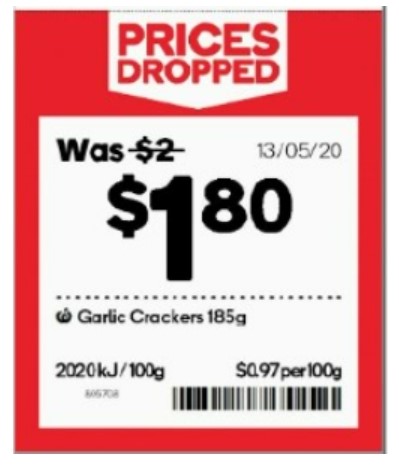
The allegations against Coles and Woolworths focus on their "Prices Dropped" and "Down Down" promotions.

Woolworths price dropped promotion

The core issue is that these supermarkets allegedly had products at regular prices. Temporarily increased these prices. Later, they dropped the price to a level above the original regular price. They then marketed these as discounted. 

The Grey Areas in Retail Pricing

As retailers, we face dealing with vague terms in consumer laws. Politicians often use words like "reasonable" without clear definitions, leaving it to the courts to determine their meaning. This creates uncertainty for retailers trying to comply with the law. My Personal Experience: I remember a situation from my childhood in our family shop that highlights the complexity of this issue. My Mum had ordered candles at one price, and then my Grandfather, unaware of the existing stock in the storeroom, ordered more. When we noticed the error, the price had gone up, so we had too much. We created a display with prices slightly above the old price and advertised it as a discount. Under today's scrutiny, this is dubious.

Practical Implications

If you've recently increased product prices, be careful about advertising discounts if the "reduced" price is still above the original price point. The tricky part is determining what constitutes a "reasonable time" between price changes if you want to use the term "discount" - something we're waiting for the courts to clarify.

The Class Action Development

Two legal firms, independent of the ACCC case, have now initiated a separate class action. While this adds another layer of complexity to the situation, it's important to note that this action is separate from the ACCC's proceedings. Even if the ACCC case fails, these might not.

How much are we looking at from the consumer, say $300/week for a typical purchase, 20 months for Woolworths at 10% of the weekly bill? We are looking at $300 (weekly spend) x 365 (days a year) / 7 (days a week) /12 (months a year) x 20 months x 10% (of the bill) = $2,6000

We are talking millions of customers, so you do the maths here now to see the seriousness of the case and add what I am sure will be tens of millions in legal costs. 

Plus, the loss of goodwill.

The links are here for you to check out or join these actions.

Class Action – Woolworths & Coles Deceptive Pricing Allegations


Protecting Your Business - POS System Compliance

A modern POS system can be your best ally in maintaining pricing compliance and transparency. Here's how: Automated Price History Tracking. Your POS system will automatically maintain a detailed audit trail of every price change, including the original price, the Date and time of the change, the staff member who made the change, and the Duration of promotional prices. Generate price change reports for compliance.

Meanwhile

While we await more explicit guidelines from the courts about what constitutes "reasonable" pricing practices, remember that when used properly, your POS system can provide the documentation and tracking tools that you may need to demonstrate compliance and maintain transparency with your customers.

FAQ

Q: What pricing practices are under scrutiny?

A: Retailers whose regular prices were temporarily increased before being "dropped" to levels above the original price while being marketed as special deals.

Q: What are the legal requirements for price promotions?

A: Under Australian Consumer Law, businesses must not use misleading or deceptive pricing practices, including transparently representing discounts and promotions.

Q: How can retailers ensure compliance?

A: Retailers should implement transparent pricing strategies, maintain clear documentation of price changes, and regularly audit their promotional practices.

Add new comment

Restricted HTML

  • Allowed HTML tags: <a href hreflang> <em> <strong> <cite> <blockquote cite> <code> <ul type> <ol start type> <li> <dl> <dt> <dd> <h2 id> <h3 id> <h4 id> <h5 id> <h6 id>
  • Lines and paragraphs break automatically.
  • Web page addresses and email addresses turn into links automatically.
CAPTCHA This question is for testing whether or not you are a human visitor and to prevent automated spam submissions. Image CAPTCHA
Enter the characters shown in the image.